
Key takeaways
- Compare the best doweling jigs for accurate, repeatable joints, with bushing sizes, fence styles, clamping, stock ranges and kit contents explained.
What's inside
As an Amazon Associate I earn from qualifying purchases. This post may contain affiliate links at no extra cost to you.
- Top Pick: Dowelmax Classic 3/8 Precision Engineered Joining System
- Runner-up: Milescraft 1334 JointMaster
- Also consider: Milescraft 1333 DowelJigKit
A dowel joint only works when the holes in both parts line up almost perfectly. A hole that drifts off position forces the joint sideways and opens a shoulder gap. A good doweling jig removes the guesswork by holding the bit square to the work and locating every hole from a fence, a self-centering jaw, or a positive stop, so the second part of the joint mirrors the first.
As an Amazon Associate, we earn from qualifying purchases.
The five jigs below cover the main design families. Self-centering jigs close two jaws around the stock and always find the middle of the thickness, which is fast and forgiving for edge joints. Adjustable fence jigs register from one face or edge, which takes more setup but lets you offset the dowel row, work on faces, and repeat a position along a long glue-up with an index pin or stop. The right choice depends on the joints you build most and your stock thicknesses.
This page contains affiliate links, and the site may earn a commission when you buy through them at no additional cost to you.
Contents
Quick Answer
For most furniture and cabinet work, pick an adjustable-fence jig with hardened steel bushings and a stop or index pin for repeating positions along long parts. The Dowelmax Classic offers the deepest spacer-based fence system here, the Milescraft JointMaster clamps itself to the stock, the Milescraft DowelJigKit is the most complete starter package, with the Kreg and ISQTLMF covering no-measure and stop-based drilling.
Dowelmax Classic 3/8 Precision Engineered Joining System

The Dowelmax Classic is the precision option in this group, built around a machined aluminum body with brass fittings and a row of five hardened steel guide bushings. Instead of centering itself, it registers from reference faces and uses spacers to position the dowel row. Changing spacers moves the row closer to or farther from the reference face, so one jig handles centered joints, offset joints, and double rows in thicker stock. The wide clamping face keeps the jig stable, and the indexing system steps hole spacing along long edges.
The trade-off is a slower setup, and the Classic is committed to one dowel size as supplied: the standard kit is built around 3/8-inch dowels, with other sizes handled by separate guide sets. It suits varied joints — edge-to-edge, edge-to-face, end grain, miters, and T-joints — for woodworkers who would rather set a fence carefully once than accept a jig that only drills on center.
Specs:
- Guide bushings: five 3/8 in hardened steel bushings fitted as standard
- Other dowel sizes: separate guide sets; additional included sizes not stated
- Body: machined aluminum with brass fittings
- Spacers included: 1/16, 3/8, 3/4 and 1-5/8 in
- Clamping face width: 3-1/2 in
- Hole spacing options: 5/8, 1-3/8, 2 and 2-5/8 in
See the Dowelmax Classic on Amazon
Milescraft 1334 JointMaster

The JointMaster takes the opposite approach: it is a self-clamping aluminum jig that grips the workpiece itself, so there is no separate clamp to position and no fence to set before the first hole. The jaws close on the stock and the guide block sits over the edge, face, or corner, covering the three joint orientations most small-shop doweling involves. Centering spacers position the hole row, and a pair of positive stops hooks onto the end of a board to keep placement consistent from part to part.
It centers and clamps in one motion, so it moves quickly along a glue-up without re-measuring. The trade-off is control: you give up the fine offset adjustments of a spacer-based fence jig, and stock outside the jaw range needs a different tool. For cabinet doors, face frames, and boxes, it is a well-judged middle ground.
Specs:
- Bushing sizes: 1/4, 5/16 and 3/8 in
- Body: aluminum, self-clamping design
- Joint types: edge, corner and surface
- Included: centering spacers and end alignment stops
- Stock thickness range: not stated
See the Milescraft JointMaster on Amazon
Milescraft 1333 DowelJigKit

The DowelJigKit is the complete starter package in this roundup. Its handheld body self-centers on the stock: two jaws close symmetrically as you tighten it, putting the guide holes on the centerline of boards from 1/2 to 1-1/2 inches thick without measuring. That designs out the most common beginner error: holes centered on one board and off-center on its mate. It handles corner, edge, and surface joints, covering bookcases, small tables, frames, and boxes.
What separates it from bare jigs is everything else in the box. The three metal bushing sizes arrive with matching brad-point bits, steel drill stops, dowel centers for transferring hole positions to the mating part, plus starter dowel pins and glue. Depth control matters: a dowel needs its length split sensibly between the two parts, and a stop collar keeps every hole the same depth. The limits are the thickness range and the fixed centerline — offset rows are jobs for a fence jig.
Specs:
- Model: Milescraft 1333 DowelJigKit
- Bushing sizes: 1/4, 5/16 and 3/8 in metal bushings
- Stock thickness: 1/2 to 1-1/2 in
- Centering: self-centering jaws
- Included: brad-point drill bits, drill stops, dowel centers, dowel pins and glue
- Joint types: corner, edge and surface
See the Milescraft DowelJigKit on Amazon
Kreg Dowel Jig Kit (KHJD345)
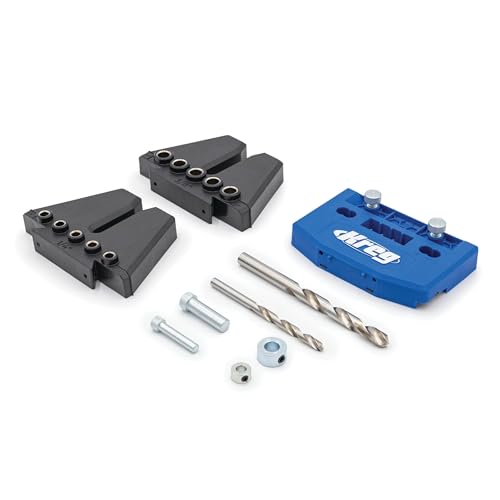
Kreg built its name on jigs that remove measuring from joinery setup, and its dowel jig follows the same idea. The kit uses removable drill guides that swap in and out of the body, so changing dowel size is a parts change rather than a new tool, and the positioning system locates holes without a tape measure or pencil layout. A built-in alignment reference registers the jig for cabinet and benchtop projects in sheet goods and standard lumber.
This is the newest design in the group, and the listing information reviewed here does not publish a full bushing size chart or complete contents list, so those points are marked as not stated rather than assumed. The intended user is clear: a woodworker who likes guided, repeatable setup and wants dowels for cabinets, shelving, and repairs without learning a fence-and-spacer system. For offset rows, mitered frames, or thick-stock double rows, the fence jigs above remain the better fit.
Specs:
- Part number: Kreg KHJD345
- Guide style: removable drill guides
- Bushing sizes: not stated
- Setup: no-measure positioning with built-in alignment reference
- Drill bits and stop collars included: not stated
See the Kreg Dowel Jig Kit on Amazon
ISQTLMF Dowel Jig Kit (DJ-123)
The ISQTLMF kit is an adjustable-fence design aimed squarely at repeatability. A fence sets the distance from the board edge to the hole row, a quick positive stop locks the position along the part, and a built-in clamp holds the jig while you drill. That addresses the two usual failure points: holes wandering off the edge line, and spacing creeping down a long board. With the stop registered against the end of the part, a run of cabinet sides or table legs comes out with matching hole patterns.
It covers the three most useful dowel sizes for furniture work, including the 1/2-inch size the two Milescraft kits stop short of, suiting heavier joints in thick legs and rails. The honest cautions concern the unknowns: the listing does not state a stock thickness range or which bits and stop collars are in the box, and a newer brand lacks the spare-parts trail of the established names.
Specs:
- Model: ISQTLMF DJ-123
- Drill sizes: 1/4, 3/8 and 1/2 in
- Fence: adjustable fence with quick positive stop
- Clamp: built-in clamp
- Stock thickness range: not stated
- Drill bits and stop collars included: not stated
See the ISQTLMF Dowel Jig Kit on Amazon
How to Choose
Start with the referencing system. A self-centering jig is the fastest route to accurate edge joints because it finds the middle of any board thickness automatically, but it always drills on center. An adjustable fence jig takes longer to set, yet it lets you offset the row toward one face, drill into faces for T-joints and frame work, and carry one setting across a project. For panel glue-ups and simple frames, self-centering is enough; for furniture with rails, legs, and aprons, choose the fence.
Match bushing sizes to the dowels you actually use. A 3/8-inch dowel is the workhorse for 3/4-inch stock, 1/4-inch suits thin frame parts, and 1/2-inch earns its place in thick legs and rails. Hardened steel bushings are worth insisting on, because a soft guide wears oval and starts drilling sloppy holes. Check the stock range against your material: a jig topping out at 1-1/2 inches cannot center on a 2-inch leg blank.
Then look at repeatability hardware. Index pins, end stops, and positive stops keep the eighth hole in line with the first on a long glue-up. Finally, check the box contents: brad-point bits, stop collars for depth control, and dowel centers for transferring positions save three extra purchases.
Who Should Skip
Skip doweling jigs entirely if your joinery is built around pocket screws or biscuits and the joints are hidden. A pocket-hole jig is faster for painted cabinets and utility furniture, and a biscuit joiner aligns panel glue-ups quickly when the joint carries little load; a dowel jig would duplicate tools without changing the result. Production shops should also skip handheld jigs: once you are drilling hundreds of identical holes a day, a dedicated dowel machine or multi-spindle boring setup pays for itself in setup time. And if you rarely build frame-based furniture, a dowel jig will sit in a drawer — spend the bench space on tools your projects actually use.
FAQ
What size dowel should I use for 3/4-inch stock?
A 3/8-inch dowel is the standard pairing. A dowel diameter between one-third and one-half of the stock thickness keeps enough wood around the hole for strength; drop to 1/4-inch for thin frame parts and 1/2-inch for thick legs and rails.
Is a self-centering jig or a fence jig more accurate?
Both drill accurate holes; they locate them differently. A self-centering jig is accurate on the centerline of any thickness but cannot offset a row. A fence jig is accurate relative to the face or edge it registers from, which face joints, T-joints, and offset rows require.
Do I really need stop collars for the drill bits?
Yes, for consistent results. A stop collar drills every hole to the same depth, splitting dowel length evenly between the two parts. Without one, deep holes bottom out the dowel and hold the joint open, while shallow holes leave too little glue surface.
Can a doweling jig drill into end grain?
Fence-style jigs can, because they register on the end of the part and hold the bit square as it starts in the end grain — the setup needed for rail-to-apron joints. Keep the bit sharp, clear chips often, and let the bushing guide the start rather than forcing the drill.
Final Verdict
For one jig covering the widest range of furniture joints with the most control, the Dowelmax Classic is the pick, provided you accept its slower spacer-based setup and single-size starting point. The Milescraft JointMaster is the better everyday choice for most small shops: it clamps itself, centers quickly, and repeats positions with its end stops. Newer woodworkers should start with the complete Milescraft DowelJigKit, the Kreg suits no-measure setup for cabinet work, and the ISQTLMF is the fence-and-stop option for larger dowel sizes. Either way, hardened bushings, a reliable stop, and depth control matter most.
Related guides
More from Amazon
Programs that pair well with the guide above. Offers and eligibility are set by Amazon and may change.
A free business account with business pricing and bulk-buying tools for work, shop or home office.
Create a business accountFree shipping on eligible items, Prime Video and more. Eligible new members can start with a free trial.
Start a Prime free trialAudiobooks and podcasts to listen to on the go. Eligible new members can start with a free trial.
Try Audible freeAd-free music streaming. Eligible new subscribers can start with a free trial.
Try Music Unlimited freeAs an Amazon Associate we earn from qualifying purchases.







Write Your Review
No reviews yet. Be the first to share your experience!