How to Use a Stationary Jointer on Short Boards Safely
What's inside
As an Amazon Associate I earn from qualifying purchases. This post may contain affiliate links at no extra cost to you.
Short boards are among the riskiest workpieces to joint on a stationary jointer. They can tip into the cutterhead, pass under a push block, or lose contact with the outfeed table before the cut is complete. The safer approach is not simply to “hold on tighter.” It is to decide whether the board is long enough for the machine, prepare the cut properly, and use another method when it is not.
Contents
Check the Board’s Length Before Jointing
Start with the jointer manufacturer’s minimum workpiece length. If the manual gives no figure, use a conservative rule: the board should be at least twice the length of the cutterhead or at least 12 inches long, whichever is greater. A 6-inch cutterhead therefore calls for roughly a 12-inch minimum. Many woodworkers use 18 inches as a more comfortable practical limit, especially on a benchtop machine with short tables.
Length is only part of the problem. A narrow, thin board can be difficult even when it meets the minimum. A piece 14 inches long, 2 inches wide, and 1/4 inch thick is much less stable than a 14-inch board that is 6 inches wide and 1 inch thick. Also reject boards with severe cup, twist, loose knots, nails, or splits near the end. Those defects can cause the board to rock or break apart while it is over the cutterhead.
| Workpiece condition | Recommended approach | Reason |
|---|---|---|
| Longer than the manufacturer’s minimum | Joint normally with push blocks | Enough surface can remain on both tables for control |
| Short but thick and stable | Use a carrier or choose a hand-tool method | Extra support may prevent tipping, but does not remove all risk |
| Short and thin | Do not joint directly | It can disappear beneath a push block or tip into the knives |
| Very short, twisted, cracked, or knotty | Use a shooting board, router setup, or discard it | The jointer cannot provide reliable support during the cut |
Prepare the Jointer and Work Area
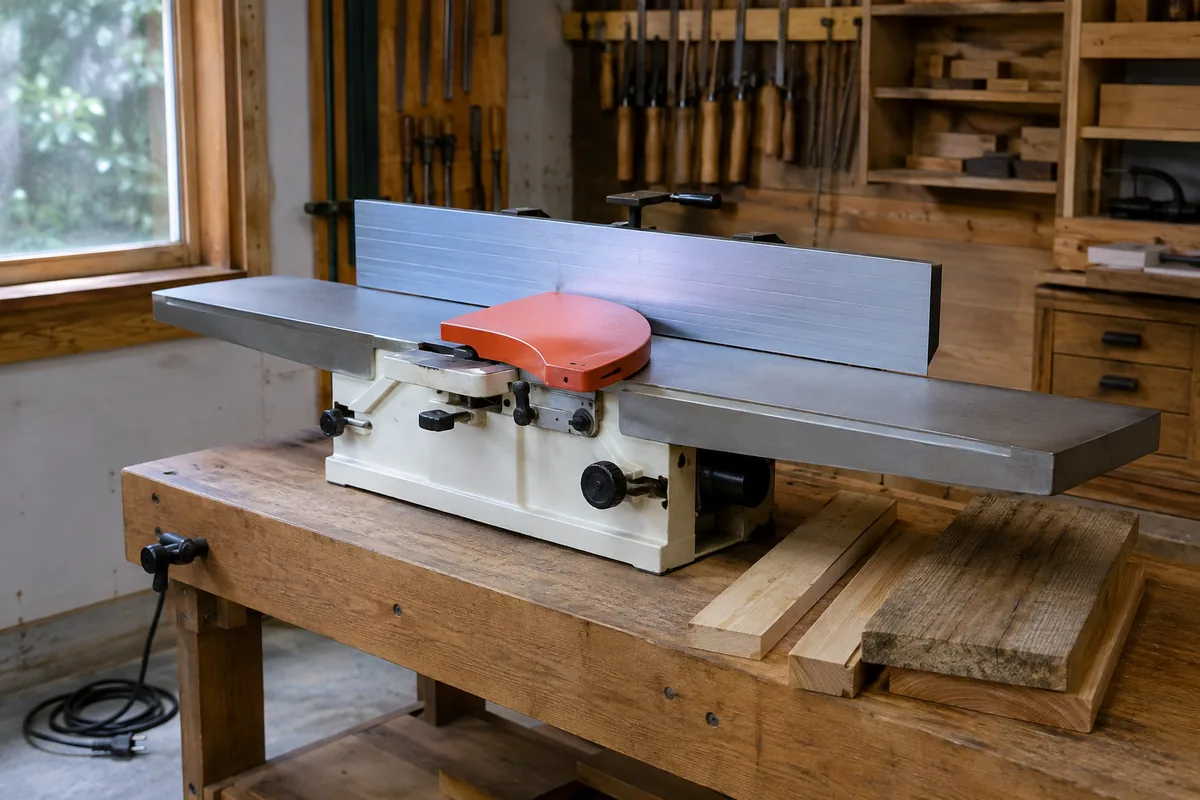
Disconnect power before checking knife height, fence alignment, or guard operation. The cutterhead guard should spring back over the exposed knives and cover the unused portion of the head. Do not remove or defeat it to make a short-board operation easier.
Set the infeed table for a light cut. For most face-jointing work, 1/32 inch is a sensible starting point; use 1/64 inch on a small machine or a fragile board. A deep cut increases the force needed to control the stock and makes the board more likely to lift or stall. Keep the fence square unless the cut specifically requires an angle.
Clear the floor and provide an unobstructed outfeed path. Short boards still need your body positioned to the side, not directly behind the stock. Wear eye protection and hearing protection. Avoid loose sleeves, gloves, jewelry, and anything that could enter the cutterhead.
A properly adjusted set of jointer push blocks is essential. Use blocks with grippy soles and handles that keep your hands well above the cutterhead. Push blocks are not a substitute for adequate board length, but they give better control than bare hands on acceptable workpieces.
Use a Controlled Cutting Procedure
Place the board on the infeed table with the face to be jointed down. Stand to the side and start the machine before contacting the wood. Let the cutterhead reach full speed.
Keep firm downward pressure over the infeed table at the beginning of the cut. Push the board forward smoothly, without forcing it. Once several inches of the jointed face have reached the outfeed table, move your forward push block onto that outfeed surface. Keep the rear block over the infeed side until the board is stable, then transfer pressure progressively forward.
Do not press down directly above the cutterhead. That can push the board into the knives and pull your hand or block toward the opening. Do not stop with the board sitting across the cutterhead, and never pull it backward over spinning knives. If the board starts to rock, stalls, or loses contact with a table, keep your hands clear, switch off the machine, and wait for the cutterhead to stop before correcting the setup.
Take only enough passes to create a continuous flat surface. Mark the high spots with pencil so you can see progress. If the board becomes too thin to control, stop jointing and finish with a low-angle block plane or sanding setup.
When a Carrier Helps—and When It Does Not
A rigid carrier board can make a short workpiece safer by extending the supported surface. Attach the workpiece to the carrier with double-sided woodworking tape, hot-melt glue tabs, or a secure mechanical arrangement that cannot contact the knives. The carrier must be flat, stiff, and wide enough to remain stable on both tables. Test the attachment by hand before starting the machine.
This method has trade-offs. The carrier can reduce the usable cutting depth, add setup time, and leave adhesive or marks on the workpiece. It also does not make a severely warped or loose piece safe. Never use a carrier that can shift, detach, or expose a screw to the cutterhead. For many small pieces, another tool is the better purchase.
| Method | Best use | Main limitation |
|---|---|---|
| Stationary jointer | Flatting a stable board with sufficient length | Unsafe for unsupported short or thin stock |
| Carrier board | Occasional short pieces that can be attached securely | More setup and possible adhesive marks |
| Hand plane and shooting board | Very short pieces and end-grain work | Slower and requires a sharp blade |
| Router table with straight bit | Trimming a reference edge against a guide | Needs careful bit exposure and dust control |
| Planer sled | Flattening one face when the jointer is unsuitable | Does not automatically create a straight edge |
Buy Support Before Buying a Larger Jointer
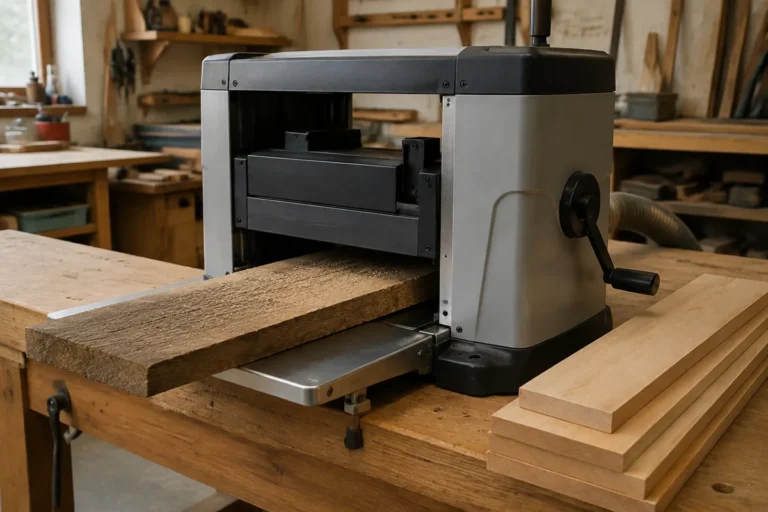
If short stock is a regular part of your work, spend first on control and alternatives rather than simply moving to a larger jointer. A hand plane and shooting-board setup is slower but handles pieces that should never go near a cutterhead. A benchtop thickness planer is useful for thicknessing longer stock, but it still needs a stable sled for a badly cupped short board.
The cheaper option is fine when you only flatten an occasional small piece: use a sharp hand plane, a straightedge, and patience. Buy a stationary jointer when you routinely prepare longer rough lumber and can maintain safe infeed and outfeed support. No machine upgrade changes the basic rule: if the board cannot stay controlled on both sides of the cutterhead, do not joint it directly.