
Key takeaways
- Compare the best tenon jigs for table saws, from the classic Delta 34-184 to modern heavy-duty fixtures, with specs, capacities and buying tips.
What's inside
As an Amazon Associate I earn from qualifying purchases. This post may contain affiliate links at no extra cost to you.
- Top Pick: Delta 34-184 Universal-Deluxe Tenoning Jig
- Runner-up: PreAsion Heavy Duty Tenoning Jig
- Also consider: THUXEON Woodworking Tenoning Fixture
The fastest way to cut accurate, repeatable tenons on a table saw is a dedicated tenoning jig: a heavy carriage that rides in the miter slot, clamps the workpiece on end, and presents each tenon cheek to the blade as a controlled rip cut. For most furniture work, the PreAsion Heavy Duty is the strongest current pick, with an all-metal body, an 82.5 mm clamp capacity and dual-angle adjustment. The Delta 34-184 remains the benchmark for microfine adjustment, while the THUXEON, Maisutseb and TECHTONGDA fixtures deliver the same proven layout at lower tiers. This guide compares all five on capacity, adjustment range and saw compatibility.
As an Amazon Associate, we earn from qualifying purchases.
Contents
Table of Contents
- Quick Picks
- 1. Delta 34-184 Universal-Deluxe Tenoning Jig
- 2. PreAsion Heavy Duty Tenoning Jig
- 3. THUXEON Woodworking Tenoning Fixture
- 4. Maisutseb Tenon Jig for Table Saw
- 5. TECHTONGDA Tenon Jig
- How to Choose a Tenoning Jig
- FAQ
- Conclusion
- Product and ASIN Reference
Quick Picks
- Best overall: PreAsion Heavy Duty Tenoning Jig — heavy all-metal build, wide clamp capacity, dual-angle adjustment.
- Best for fine adjustment: Delta 34-184 Universal-Deluxe — the classic design, with a microfine feed knob and positive angle stops.
- Best quick-clamp design: THUXEON Woodworking Tenoning Fixture — collet clamping speeds up batch work.
- Best budget pick: Maisutseb Tenon Jig — the same core geometry and adjustment range at the budget tier.
- Best heavy fixture: TECHTONGDA Tenon Jig — full-size tenoning machine format with a complete published spec sheet.
1. Delta 34-184 Universal-Deluxe Tenoning Jig
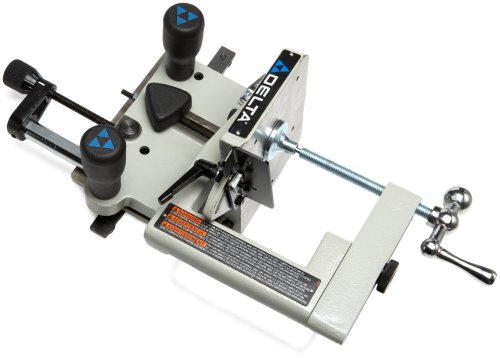
The Delta 34-184 is the design most other tenoning jigs are measured against. It is a cast carriage that runs in the standard 3/8 by 3/4 inch miter slot, with a work support that holds stock up to 3-1/4 inches thick upright against the blade. Two handles sit on the sliding table itself rather than on the work support, which keeps pushing pressure on the carriage instead of the clamped part.
Adjustment is where the Delta separates itself. A push-button coarse slide gets the work support close to the blade, and a microfine knob then creeps it in, each graduation moving the support about 0.004 inch. That makes it practical to sneak up on a tenon thickness that slides into its mortise with light hand pressure. The backstop tilts from 45 to 90 degrees with positive stops, so angled tenons repeat from one part to the next.
At roughly 20 pounds, the 34-184 has the mass to track smoothly through a cheek cut without chattering, and its footprint stays compact on the saw table. It suits left- and right-tilt saws once the guide bar is set up for the slot position, and Delta backs it with a two-year limited warranty.
Specs
- Model: Delta 34-184 Universal-Deluxe
- Miter slot fit: 3/8 x 3/4 inch standard slot
- Maximum stock thickness: up to 3-1/4 inches
- Backstop angle adjustment: 45 to 90 degrees with positive stops
- Fine adjustment: microfine knob, about 0.004 inch per graduation
- Dimensions: 11.75 x 12 x 8.25 inches
- Weight: approximately 20 pounds
- Warranty: 2-year limited warranty
2. PreAsion Heavy Duty Tenoning Jig
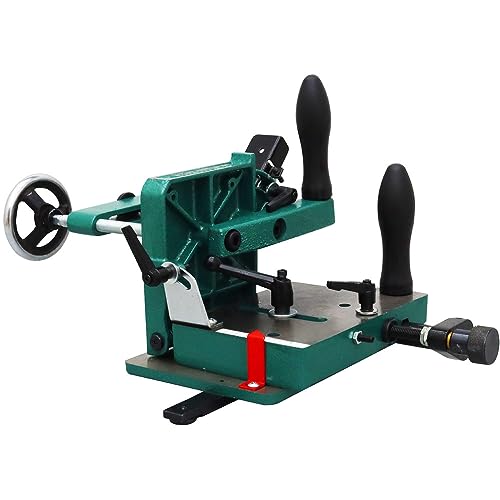
The PreAsion Heavy Duty follows the classic cast-jig layout and is currently the easiest version of that design to recommend for a new purchase. The body is all metal, and the published figures put the whole machine at 8.7 kg, heavy enough to stay planted as it slides through a cut. A screw clamp and multi-position control levers lock the workpiece against the backstop, with better locking leverage than simple knobs.
Its adjustment range covers both straight and angled joinery. The rear pallet tilts from 0 to 45 degrees and the backing plate adjusts from 0 to 15 degrees, so compound setups for chair work are possible without shimming. Maximum grip is 82.5 mm, roughly 3-1/4 inches, matching the working capacity of the classic cast jigs and covering most table rails, aprons and leg stock.
Compatibility follows the standard import pattern: the guide rod is sized for a 19.05 mm T-type chute, and the jig works when the distance from the chute center to the blade falls between 95 and 170 mm. That covers most cabinet and contractor saws, but the maker advises measuring before ordering. As a newer brand, PreAsion lacks the Delta’s long track record, so checking the carriage for square during first setup is sensible. In the mid-range tier, it is the most complete package of capacity, mass and adjustment.
Specs
- Construction: all-metal body
- Chute size: 19.05 mm wide x 9.525 mm deep, T-type
- Guide rod: 265 x 19 x 9.5 mm
- Maximum grip: 82.5 mm
- Slot center to blade distance: 95 to 170 mm
- Rear pallet angle: 0 to 45 degrees
- Backing angle: 0 to 15 degrees
- Net weight: 8.7 kg
- Controls: multi-position locking levers
3. THUXEON Woodworking Tenoning Fixture
The THUXEON fixture takes the same heavy-duty template and emphasizes clamping speed. Instead of a slow screw-only clamp, it uses a collet that snugs the workpiece quickly, which matters when a project calls for a run of identical rails: clamp, cut both cheeks, swap parts, repeat. The listing describes it as a dedicated tenoning jig for precision tenoning and crosscutting.
The backstop, listed as the rear pallet, adjusts from 0 to 45 degrees, and the backing tilts from 0 to 15 degrees, so angled tenons and bevel-ended parts are within its range. Maximum clamp width is 82.5 mm, matching the roughly 3-1/4 inch stock ceiling of this jig family. The guide rod measures 265 x 19 x 9.5 mm and the chute depth is 9.53 mm, dimensions aimed at the standard 19.05 mm T-slot on most American table saws.
Like its peers, the THUXEON works when the chute center sits 95 to 170 mm from the blade, and the seller asks buyers to measure the T-slot before purchasing. For woodworkers who value fast, repeatable clamping in the mid-range tier and mostly cut straight tenons with the occasional angled set, the THUXEON is a practical option.
Specs
- Construction: metal tenoning fixture
- Chute fit: 19.05 mm T-type chute, 9.53 mm depth
- Guide rod: 265 x 19 x 9.5 mm
- Maximum clamp width: 82.5 mm
- Slot center to blade distance: 95 to 170 mm
- Rear pallet angle: 0 to 45 degrees
- Backing angle: 0 to 15 degrees
- Clamping: quick-action collet
4. Maisutseb Tenon Jig for Table Saw

The Maisutseb is the budget-tier expression of the same design, sold as a multi-functional fixture for tenon and mortise work on the table saw. It uses a quick-tightening collet to clamp the wood, so setup for each part is fast, and the metal body keeps the carriage rigid for clean cheek cuts on furniture-sized stock.
Published parameters line up with the rest of the family: a standard 19.05 mm T-type chute, 9.525 mm chute depth, and a working window of 95 to 170 mm from the chute center to the blade. The rear pallet adjusts from 0 to 45 degrees and the back plate from 0 to 15 degrees, so the angled-tenon capability of the pricier versions is not sacrificed to hit the lower tier.
The trade-offs are the usual ones at the budget end of this category. The listing does not publish a maximum grip figure or a machine weight, so buyers working near the 3-1/4 inch class ceiling should confirm the clamp opening on the product page, and the sliding parts may need a quick check for square on arrival. For occasional tenon work — a dining table, a set of face frames, a bed frame — those are reasonable compromises.
Specs
- Construction: metal body
- Chute size: 19.05 mm wide x 9.525 mm deep, T-type
- Slot center to blade distance: 95 to 170 mm
- Rear pallet angle: 0 to 45 degrees
- Back plate angle: 0 to 15 degrees
- Clamping: quick-tightening collet
- Intended use: tenon and mortise fixture work on table saws
5. TECHTONGDA Tenon Jig

TECHTONGDA sells its version as a tenoning machine and joinery tool, and it publishes the most complete parameter list of the import fixtures in this group. The clamping device is a chuck-style quick clamp, the slide rails are set to the standard American pattern, and the body is high-quality metal throughout. At 8.7 kg net weight, it matches the PreAsion for mass.
The numbers are the familiar class standard, stated in full: chute width 19.05 mm, chute depth 9.525 mm, guide rod 265 x 19 x 9.5 mm, maximum grip 82.5 mm, and a chute-center-to-blade range of 95 to 170 mm. The rear pallet adjusts between 0 and 45 degrees and the backing between 0 and 15 degrees, covering straight tenons, angled tenons and bevel work.
TECHTONGDA is candid in its listing that the jig fits most, not all, American table saws, and repeats the advice to measure the T-slot before buying. In the mid-range tier, it suits woodworkers who want the full-size machine format and a complete published spec sheet to check against their own saw.
Specs
- Construction: high-quality metal body
- Chute size: 19.05 mm wide x 9.525 mm deep, T-type
- Guide rod: 265 x 19 x 9.5 mm
- Maximum grip: 82.5 mm
- Slot center to blade distance: 95 to 170 mm
- Rear pallet angle: 0 to 45 degrees
- Backing angle: 0 to 15 degrees
- Net weight: 8.7 kg
- Clamping: quick-clamp chuck
How to Choose a Tenoning Jig
Start with fit, because no feature matters if the jig cannot ride your saw. Nearly every jig in this category is built around the standard 3/4 by 3/8 inch miter slot, listed as 19.05 by 9.525 mm on the import models. Measure your slot width and depth, then measure from the slot center to the blade: most of these fixtures need that distance to fall between about 3-3/4 and 6-3/4 inches. Benchtop and jobsite saws are the usual misfits.
Next, match capacity to your work. A clamp opening around 3-1/4 inches covers typical furniture rails and legs. If you regularly tenon thick stock for workbenches or timber-frame-style projects, confirm the maximum grip on the product page, because not every maker publishes it. Mass matters too: a jig in the 19 to 20 pound range tracks smoothly and resists chatter, while lighter fixtures demand a slower feed.
Adjustment style decides how the jig feels in daily use. A microfine feed knob, like the Delta’s, makes it easy to creep up on an exact tenon thickness and return to it later. Collet and chuck quick clamps trade some of that finesse for speed, which pays off when a project needs dozens of identical parts. Finally, check the angle ranges: a backstop that tilts to 45 degrees, plus a few degrees of backing tilt, covers angled chair joinery. Whichever tier you choose, plan on one setup ritual: square the carriage to the blade and make the first cuts in scrap the same thickness as your workpiece.
FAQ
Do tenoning jigs work on any table saw?
They work on most cabinet, contractor and hybrid saws with a standard 3/4 by 3/8 inch miter slot. The jig also has to reach the blade, so check the slot-center-to-blade distance against the maker’s stated range. Some benchtop and jobsite saws use smaller slots and will not accept these fixtures.
What size tenons can these jigs cut?
Tenon thickness is set by how far the work support sits from the blade, and tenon length by blade height. The practical limit is stock thickness: the jigs here clamp parts up to about 3-1/4 inches thick, covering the rails, aprons and legs used in most furniture joinery.
Should the shoulders or the cheeks be cut first?
Both sequences are used, but the common approach is to cut the shoulders first with the workpiece flat on the table, against the miter gauge or a crosscut sled, then stand the part in the jig for the cheek cuts. Cutting cheeks second lets the jig’s fine adjustment dial the final thickness to fit the mortise.
How is a tenoning jig different from a dado stack setup?
A dado stack removes cheek waste with the board lying flat, nibbling across the grain in several passes. A tenoning jig holds the board on end and rips each cheek in a single pass, which usually leaves a smoother cheek and keeps both hands on the jig, away from the blade. The jig is also faster to repeat once dialed in.
Conclusion
Every jig in this roundup follows the same sound idea — clamp the work on end, ride the miter slot, and rip the cheeks — so the right choice comes down to fit, capacity and adjustment style. The PreAsion Heavy Duty is the best starting point for most shops, the Delta 34-184 rewards woodworkers who want microfine control and a proven design, and the THUXEON, Maisutseb and TECHTONGDA fixtures cover quick clamping, budget buying and full-size machine format respectively. Measure your slot, confirm the slot-to-blade distance, and any of the five will make tenon cutting a repeatable routine.
Related guides
More from Amazon
Programs that pair well with the guide above. Offers and eligibility are set by Amazon and may change.
A free business account with business pricing and bulk-buying tools for work, shop or home office.
Create a business accountFree shipping on eligible items, Prime Video and more. Eligible new members can start with a free trial.
Start a Prime free trialAudiobooks and podcasts to listen to on the go. Eligible new members can start with a free trial.
Try Audible freeAd-free music streaming. Eligible new subscribers can start with a free trial.
Try Music Unlimited freeAs an Amazon Associate we earn from qualifying purchases.


Write Your Review
No reviews yet. Be the first to share your experience!