
Key takeaways
- Compare the best tape measures for woodworking and carpentry, with blade width, standout, scale styles and lock types explained for every pick.
What's inside
As an Amazon Associate I earn from qualifying purchases. This post may contain affiliate links at no extra cost to you.
- Top Pick: FastCap ProCarpenter PSSR-16
- Runner-up: Stanley PowerLock 33-425
- Also consider: Komelon SL2825 Self Lock
The best tape measure for woodworking is the one whose scale you can read at a glance and whose blade stays put while you mark: the FastCap ProCarpenter PSSR-16 leads this list because its reverse-reading scale and printed fractions suit bench work so well, while the Milwaukee Wide Blade 48-22-0225 is the pick when long standout matters more. Below are five tapes compared on blade width, standout, markings, case build, belt clip and lock type, all taken from published maker data.
As an Amazon Associate, we earn from qualifying purchases.
Contents
Table of Contents
- How These Tape Measures Were Compared
- FastCap ProCarpenter PSSR-16
- Stanley PowerLock 33-425
- Komelon SL2825 Self Lock
- Milwaukee Wide Blade 48-22-0225
- Crescent Lufkin Shockforce Nite Eye G1 L1125B-02
- How to Choose a Tape Measure for Woodworking
- Frequently Asked Questions
- Conclusion
- Product and ASIN Reference
How These Tape Measures Were Compared
Every figure in this guide comes from published maker or listing data, and where a headline number conflicts with the same maker specification section, the specification figure is the one used. Standout is the clearest example: brands publish both a standout figure and a longer reach figure, and only the standout number appears in the Specs blocks below.
The comparison weighs the things that decide accuracy and comfort in a shop. Blade width drives standout and stability, so each tape lists both. Scale style matters just as much: fraction-printed blades, reverse-reading blades and dual-sided blades each solve a different reading problem. Case material, belt clip design and lock type round out the comparison, because a tape that lives on a belt or apron hook all day has to survive drops and stay where it is clipped. The five picks are grouped into budget, mid-range and premium tiers so the trade-offs are easy to weigh without any price talk.
FastCap ProCarpenter PSSR-16
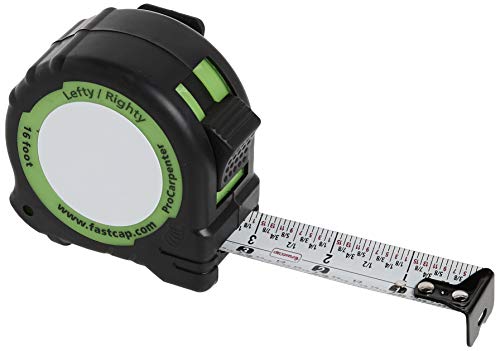
The FastCap ProCarpenter is built around one idea: measuring and marking at the bench should not require flipping the tape or doing fraction math in your head. Its Standard/Standard Reverse blade reads correctly from either direction, so left-handed and right-handed pulls both give a scale that reads upright. Fractions are printed along the blade to a sixteenth of an inch, which removes the counting step when a cut list calls out sixteenths and thirty-seconds all morning.
Two shop-friendly details set it apart from jobsite tapes. The case carries an erasable notepad panel for jotting a measurement the moment it is taken, and a built-in pencil sharpener sits in the case for keeping a layout pencil pointed. A protective rubber boot wraps the case against knocks on a bench top or floor. At 16 feet, the blade covers sheet goods, cabinet parts and furniture dimensions with room to spare, while the shorter length keeps the case compact on a belt. FastCap publishes an accuracy figure of plus or minus a sixteenth of an inch per 10 feet for this model.
Specs
- Blade length: 16 ft
- Blade width: 1 in
- Standout: not published by the maker
- Markings and scales: Standard/Standard Reverse scale readable from both directions, fractions printed to 1/16 in, accuracy rated at plus or minus 1/16 in per 10 ft
- Case material: high-impact case with protective rubber boot, erasable notepad panel and built-in pencil sharpener
- Belt clip and lock type: lever-action belt hook, blade lock
Stanley PowerLock 33-425
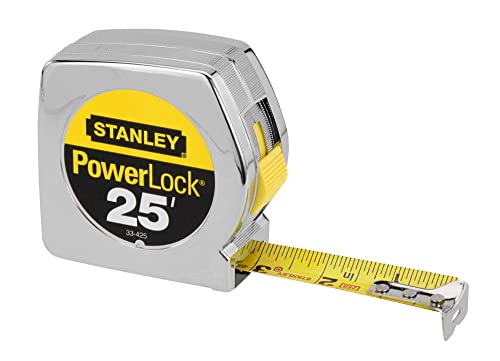
The PowerLock is the long-running classic of the group, a compact chrome case holding a 1 inch blade that has been a shop and site staple for decades. The blade carries a Mylar polyester coating, which Stanley publishes as a wear layer that extends blade life well beyond an uncoated blade, and the graduations include stud center marks at 16 inches and 19.2 inches for framing layout.
A sliding lock holds the blade at the pulled length so a measurement stays put while it is transferred to the workpiece, and the Tru-Zero end hook moves by exactly its own thickness so inside and outside readings both land true. The published standout is 7 feet, modest next to the wide blades in this list, but for bench work, cabinet interiors and room layout in a small shop it is rarely the limiting factor. The case is slim enough to ride in an apron pocket, and a belt clip is fitted for belt carry. For woodworkers who want a proven, simple tape with an easy-reading fractional scale, this remains the budget benchmark.
Specs
- Blade length: 25 ft
- Blade width: 1 in
- Standout: 7 ft
- Markings and scales: fractional graduations with stud center marks at 16 in and 19.2 in, Mylar polyester blade coating, Tru-Zero end hook
- Case material: chrome-plated case
- Belt clip and lock type: belt clip fitted, sliding blade lock
Komelon SL2825 Self Lock

The Komelon SL2825 flips the usual lock arrangement: the blade locks itself as it is pulled out, and a push button on the case releases it for retraction. For solo measuring that means one hand pulls, the hook catches, and the reading stays without a thumb holding a slide lock down. It is a small change that speeds up repetitive layout work such as marking shelf pin rows or checking carcass diagonals one after another.
The blade is nylon coated for protection against wear, printed with graduations and stud marks, and the case pairs an impact-resistant shell with a rubber overmold grip that stays secure in a dusty hand. Komelon does not headline a standout figure in its published listing data for this model, so none is claimed here; the 25 foot length and 1 inch blade put it in the general-purpose class rather than the long-reach class. As a budget pick that removes lock fumbling from the routine, it earns its place.
Specs
- Blade length: 25 ft
- Blade width: 1 in
- Standout: not specified in the published listing data
- Markings and scales: printed graduations with stud marks, nylon-coated blade
- Case material: impact-resistant case with rubber overmold grip
- Belt clip and lock type: belt clip fitted, self-locking blade with push-button retraction
Milwaukee Wide Blade 48-22-0225

Milwaukee Wide Blade tapes are built for reach. The blade is 1-5/16 inches wide, the widest in this list, and Milwaukee publishes a standout of 14 feet with up to 17 feet of reach, which makes long one-person measurements across a room or along a sheet goods rack realistic. The blade print runs on both sides, so the scale can be read from above or below the blade.
Protection is layered: a nylon bond coating guards the full blade, and an anti-tear coating reinforces the first 6 inches, the section that takes the most hook-end abuse. The frame is a 5-point reinforced design, and a finger stop at the case mouth gives controlled, braked retraction instead of a full-speed snap back. A lanyard loop is molded in for tethered work, and the wire belt clip is shaped to reduce pocket and belt wear. This is the premium pick for woodworkers who regularly measure long stock alone and want the blade to stay straight while they do it.
Specs
- Blade length: 25 ft
- Blade width: 1-5/16 in (33 mm)
- Standout: 14 ft, with up to 17 ft of reach
- Markings and scales: two-sided blade print with fractional scale, nylon bond blade protection, anti-tear coating on the first 6 in
- Case material: 5-point reinforced frame with rubber overmold and finger stop
- Belt clip and lock type: wire belt clip, blade lock with finger stop for controlled retraction, lanyard loop fitted
Crescent Lufkin Shockforce Nite Eye G1 L1125B-02

The Shockforce Nite Eye takes the opposite approach to readability: instead of black print on a yellow blade, it prints high-visibility green markings on a matte black blade, a scheme Crescent Lufkin publishes for legibility in any light, from a bright shop to a dim cabinet interior. The print is dual-sided, with a vertical quick-read scale on the underside for overhead and awkward-angle measurements where the top of the blade cannot be seen.
The blade is 1-3/16 inches wide with a nylon coating, and Crescent Lufkin publishes a standout of 14 feet for the model, matching the Milwaukee on reach while keeping a slightly narrower blade. Durability claims are unusually specific: the maker publishes a drop rating of 100 feet onto concrete for the case, and metal roll bars guard the lock button against impact damage. A diamond-coated end hook is fitted for grip on edges. The lock is a manual slide type rather than an automatic lock, per the published specification table, and a belt clip is fitted. For woodworkers who read fractions all day under mixed lighting, this mid-range tape is the readability pick.
Specs
- Blade length: 25 ft
- Blade width: 1-3/16 in
- Standout: 14 ft
- Markings and scales: dual-sided print, green on matte black Nite Eye blade, vertical quick-read scale on the underside, nylon-coated blade, diamond-coated end hook
- Case material: compact case with metal roll bars protecting the lock button, published drop rating of 100 ft onto concrete
- Belt clip and lock type: belt clip fitted, manual slide lock
How to Choose a Tape Measure for Woodworking
Begin with the scale, because it is what you read hundreds of times a day. Fraction-printed blades such as the FastCap and the Stanley remove the need to count tick marks, while a reverse-reading blade helps anyone who pulls left-handed or measures from the right side of a bench. Dual-sided print, as on the Milwaukee and the Crescent Lufkin, pays off whenever the measurement has to be read from below or overhead.
Blade width comes next. A 1 inch blade is lighter and curls less in a pocket, but standout tops out around 7 feet on the PowerLock. Wider blades at 1-3/16 and 1-5/16 inches push standout to a published 14 feet, which matters for solo work on long boards and room layout, at the cost of a bigger, heavier case. Length follows the same logic: 16 feet covers nearly all furniture and cabinet work, while 25 feet adds framing and room dimensions.
Then weigh the lock and the carry details. A self-locking blade like the Komelon suits fast, repetitive solo layout; a sliding lock suits set-and-mark work; a finger stop adds control on retraction. Check the case build for shop life: rubber boots, overmold grips and reinforced frames all absorb the drops a tape will eventually take, and a belt clip that matches how you actually carry the tape, belt, apron or pocket, keeps it within reach. Finally, match the tier to the duty: a budget tape as a second tape for the bench drawer, a mid-range tape as the daily driver, and a premium wide blade when standout is the whole point.
Frequently Asked Questions
What blade length is best for woodworking?
A 16 ft blade covers most furniture, cabinet and sheet goods work and keeps the case compact, while a 25 ft blade adds framing and full-room layout; many shops keep one of each.
Why do wider tape measure blades stand out farther?
Blade width and the curve pressed into the blade give it stiffness, so a 1-5/16 in blade can reach a published standout of 14 ft before it breaks, while a 1 in blade typically tops out near 7 ft.
Are fraction-printed blades worth it for carpentry?
Fraction printing removes the step of counting small tick marks at every reading, which speeds up cut lists full of sixteenths and reduces misreads, so most bench woodworkers find it worthwhile.
What is the difference between standout and reach?
Standout is the unsupported length a blade holds straight before it breaks, while reach adds the length a user can extend by holding the case, so reach figures are always longer than standout figures.
Conclusion
For bench-first woodworking, the FastCap ProCarpenter PSSR-16 is the standout pick on scale design alone, with its reverse-reading blade, printed fractions, notepad and pencil sharpener. The Stanley PowerLock 33-425 remains the budget classic, the Komelon SL2825 removes lock fumbling for solo layout, the Milwaukee Wide Blade 48-22-0225 is the premium reach pick, and the Crescent Lufkin Shockforce Nite Eye G1 is the one to read under poor light. Match the scale style to how you read, the blade width to how far you measure alone, and any of the five will serve a shop well.
Related guides
More from Amazon
Programs that pair well with the guide above. Offers and eligibility are set by Amazon and may change.
A free business account with business pricing and bulk-buying tools for work, shop or home office.
Create a business accountFree shipping on eligible items, Prime Video and more. Eligible new members can start with a free trial.
Start a Prime free trialAudiobooks and podcasts to listen to on the go. Eligible new members can start with a free trial.
Try Audible freeAd-free music streaming. Eligible new subscribers can start with a free trial.
Try Music Unlimited freeAs an Amazon Associate we earn from qualifying purchases.








Write Your Review
No reviews yet. Be the first to share your experience!