How to Choose Drill Press Speed for Different Wood Species
What's inside
As an Amazon Associate I earn from qualifying purchases. This post may contain affiliate links at no extra cost to you.
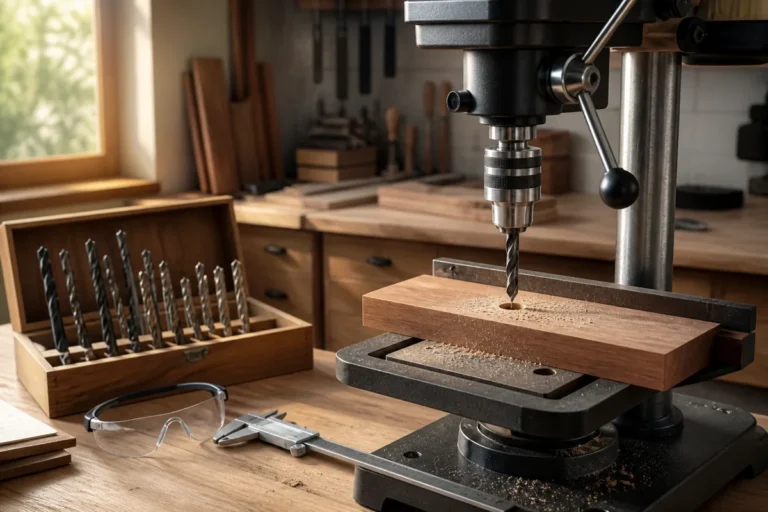
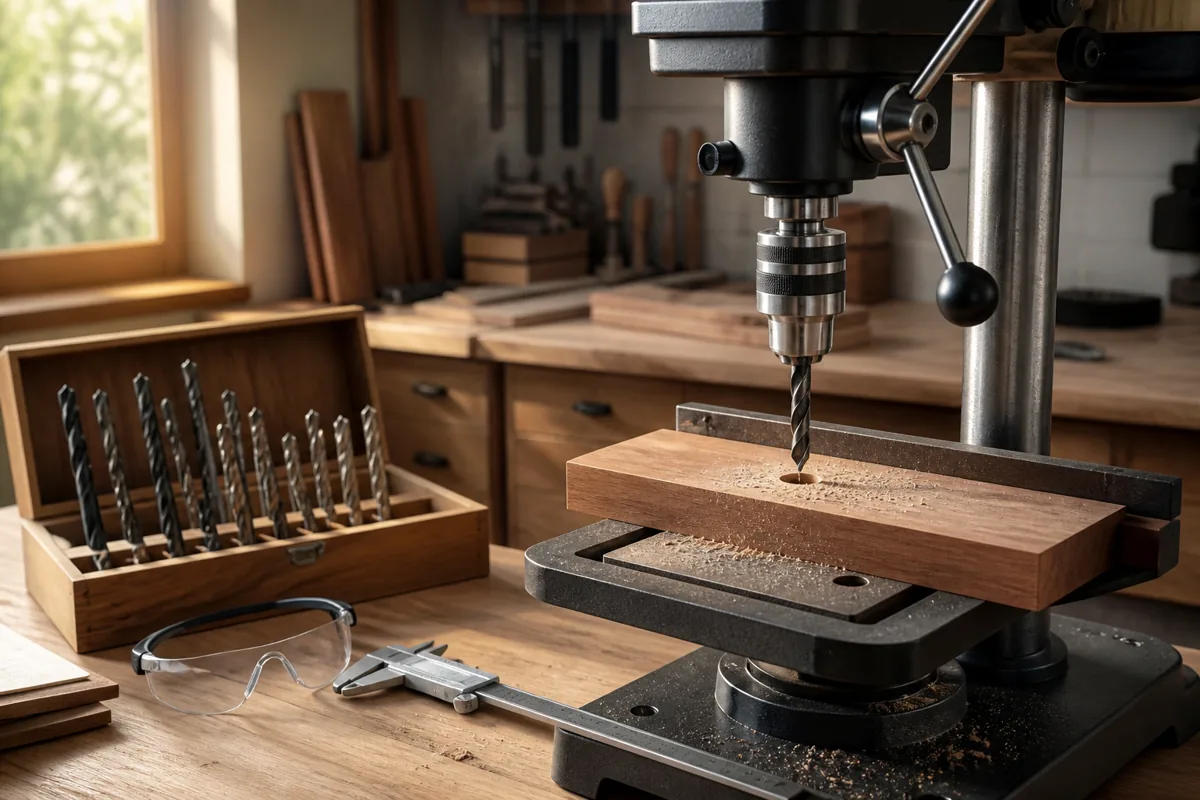
Drill-press speed is set by matching spindle RPM to the bit’s diameter, the wood’s density, and the hole you need. A large bit moves faster at its cutting edge than a small bit at the same RPM, so it usually needs a slower setting. Dense hardwood also builds heat more quickly than softwood, especially in deep holes or with a dull bit.
There is no single speed chart that fits every bit and species. Use the bit maker’s limits when available, then treat the ranges below as starting points. Listen to the cut, clear chips, and adjust if the bit burns, chatters, or stops cutting cleanly.
Contents
Start with bit diameter
Most drill presses offer stepped pulleys rather than infinitely variable speed. Unplug the machine before changing belt positions, and never run it above the bit’s rated maximum. As a rough guide for ordinary twist bits in wood, small bits can run fast; larger bits need progressively lower RPM.
| Bit diameter | Starting RPM range | Typical use |
|---|---|---|
| 1/8–1/4 in. | 2,000–3,000 RPM | Pilot holes, small hardware holes |
| 5/16–1/2 in. | 1,200–2,000 RPM | General screw and dowel holes |
| 9/16–1 in. | 500–1,200 RPM | Larger clearance holes |
| Over 1 in. | 250–600 RPM | Forstner bits, hole saws, large augers |
These ranges are deliberately broad. A Forstner bit, hole saw, auger, and twist bit of the same diameter do not cut the same way. Check the bit maker’s instructions, particularly for large bits. If your press’s slowest setting is too fast for a wide bit, do not compensate by pushing harder; use a smaller bit, a slower machine, or a bit rated for the available speed.
Adjust for the wood species
Species mainly affect how readily the bit cuts and how much heat builds up. For a given diameter and bit style, start toward the lower end of the range in hard, dense wood and toward the middle or upper end in soft, easy-cutting wood. The change is usually less important than bit diameter, sharpness, feed pressure, and chip removal.
| Wood group | Examples | Practical speed adjustment | Watch for |
|---|---|---|---|
| Softwoods | Pine, cedar, fir | Use the middle to upper part of the range | Fuzzy edges, resin buildup, tear-out |
| Medium-density hardwoods | Cherry, walnut, maple | Start near the middle; lower speed for large bits | Burning in deep holes, especially in maple |
| Dense or abrasive hardwoods | White oak, hard maple, hickory | Start near the lower end | Heat, squealing, stalled bits |
| Engineered panels | Plywood, MDF, particleboard | Follow bit guidance; use moderate speed and controlled feed | Splintering, dust, rapid bit wear |
For example, a 1/2-inch twist bit in pine can often start around 1,500–2,000 RPM, while the same bit in hard maple is better started around 1,000–1,500 RPM. If it cuts cleanly without heating, there may be no reason to change. A 1-inch Forstner bit in either species should run far slower—perhaps 500–800 RPM—because its broad rim creates substantial friction.
Read the cut, not just the chart
Smoke, a scorched rim, or a burnt-wood smell means something is wrong. Reduce speed, use a sharp bit, ease feed pressure, and withdraw the bit periodically to clear chips. In a deep hole, packed chips rub against the bit and trap heat. A drill press feed handle is not a license to force the cut; excessive pressure can stall the motor, bend a small bit, or pull the workpiece around.
Chatter or a rough, oversized hole may mean the work is not clamped securely, the bit is dull, or the speed and feed do not suit the setup. Clamp the work to the table, particularly when drilling with large bits. A small piece can spin violently if the bit catches. Backing up thin stock with scrap wood helps reduce splintering as the bit exits.
Too slow is not automatically safer. A bit that rubs without cutting can still burn the wood, and a dull bit can overheat at any speed. Make sure the bit is sharp and correctly seated, then change one factor at a time. Forstner bits benefit from a steady, moderate feed; brad-point bits tend to leave a cleaner entry in solid wood; twist bits are economical for ordinary holes but may wander in wide or deep cuts.
Choose a press with useful speed range
If you regularly drill small pilot holes and large Forstner-bit holes, look for a press whose published spindle-speed range covers both jobs. Many benchtop presses have only five pulley settings and may top out near 3,000 RPM; that is adequate for common woodworking, but the slowest setting can be limiting for large cutters. A variable-speed model is convenient, though it may cost more and still have a minimum RPM too high for some bits.
A basic benchtop drill press is fine for occasional furniture and shop projects if its lowest speed suits your largest bit and the work fits under its capacity. A floor-standing press can offer more throat depth, table travel, and sometimes a wider speed range, but it takes more space and is not automatically more accurate. Compare actual RPM settings, swing, quill travel, and table size rather than buying by horsepower alone.
For repeatable work, a drill-press speed chart mounted near the machine can be useful, but treat it as a reference rather than a guarantee. Charts often omit bit style and wood species. Record the settings that work with your own bits, keep cutters sharp, and slow down when diameter, density, or hole depth increases.