Best 110 Volt Dust Collectors for Small Shops (2026)
What's inside
- Quick comparison of 110 volt dust collectors
- What 110 volt means for dust collection
- Best overall: Shop Fox W1685
- Best quiet portable: Jet DC-650
- Best for mid-size shops: Jet DC-1100VX class
- Best budget approach: shop vacuum plus cyclone separator
- Best for tight space: wall-mounted cyclone class
- Matching CFM to the machine
- Worked example: why the box number is not enough
- How to choose a 110 volt dust collector
- Maintenance
- Frequently Asked Questions
As an Amazon Associate I earn from qualifying purchases. This post may contain affiliate links at no extra cost to you.
The best 110 volt dust collector for a small woodworking shop is a 1.5 HP single-stage unit such as the Shop Fox W1685, rated at 1,280 CFM, or a 1 HP unit like the Jet DC-650 if you want a quieter machine with a smaller footprint. Both plug into a standard outlet. The right choice depends on the longest duct run, the tools you connect, and whether you want a bag filter or a canister, because the CFM on the box drops sharply once you add hose and bends.
As an Amazon Associate we earn from qualifying purchases at no extra cost to you.


Contents
- Quick comparison of 110 volt dust collectors
- What 110 volt means for dust collection
- Best overall: Shop Fox W1685
- Best quiet portable: Jet DC-650
- Best for mid-size shops: Jet DC-1100VX class
- Best budget approach: shop vacuum plus cyclone separator
- Best for tight space: wall-mounted cyclone class
- Matching CFM to the machine
- Worked example: why the box number is not enough
- How to choose a 110 volt dust collector
- Maintenance
- Frequently Asked Questions
Our Top Picks
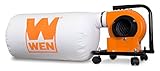
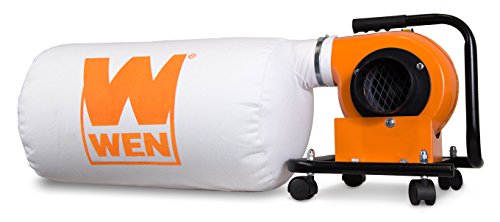
 VEVOR Dust Collector40.94 x 13.78 x 15.75 inch40.94 x 13.78 x 15.75 Inches24.03 poundsCheck on Amazon

Quick comparison of 110 volt dust collectors
| Pick | Best for | Motor | Rated airflow | Filtration | Inlet | Price range |
|---|---|---|---|---|---|---|
| Shop Fox W1685 | Best overall 110 V single-stage | 1.5 HP, 110 V | 1,280 CFM, 10.1 in. static pressure | 2.5 micron bag (canister upgrade available) | 6 in. with Y for two 4 in. | Mid-range |
| Jet DC-650 | Best quiet portable | 1 HP, 115/230 V | 650 CFM | 5 micron or 30 micron bag, by version | 4 in. | Mid-range to upper-mid |
| Jet DC-1100VX class | Best for mid-size shops | 1.5 HP, 115/230 V | About 1,100 CFM | Canister or bag | 6 in. class | Upper-mid |
| Oneida Dust Deputy with shop vacuum | Best for small tools and tight budgets | Shop vacuum motor | Shop vacuum rated, about 100 to 150 CFM | HEPA vacuum filter | 2-1/2 in. | Budget |
| Wall-mounted 1 HP cyclone class | Best for tight floor space | 1 HP | 600 to 800 CFM class | Cyclone with canister | 4 to 5 in. | Premium |
Airflow figures are manufacturer ratings at the inlet with no hose. In a real duct run the delivered CFM is lower, so do not size a system on the box number alone.
What 110 volt means for dust collection
A dust collector is simply a high-volume fan. More horsepower gives more airflow and static pressure, and static pressure is what pulls air through a long hose and a filter. At 110 or 120 volts, the practical limit is about 1.5 HP on a 15-amp circuit. Collectors rated 2 HP and above are generally 220 or 240 volts. For a typical home shop, a 1 to 1.5 HP unit handles a table saw, a planer, a jointer, a band saw, and a router table, as long as you only run one machine at a time and keep the duct run short.
Best overall: Shop Fox W1685
The W1685 is a 1.5 HP, 110 volt single-stage collector rated at 1,280 CFM with 10.1 inches of static pressure, according to the manufacturer. The 6-inch inlet has a Y adapter for two 4-inch hoses. Standard filtration is a 2.5-micron bag, and an optional canister filter brings it to 1 micron. One review reports a sound level of around 66 decibels, which is quiet for a machine of this power. It draws near the limit of a 15-amp circuit, so run it on a dedicated line. The weakness of any bag-style single-stage collector is fine dust: the bag filters the 2.5-micron range, but you should keep the filter clean and consider a respirator while sanding.
Best quiet portable: Jet DC-650
Jet’s DC-650 is a 1 HP, 115/230 volt collector at 650 CFM, offered with a 5-micron bag or 30-micron bag depending on the model number. It is compact, sturdy, and quieter than larger single-stage collectors. At 650 CFM it suits a bandsaw, a drill press, a sander, and a small planer when you use a short hose. It is underpowered for a 13-inch planer or a wide jointer, and it will struggle with a long duct run.
Best for mid-size shops: Jet DC-1100VX class
The DC-1100VX series is a 1.5 HP collector, around 1,100 CFM, with a canister filter option and a compact upright design. It sits between the Jet 650 and the Shop Fox in airflow. Choose it when you want better fine-dust filtration than a bag and a smaller footprint than a large cyclone.
Best budget approach: shop vacuum plus cyclone separator
For a bench-top sander, a miter saw, a router, or a small planer, a shop vacuum with a cyclone separator such as the Oneida Dust Deputy can outperform a bigger collector. A cyclone drops chips into a bucket before they reach the filter, so the filter stays clean. A shop vacuum has high static pressure but low airflow, so it works well with a 2-1/2 inch hose at the tool and poorly for a table saw cabinet or planer. This is the best low-cost way to keep fine sanding dust out of your lungs when combined with a HEPA filter.
Best for tight space: wall-mounted cyclone class
Compact cyclones, wall-mounted and 1 HP, deliver 600 to 800 CFM and capture fine dust in a bin before it hits the filter. They cost much more than single-stage collectors, but the filter stays cleaner and suction stays steady. They suit shops where floor space is limited and fine dust matters.
Matching CFM to the machine
| Machine | Typical airflow need | Port size |
|---|---|---|
| Random orbital or bench sander | 350 to 450 CFM | 2-1/2 in. or 4 in. |
| Band saw (14 in.) | 350 CFM | 4 in. |
| Table saw (cabinet style) | 350 to 450 CFM | 4 in. |
| Jointer (6 to 8 in.) | 400 to 500 CFM | 4 in. |
| Thickness planer (12 to 15 in.) | 400 to 800 CFM | 4 in. |
| Router table | 350 CFM | 2-1/2 to 4 in. |
These are commonly cited planning figures from tool makers and dust-collection guides. Check each machine’s manual for its recommendation.
Worked example: why the box number is not enough
Suppose you buy a 1,280 CFM collector and connect it to a planer with 15 feet of 4-inch flexible hose and two bends. Each foot of flexible hose and each 90-degree elbow adds resistance. The delivered airflow might drop to 450 to 600 CFM at the planer. If you used 6-inch smooth metal duct for the main run and reduced to 4 inches only at the machine, you would keep more airflow. The practical rules: use the shortest run possible, use smooth rigid duct for long runs, use large-radius elbows, and keep flexible hose to a few feet at each tool.
How to choose a 110 volt dust collector
Plan the duct run first
A collector at the end of a long, narrow duct will not perform. Sketch the layout and add up the length and bends before choosing a model.
Choose filtration with health in mind
Fine dust under 10 microns is the type most associated with respiratory irritation. Look for filters rated to 1 micron or better, wear a respirator when sanding, and consult a medical professional if you have concerns about dust exposure.
Single-stage or cyclone
Single-stage collectors are less expensive and move more air per dollar. Cyclones separate the chips so the filter clogs less and suction stays consistent.
Noise
Collectors run at 70 to 85 decibels. Quiet models help, as does placing the collector in a closet or a separate room with a closed door.
Circuit
A 1.5 HP motor draws 12 to 15 amps at 110 volts. Put it on its own 20-amp circuit if possible, and do not run it with other high-draw tools.
Maintenance
- Empty the collection bag or drum before it is full, since a full bag cuts airflow.
- Clean a canister filter with the built-in paddle or compressed air from the clean side.
- Ground the duct if you use plastic pipe to reduce static buildup.
- Check for leaks at joints; a small air leak near the machine cuts suction significantly.
Frequently Asked Questions
Is a 110 volt dust collector powerful enough for a planer?
A 1.5 HP unit around 1,100 to 1,300 CFM can collect from a benchtop or 13-inch planer if the hose is short. A smaller 650 CFM unit may leave chips behind on a wide planer.
How many CFM do I need?
Most machines in a home shop need 350 to 800 CFM at the tool. Choose a collector that can deliver this after losses in the duct, not just at the inlet.
Do I need a cyclone?
Not necessarily. A cyclone helps if you want to keep filters clean and need steady suction, or if you plan to collect fine dust. For small shops running one machine at a time, a single-stage collector is workable.
Can I use a shop vacuum instead of a dust collector?
For sanders, routers, and small saws, yes, especially with a cyclone separator. For planers and jointers, a vacuum does not move enough air.
Is fine dust from wood harmful?
Wood dust can irritate eyes and airways, and some species are known sensitizers. Collect dust at the source, use appropriate respiratory protection, and seek medical advice if you have symptoms.