Table Saw vs Jointer for Flattening the Edge of a Rough Board
What's inside
As an Amazon Associate I earn from qualifying purchases. This post may contain affiliate links at no extra cost to you.
Contents
What you’re trying to fix
A rough board’s edge is often wavy, bowed, or not square to its face. The goal is to make one edge straight enough to guide against a table saw’s fence. A jointer is built to do that directly. A table saw can produce a straight edge too, but it needs a reliable reference—usually a jointed edge, a straight-line ripping jig, or a carefully set up fence and hold-down arrangement.
The distinction matters: a saw cut can make an edge straight relative to the saw’s guide, but it does not remove the board’s twist or flatten its face. If the board rocks on the saw table, the cut may follow that movement rather than produce a dependable edge.
As an Amazon Associate we earn from qualifying purchases at no extra cost to you.



Using a jointer
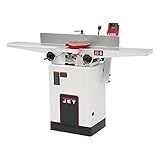
A jointer removes small amounts of material from an edge as you feed the board across its knives. The infeed and outfeed tables support the work, while the fence holds the edge square to the face. For ordinary edge jointing, set the cut shallow—around 1/32 inch is a reasonable starting point—and take additional passes rather than trying to remove a large amount at once.
Check the edge with a straightedge and the face with a square. If the board is bowed, keep downward pressure over the infeed table before the cut and shift pressure to the outfeed table as the newly cut section reaches it. Pressing down hard in the middle can bend a long board during the cut, leaving an edge that springs back into a curve.
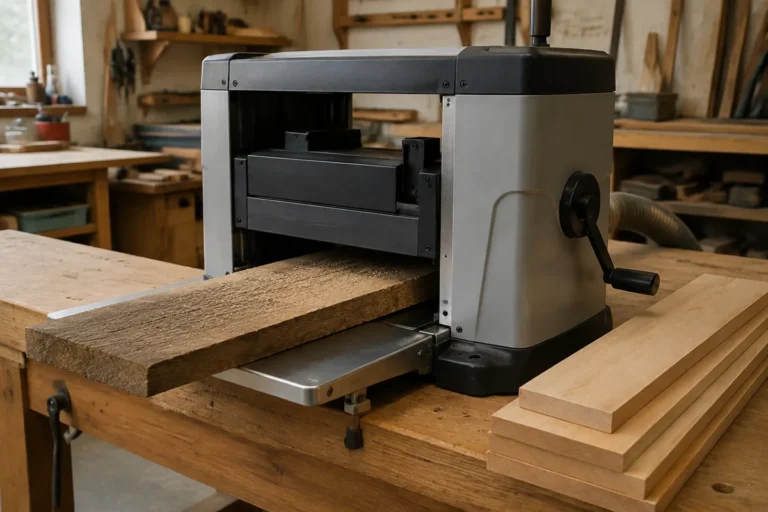
Jointers work best when the board has a reasonably stable face to ride on. They are not the right tool for a badly twisted board whose face rocks on the table. Flatten one face first, typically with a planer sled or by hand, then joint the edge. For boards wider than the jointer’s capacity, the edge can still be jointed if the board is within the machine’s width capacity; the real limits are board length, support, and safe control.
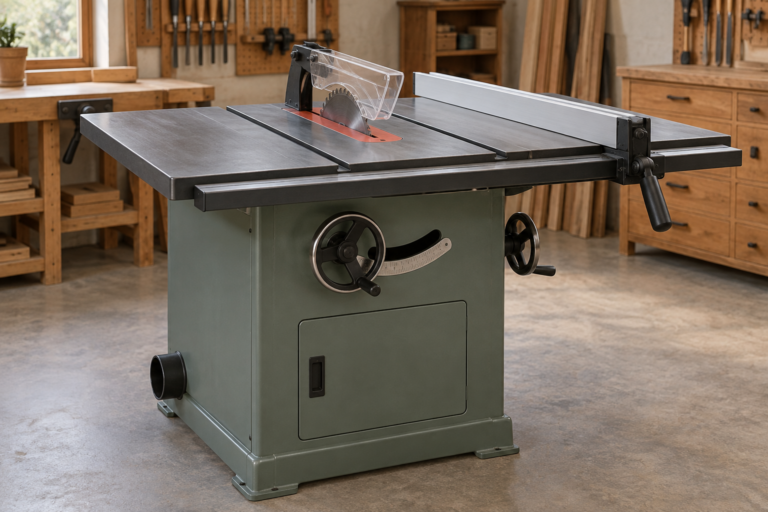
Using a table saw
Do not simply press a rough, crooked edge against the fence and rip it. The board can pivot into the blade, pinch the blade as the cut closes, or be pushed away from the fence. The result may be a wandering edge or dangerous kickback.
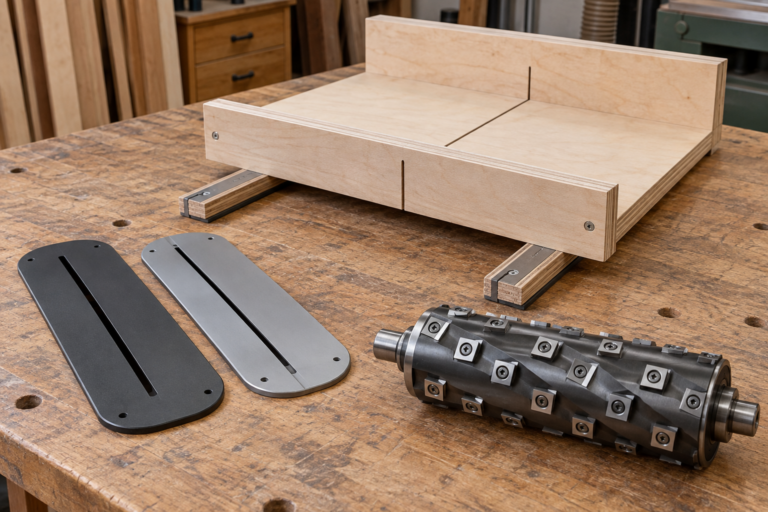
The usual solution is a straight-line ripping jig: fasten the board to a straight, rigid carrier with clamps or screws placed clear of the blade path, then guide the carrier against the fence. The carrier supplies the straight reference that the board lacks. Set the blade only slightly higher than the board, use a riving knife, and keep hands away from the blade. Support long stock at both ends so it cannot tip or bind during the cut.
A table saw is a practical option for occasional work if you already own one and can make a stable jig. It also removes material quickly, so leave enough width for a cleanup pass if the edge needs a better finish. A saw blade can leave small ridges or burn marks, especially if it is dull, dirty, or poorly aligned. A jointer generally leaves an edge ready for glue-up, though a light sanding or hand-plane pass may still be useful.
Jointer vs. table saw
| Factor | Jointer | Table saw with straight-line jig |
|---|---|---|
| Reference | Its tables and fence guide the edge | The jig must provide a straight reference |
| Setup | Adjust fence and cut depth | Build or position jig, secure board, check clearance |
| Edge finish | Usually smooth and ready for fitting | Can show blade marks; may need cleanup |
| Best fit | Frequent edge jointing and repeatable work | Occasional straightening when a saw is already available |
| Main risk | Sniping, uneven pressure, or losing control of long stock | Board shifting, binding, or kickback if the jig or support is poor |
What to buy
If you regularly prepare solid-wood edges for panels, a jointer is the more direct and repeatable choice. A benchtop jointer is less expensive and easier to fit in a small shop, but its short tables make long boards harder to control. For furniture-length stock, look for longer support or plan to use well-positioned infeed and outfeed supports. Compare a benchtop jointer against your actual board lengths, not just its advertised cutting width.
If you joint only a few boards a year, a dedicated machine may not earn its space or cost. A straight-line jig is cheaper, works with a table saw you already own, and can handle boards wider than a small jointer. It does require careful setup every time. A straight-line ripping jig is worth considering if it holds the board securely and runs steadily against the fence; a homemade carrier can do the same job if it is flat and rigid.
Common mistakes to avoid
On a jointer, taking a deep cut to save time can overload the machine, tear out grain, or make a narrow board difficult to control. Keep hands clear of the cutterhead and use push blocks suited to the stock. Do not joint a board that is too short or too thin for the machine’s instructions and guard arrangement.
On a table saw, the biggest mistake is treating the fence as a straightening tool when the board has no straight edge to register against. A crooked board can contact the fence at only one point and swing as it feeds. Stop if the stock shifts, the kerf closes, or feeding resistance suddenly increases. Never pull a board backward through a spinning blade to correct a bad cut.
For one or two rough boards, a table saw jig is often the sensible low-cost route. For repeated, accurate edge jointing, the jointer is faster to set up and easier to control. Choose based on how often you do the work and whether you can safely support the longest boards in your shop.