How to Align a Table Saw Blade Parallel to the Miter Slot
What's inside
As an Amazon Associate I earn from qualifying purchases. This post may contain affiliate links at no extra cost to you.
Contents
Why blade-to-slot alignment matters
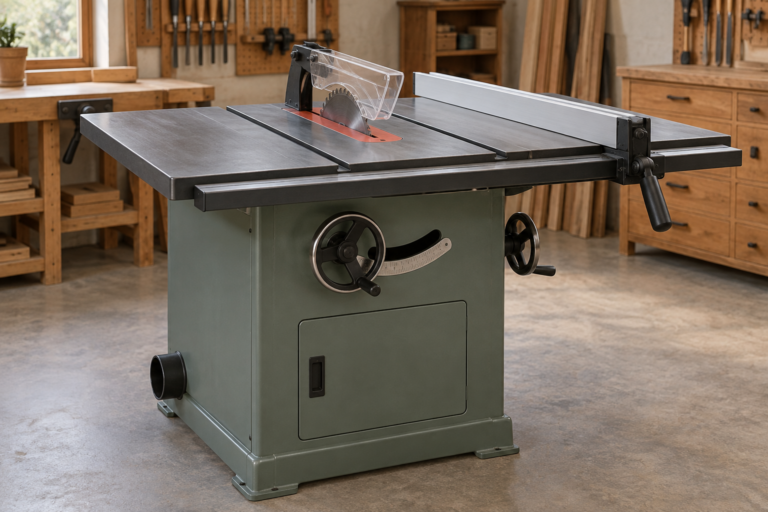
A table saw blade should travel parallel to the miter slot. If it points slightly toward or away from the fence as it cuts, the teeth can rub the workpiece, leave burn marks, or make a cut drift. Severe misalignment can increase kickback risk. Aligning the blade to a slot gives you a reliable reference for checking the fence afterward.
This is a precision adjustment, not a way to correct every saw problem. A bent blade, loose arbor, damaged miter slot, or warped tabletop can make readings inconsistent. Unplug the saw before checking anything, and follow the manufacturer’s instructions for tilting and adjusting the saw. Never reach near the teeth while the machine is connected to power.
Tools and measurement options
You can measure with a dial indicator mounted to a miter-slot bar, or use a combination square or a ruler with a fixed pointer. A dial indicator makes small differences easier to see, but a careful ruler method is adequate for many home-shop saws. The important part is using the same tooth and keeping the measuring tool square to the slot.
| Method | What it’s good at | Trade-off |
|---|---|---|
| Dial indicator and slot bar | Repeatable readings in thousandths of an inch | Costs more; the bar must fit the slot without rocking |
| Combination square or ruler and pointer | Low-cost checks and rough alignment | Harder to distinguish small differences; setup can introduce error |
If you want repeatable measurements, a table-saw dial indicator alignment gauge is a useful purchase. For occasional setup work, a straight, accurate combination square may be enough. Avoid relying on a cheap ruler with a loose joint or a slot bar that rocks from side to side.
Prepare the saw and blade
Unplug the saw. Clean pitch and dust from the tabletop, miter slot, blade plate, and arbor flange. Raise the blade fully and set it to 90 degrees to the table; use a reliable square to check rather than trusting the bevel scale. If the blade is visibly warped or has damaged teeth, replace it before measuring. A crooked blade can look like a trunnion alignment problem.
Check for arbor play by gently moving the blade side to side with the saw unplugged. There should not be obvious movement. Also make sure the blade is seated firmly against the arbor flange and the nut is secure. If you find play, stop and address the arbor or bearing issue first.
Mark one tooth near the front of the blade. Rotate the blade by hand until that tooth is at the front measurement point, just above the table. Keep using that same tooth for the rear reading. This reduces error from small differences in tooth set or blade runout.
Take front and rear readings
For a dial indicator, fit its bar snugly in the miter slot and set the indicator tip against the marked tooth. Zero the dial, then slide the gauge to the back of the blade, rotate the blade by hand to bring the same tooth to the rear measurement point, and record the reading. Keep the indicator tip at the same height and angle for both readings.
With a combination square, place its head against the miter-slot edge and extend the rule toward the blade. Bring the rule close to the marked tooth without touching it. Note the gap, then repeat at the rear with the same tooth. A thin feeler gauge can help compare small gaps. Do not use the fence as your reference; the fence itself may be out of alignment.
The difference between the two measurements is the blade’s alignment error over the distance you measured. For example, a 0.010-inch difference front to rear means the blade is not parallel by that amount across the measured span. Many woodworkers aim for a difference of about 0.003 to 0.005 inch or less. Check your saw’s manual for its specification; some manufacturers provide a different tolerance. Consistency matters more than chasing a number your tools cannot measure reliably.
Adjust the blade alignment
If the saw allows it, adjust the trunnion or blade-mounting assembly—not the miter slot. The exact procedure varies. Some saws have adjustment bolts accessible from underneath; others require loosening the table or cabinet fasteners. Consult the manual before loosening anything. Mark the original position with a pencil so you can reverse the change if needed.
Loosen the relevant fasteners only enough to move the assembly. Tap the trunnion gently with a soft-faced mallet, or use controlled pressure on the assembly as the manual directs. A small movement at the mounting point can shift the blade substantially, so adjust in tiny increments. Retighten the fasteners evenly, then repeat the front and rear measurements. Tightening can pull the assembly out of position, so always recheck after the bolts are secure.
If the saw has a fixed trunnion arrangement, the manufacturer may specify shifting the tabletop instead. Do not pry against the blade or force a cast-iron table. If the adjustment requires more movement than the mounting slots allow, or the readings change unpredictably, inspect for damaged parts and contact the manufacturer or a qualified repair technician.
Verify the fence and make a test cut
Once the blade is aligned, check the rip fence against the miter slot. Set the fence parallel to the slot or with a very slight toe-out at the rear if the saw’s manual recommends it. A fence that toes in can pinch stock against the back of the blade. Do not use a large toe-out as a workaround for blade misalignment.
Make a test cut in scrap, keeping the guard and riving knife installed where the operation permits. Look for burning, unusual resistance, or a kerf that wanders. If the cut still binds, check the blade, fence, riving knife alignment, stock condition, and feed technique before making further adjustments. A clean test cut is useful confirmation, but it does not replace correct setup or safe workholding.