Best Jigsaw: Blade Control Beats Motor Power
Key takeaways
- Why the best jigsaw for woodworking is decided by blade guidance and base plate rigidity rather than motor power, and how to judge the difference before you buy.
What's inside
As an Amazon Associate I earn from qualifying purchases. This post may contain affiliate links at no extra cost to you.
Almost every jigsaw sold in the United States has enough motor to cut three-quarter inch hardwood. That has been true for at least a decade. Yet plenty of woodworkers still finish a curved cut, flip the workpiece over, and find a bottom edge that wanders four or five degrees off square. The motor was never the problem. The problem is that the blade is a thin, unsupported cantilever being pushed sideways by grain, and the tool either controls that or it does not. So when we talk about the best jigsaw, we are really talking about blade control: how well the tool guides a flexible blade, how rigidly the shoe sits on the work, and how little the whole assembly deflects under real cutting pressure.
This guide is written against stated criteria rather than spec sheets. We compare tool lines and categories, not individual part numbers, because manufacturers revise models constantly while the underlying design philosophy of a line tends to persist. If you understand what to look for at the blade and the shoe, you can walk into any store or scroll any listing page and evaluate what is in front of you.
As an Amazon Associate we earn from qualifying purchases at no extra cost to you. Product prices and availability are accurate as of the date shown and are subject to change.


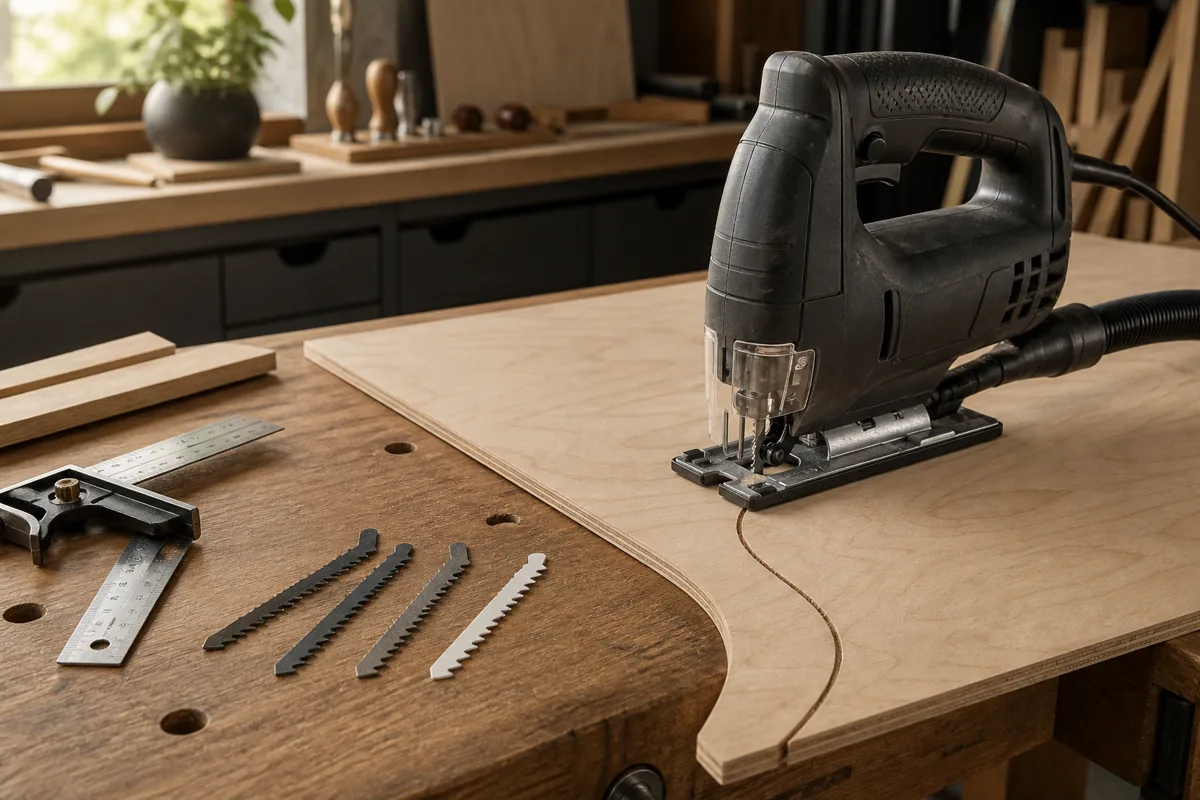
What actually separates the best jigsaw from an average one
Start with the blade guidance system. Cheaper saws hold the blade only at the plunger, which means the last inch and a half of exposed steel is free to twist. Better designs add a guide near the base: a hardened roller, or a pair of carbide or ceramic pads that pinch the blade just above the workpiece. That single feature does more for cut squareness in thick stock than any increase in stroke rate.
Next, the base plate. Press down on the front of the shoe with your thumb while the tool is unplugged or the battery is out. A thin stamped shoe will flex visibly. A thicker cast or heavily ribbed plate will not. Flex at the shoe translates directly into a bevel you did not ask for, because the blade is referenced off that plate. Related to this: check how the shoe locks for bevel cuts. A cam lever with positive detents at zero and forty-five degrees, plus a hard stop you can feel, is worth more than a scale printed on the casting. Vague detents are the single most common complaint we hear from readers about mid-priced jigsaws.
Third, the blade clamp. Tool-free clamps are now standard and generally good, but they vary in how squarely they seat a T-shank blade and how much play develops after a season of use. A clamp that lets the blade rock front to back will never cut a clean line no matter what else the tool does well.
Finally, look at the plunger bearing and overall runout. You cannot measure this in a store, but you can feel it. Run the saw at low speed with no blade installed and watch the plunger. Smooth, quiet, and visually stable is what you want. A plunger that chatters at idle will chatter under load.
| Criterion | Why it matters | What good looks like |
|---|---|---|
| Blade guidance | Controls lateral deflection in thick stock | Roller or carbide pads close to the shoe |
| Base plate rigidity | Prevents unintended bevel | Cast or heavily ribbed, no thumb flex |
| Bevel detents | Repeatable 0 and 45 degree cuts | Positive click, hard stop, cam lock |
| Blade clamp | Keeps blade square and seated | No front-to-back rock, tool-free release |
| Dust management | Line visibility | Blower plus port that fits a shop hose |
| Balance and grip | Control on curves | Low center of mass, no wrist strain |
Barrel grip or top handle
This is a genuine fork in the road and not a matter of price. Top-handle saws put your hand above the tool, which most people find intuitive and which works well when the saw sits on a flat panel. Barrel-grip saws put your hand around the body, closer to the work, and give you a lower, more direct sense of where the blade is going. Furniture makers cutting tight curves and template work often prefer barrel grips for exactly that reason. Sheet goods installers and general remodelers usually prefer top handles.
Our practical advice: if you mostly break down plywood and cut rough openings, buy a top handle. If you cut curves in solid stock, cut chair parts, or work off templates, spend the extra effort to find a barrel grip. Barrel-grip options are thinner on the ground in the US market than in Europe, so search deliberately rather than assuming your preferred brand offers one in every line.
Cordless barrel-grip jigsaws
The barrel-grip layout gives you the most direct feel for blade wander, which is precisely what matters on curved and template work. Expect a premium over top-handle equivalents and confirm the specific tool has a blade guide near the shoe before you commit.
Corded, cordless, and what the platform decision really costs
Cordless jigsaws stopped being a compromise several years ago. Brushless platforms such as DeWalt XR, Milwaukee FUEL, and Makita LXT deliver stroke rates and torque that hold up in two-inch hardwood, and the freedom to cut on sawhorses without dragging a cord is a real quality-of-life gain. The honest tradeoffs are weight and cost. A jigsaw with a large battery hanging off the back sits higher and heavier than a corded tool, which changes how it balances on a curve. Smaller compact batteries restore the balance but shorten runtime.
Corded saws remain the value play. If you already own no batteries in a given system, a good corded jigsaw with a proper blade guide typically costs a fraction of a bare-tool premium saw plus a battery and charger. Corded tools also run cooler on long ripping sessions and never fade as a cell drains. For a shop where the saw lives at the bench, cord is a non-issue.
If you do own a battery platform, buy within it. The bare-tool price is where cordless makes economic sense, and platform loyalty on a jigsaw costs you less than it does on, say, a table saw.
- ✔ Cordless brushless models cut hardwood without noticeable bogging
- ✔ No cord to snag on sawhorses or drag across a finished panel
- ✔ Bare-tool pricing is reasonable if you already own batteries
- ✔ Modern LED and blower systems genuinely improve line visibility
- ✘ Battery weight raises the center of mass and dulls feel on curves
- ✘ Compact batteries fix balance but cut runtime meaningfully
- ✘ Bare tool plus battery and charger can double the effective cost
- ✘ Long continuous cuts still favor corded tools for consistency
Blades matter more than the tool, and nobody wants to hear it
A four-hundred-dollar saw with a tired blade cuts worse than a budget saw with a fresh one. Jigsaw blades are cheap, they dull faster than most people assume, and blade selection controls tearout more than any orbital setting.
Keep three families on hand. Reverse-tooth or down-cut blades for melamine, veneered plywood, and any face you cannot sand: they push chips downward so the visible surface stays clean. Fine-tooth clean-cut blades for hardwood curves where you want minimum cleanup. Aggressive coarse-tooth blades for framing and rough sheet stock, where speed matters and the edge will be hidden. Add a metal-cutting bimetal blade if you ever touch sheet metal or nails.
One more habit worth adopting: reduce or eliminate orbital action for curves and clean cuts, and increase it for fast straight cuts in thick softwood. Many people set orbital once and forget it, then blame the tool for tearout it did not cause.
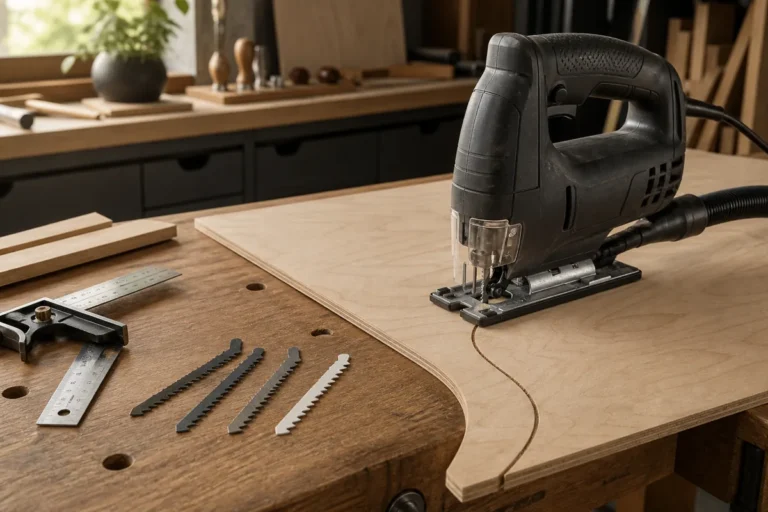
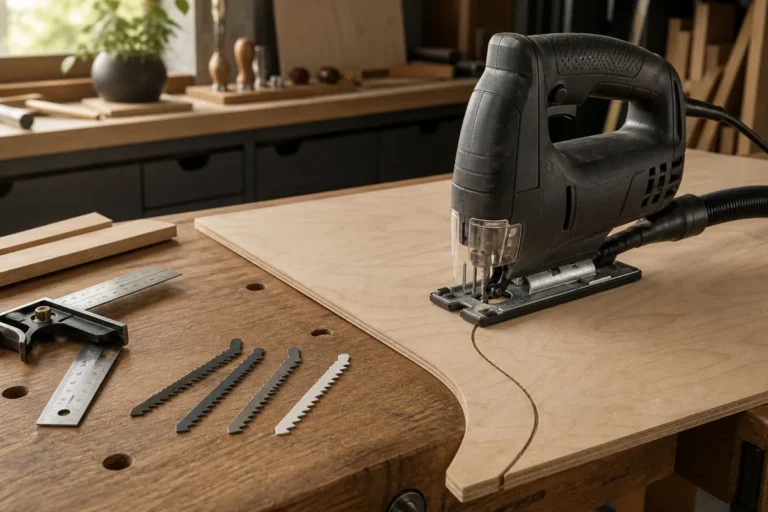
T-shank jigsaw blade assortment
If your current jigsaw frustrates you, spend a small amount on a proper blade assortment before spending a large amount on a new saw. Down-cut blades for finished faces are the single biggest improvement most users can make.
Matching the tool to the work
For occasional DIY use, cutting a sink opening or a few plywood shelves, a mid-priced corded top handle with a visible blade guide and a rigid shoe is entirely sufficient. Spending more buys refinement you will not exercise often.
For furniture and cabinet work, prioritize blade guidance, shoe rigidity, and detent quality above all else, and seriously consider a barrel grip. This is the use case where the difference between an average saw and a genuinely good one shows up in every curved part you cut.
For jobsite and remodeling work, favor cordless within your existing battery platform, a durable shoe with a replaceable plastic overlay to protect finished surfaces, and easy one-handed bevel adjustment. Dust extraction matters less outdoors and more indoors, so check whether the port accepts a standard shop vacuum hose without an adapter you will lose.
Cordless brushless top-handle jigsaws
The default recommendation for most buyers who already own batteries. Choose within your existing platform, pair it with a compact battery for better balance, and verify the shoe locks positively at zero degrees.
Frequently asked questions
Does a higher stroke rate mean a better cut? No. Above a certain point, stroke rate mainly affects cutting speed, not cut quality. A saw that guides the blade well at moderate speed will produce a squarer, cleaner edge than a faster saw that lets the blade twist. Variable speed matters more than maximum speed, because slowing down is what saves you on tight curves and thin material.
Why does my jigsaw cut at an angle even at zero bevel? Usually one of three things: blade deflection from a dull or too-thin blade, shoe flex from a thin stamped base plate, or the bevel adjustment not seating fully at its zero detent. Check the detent first, since it is free to fix. Then try a fresh, thicker blade. If both are fine and the cut still wanders, the tool lacks adequate blade support for the thickness you are cutting.
Can a jigsaw replace a bandsaw or a track saw? Not really. A jigsaw excels at interior cutouts, curves in installed work, and portability. A bandsaw gives far better control and squareness on repeatable curves in thick stock, and a track saw makes straight cuts a jigsaw will never match. Think of the jigsaw as the tool that goes where the others cannot.
Verdict
The category has converged on adequate power, so power is no longer a useful way to choose. The tools we would recommend are the ones that hold a blade steady: a guide close to the workpiece, a shoe you cannot flex with your thumb, bevel detents that click into place with authority, and a clamp that seats a blade square. Judge on those four points and the price tiers sort themselves out quickly. If you cut curves in solid wood for furniture, stretch for a barrel grip in a premium line and pair it with fresh down-cut blades. If you cut sheet goods and openings, a rigid mid-priced top handle, corded or cordless within a platform you already own, will do everything you ask of it. Either way, budget for blades. They are the cheapest performance upgrade in the shop, and the one most people skip.
Check prices on Amazon →