Best Phone Tripods for Content Creators
What's inside
As an Amazon Associate I earn from qualifying purchases. This post may contain affiliate links at no extra cost to you.
The best phone tripods for content creators are the ones that match your shooting distance and phone setup: choose the Ulanzi MT-44 for an affordable all-rounder, the Joby GripTight PRO TelePod for compact versatility, or a full-size video tripod when maximum stability matters more than portability.
As an Amazon Associate we earn from qualifying purchases at no extra cost to you.


Contents
Quick picks by creator situation
| Creator situation | Best fit | Why it makes sense | Main compromise |
|---|---|---|---|
| First tripod, low budget | Extendable phone tripod with Bluetooth remote | Usually costs about $20–$45 and covers desk, standing, and group shots | Thin legs and plastic joints can wobble at maximum height |
| Frequent travel or short-form video | Joby GripTight PRO TelePod | Combines a handheld grip, monopod-style extension, tripod base, and adjustable phone mount | Not as tall or wind-resistant as a full-size tripod |
| Desk tutorials and overhead work | Heavy tabletop tripod with a ball head or articulating arm | Stable framing close to the work surface; easy to leave set up | Limited shooting height unless paired with a boom or overhead arm |
| Outdoor filming and larger phones | Ulanzi MT-44 or a metal video tripod with a locking clamp | Greater height, wider stance, and a cold shoe for a microphone or light | Bulkier to carry and more sensitive to uneven ground |
| Professional-looking movement | Smartphone gimbal with a tripod base, such as DJI Osmo Mobile 7 | Motorized stabilization and tracking features can improve walking shots | More expensive, heavier, and requires charging and balancing |
What to look for in a phone tripod
Stability before maximum height
A tripod that reaches 60 inches is not automatically better than one that reaches 50 inches. Tall, narrow legs raise the phone’s center of gravity, so the setup can shake when you tap the screen or when a light breeze catches a large phone. Look for rubber feet, positive leg locks, and a center section that does not flex when extended.
For indoor talking-head videos, a tripod weighing roughly 1–2 pounds is often a useful compromise. If you record outdoors, use a wider stance and consider a model weighing 2 pounds or more. Do not hang a heavy bag from the center hook unless the manufacturer provides one and the hook is designed for that load; swinging weight can make a tripod less stable rather than more stable.
Phone compatibility and clamp design
Most universal phone clamps cover approximately 2.2–3.5 inches, or about 56–90 mm, but the important measurement is the phone with its case installed. A thick case, wallet attachment, or external lens can exceed the clamp’s usable width or prevent the jaws from gripping evenly.
Spring-loaded clamps are quick for casual filming. Screw-tightened clamps are slower but generally more secure for long recordings, overhead angles, and heavier phones. Rubber or silicone contact pads protect the case and reduce slipping. Check that the clamp can rotate between portrait and landscape without forcing the phone against the tripod head.
Height and shooting angle
For seated videos, a 12–24-inch tabletop tripod or a short extension is usually enough. For standing videos, aim for a phone lens near eye level; this often means a tripod reaching 50–65 inches, depending on your height and whether the phone is mounted above the head of the tripod.
A ball head is useful for quickly changing from landscape to portrait. A two-way video head is better for smooth pans and tilts. If you record overhead craft, cooking, or woodworking demonstrations, prioritize a stable horizontal arm and a locking joint rather than a tall selfie-stick design.
Remote shutters and creator features
A detachable Bluetooth shutter lets you start recording without touching the phone, reducing framing shake. Typical remotes use a replaceable coin-cell battery and can work from roughly 20–30 feet in an unobstructed indoor environment, although walls and interference reduce that distance.
Cold-shoe mounts are valuable when you add a compact microphone, fill light, or monitor. A 1/4-inch-20 thread allows the phone mount to be used on other tripods, clamps, and magic arms. Some selfie-stick tripods include a built-in remote, but the remote may be easy to lose; a recessed storage slot or tether is a useful ownership detail.
Head-to-head: the most useful tripod types
Extendable selfie-stick tripod
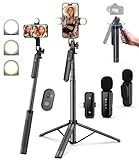
This is the most versatile starting point for short-form creators. It folds small, extends to standing height, and usually includes a Bluetooth shutter. The best versions have a broad base, a metal or reinforced center column, and a phone clamp that can tilt independently of the stick.
Its weakness is stability at full extension. Use the lowest height that gives you the composition you need, spread the legs fully, and avoid placing it on a vibrating table. Market prices generally range from $20 to $60.
Tabletop tripod with a quality ball head
A compact tabletop model is often the better choice for product demonstrations, streaming, and desk-based tutorials. Its low center of gravity resists accidental knocks, and it can sit on a workbench, shelf, or floor. Some models accept a separate phone clamp, allowing you to replace the mount without replacing the legs.
It cannot frame a full standing subject without additional accessories. Expect roughly $25–$90 depending on the head, materials, and included clamp.
Joby GripTight PRO TelePod
The GripTight PRO TelePod is designed around flexible shooting positions: it can be used as a grip, monopod-style extension, or small tripod. Its adjustable phone mount is suitable for portrait and landscape framing, and the compact folded design suits travel creators who do not want a conventional tripod bag.
It is strongest for handheld pieces to camera, quick travel clips, and small indoor spaces. It is not the ideal choice for a windy location, a long lens attachment, or a locked-off shot where maximum height and rigidity are priorities.
Ulanzi MT-44
The Ulanzi MT-44 is a taller, creator-oriented phone tripod and selfie stick with a larger footprint than many pocket models. It is known for combining a height-adjustable design with a phone holder and accessory mounting options, making it useful for vertical video, livestreaming, and occasional lighting or microphone additions.
Its extra height improves framing flexibility, but the extended column still demands care. Keep the legs wide, place the setup on firm ground, and avoid mounting a heavy accessory high above the phone. It typically falls in the approximately $30–$60 market range.
Smartphone gimbal with tripod base
A gimbal is worth considering when your content depends on walking, panning, or subject tracking. The DJI Osmo Mobile 7 is an example of this category, offering motorized phone stabilization and a foldable design with a tripod-related accessory ecosystem.
A gimbal does not replace a sturdy static tripod in every situation. It needs charging, may require the phone to be balanced within its clamp, and can be less convenient when you only need a fixed overhead or talking-head shot. Prices for current smartphone gimbals commonly range from about $70 to $160, depending on the bundle.
Concrete size and capacity comparison
| Category | Typical folded size | Typical working height | Typical weight | Useful load guidance |
|---|---|---|---|---|
| Mini tabletop tripod | 6–12 in | 4–16 in | 0.3–1.0 lb | Phone and small microphone |
| Selfie-stick tripod | 12–18 in | 20–65 in | 0.8–2.0 lb | Phone, remote, and one small accessory |
| Travel video tripod | 16–24 in | 20–60 in | 2–4 lb | Phone, light microphone, and compact light |
| Phone gimbal with tripod | 8–14 in | 8–16 in on included base | 1–2 lb | Phone within the manufacturer’s clamp range |
These are category ranges rather than a guarantee for every model. Treat the manufacturer’s maximum load as a ceiling, not a target. A phone with a large case, lens, microphone, and light can create more leverage than its scale weight suggests.
A simple fit calculation before buying
Measure your cased phone from the outside edge of one side to the outside edge of the other. Suppose it measures 78 mm and the phone clamp is specified for 60–85 mm. That leaves only 7 mm of total spare width, or 3.5 mm per side. The phone may fit, but there is little room for an uneven case edge or a spring that loses tension over time. A clamp rated to 55–95 mm would provide a more comfortable margin.
For height, measure the camera lens position while holding the phone at your intended filming height. If the lens needs to be 58 inches from the floor and the tripod’s listed maximum is 60 inches, the setup may still work, but it leaves little allowance for uneven ground or portrait rotation. A maximum height of 65–70 inches gives more practical adjustment.
Ownership details that affect long-term value
- Most common wear points: leg-lock hinges, spring-loaded clamp joints, rubber feet, and small plastic threads. These parts experience repeated stress before the main tubes fail.
- Keep threads clean: dust and sawdust can damage the 1/4-inch-20 connection. Brush debris away before tightening accessories, especially in a workshop.
- Do not overtighten: tighten the phone clamp until secure, not until the case deforms. Excess force can weaken plastic hinges and damage a phone’s buttons.
- Protect Bluetooth remotes: remove or replace the coin-cell battery if the remote will sit unused for months. A leaking battery can permanently damage the compartment.
- Check every joint before recording: open the legs fully, lock each section, and confirm that the phone remains level after rotating from portrait to landscape.
Final buying recommendation
Choose a basic extendable phone tripod if you need one inexpensive tool for vertical videos, group photos, and occasional standing shots. Choose a compact tabletop tripod when your work is mostly desk-based and stability matters more than height. Pick the Joby GripTight PRO TelePod for portability and fast repositioning, or the Ulanzi MT-44 when you need more height and creator accessory mounting. Move to a full-size video tripod for frequent outdoor filming, and choose a smartphone gimbal only when moving shots and electronic stabilization justify the extra charging and setup.