Best Kreg Jigs for Strong, Hidden Pocket-Hole Joinery
What's inside
As an Amazon Associate I earn from qualifying purchases. This post may contain affiliate links at no extra cost to you.
Contents
Best Kreg Jigs at a Glance
The short answer: for most woodworkers in 2026, the Kreg 720 Pro is the best all-around Kreg jig thanks to its one-motion AutoMaxx clamping and wide material range, while the Kreg Mini Jig is the smart pick if you only need occasional pocket holes or want a repair tool that fits in a toolbox. The right choice depends on how thick your stock runs, how often you drill, and whether you work at a bench or at the project.
What Is a Kreg Jig, Exactly?
A Kreg jig is a drill guide that bores a steeply angled pocket into one workpiece, so a self-tapping pocket-hole screw can pull it tight against a mating piece. The screw head sits hidden in the pocket, giving you a strong mechanical joint with no visible fasteners, no mortise-and-tenon layout, and often no clamping during glue-up. It’s one of the fastest joinery methods for face frames, cabinets, furniture carcasses, and DIY builds — which is why “Kreg jig” has practically become the generic name for the whole tool category.
As an Amazon Associate we earn from qualifying purchases at no extra cost to you.


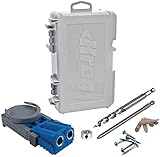
Kreg Tool Company makes several jigs at different price and capability levels. Here’s how they actually differ — and which situations each one wins.
Key Specs Compared
| Model | Material thickness | Clamp style | Setup | Weight (approx.) | Dust collection | Typical price range |
|---|---|---|---|---|---|---|
| Kreg Mini Jig | 1/2″–1-1/2″ | None — needs your own clamp | Manual positioning | ~0.5 lb | None | $20–$30 |
| Kreg R3 | 1/2″–1-1/2″ | Clamp pad — needs face clamp or separate clamp | 9-position thickness settings | ~1 lb | Optional adapter | $35–$50 |
| Kreg K4 | 1/2″–1-1/2″ | Front toggle clamp (bench or handheld) | 3-hole drill guide, removable | ~2.5 lbs | Dust port on base | $80–$110 |
| Kreg 520 Pro | 1/2″–1-1/2″ | VersaGrip rotating handle clamp | Tool-free thickness setup | ~3 lbs | Dust port + chip relief | $90–$120 |
| Kreg 720 Pro | 1/2″–2″ | AutoMaxx auto-adjusting clamp | One-motion clamp + drill, docking station | ~5 lbs with dock | Dust collection blade/port | $130–$170 |
| Kreg Pocket-Hole Jig XL | 1-1/2″–4-1/2″ | Clamp pad — needs clamp | Oversized guide for 2x and 4x lumber | ~1.5 lbs | None | $60–$80 |
Picks by Situation
Best overall: Kreg 720 Pro
The 720 Pro is the flagship for a reason. Its AutoMaxx clamp automatically adjusts to any stock thickness between 1/2″ and 2″ — squeeze the handle and it locks, no dial or spacer to set. That matters more than it sounds: on a cabinet job mixing 3/4″ plywood, 1-1/2″ face frames, and 1/2″ backs, you never touch an adjustment. The steel-reinforced drill guide holds up under production use, and the docking station gives you a place for bits, screws, and accessories. If you build furniture or cabinets regularly, the repeatability pays for itself in setup time saved. The 2″ max thickness also covers 8/4 hardwood that smaller jigs can’t reach.
Best handheld for repairs and on-site work: Kreg 520 Pro
The 520 Pro trades the 720’s bench docking system for a rotating VersaGrip handle that clamps onto the workpiece itself — meaning you can bring the jig to a drawer front, an installed face frame, or a workpiece too big for a bench jig. If your projects are a mix of bench work and repairs around the house, this is the more flexible body style.
Best bench jig on a budget: Kreg K4
The K4 is the older workhorse. Its front-mounted toggle clamp and three-hole drill guide let you drill repetitive pocket holes quickly at the bench, and the guide block lifts off for repairs. It lacks the newer jigs’ auto-adjusting clamp, so thickness changes require manual setup — fine for hobbyists building with mostly 3/4″ stock, mildly annoying for mixed-thickness work.
Best cheap entry point and repair tool: Kreg Mini Jig
The Kreg Mini is a single hardened-steel drill guide with a fence — no clamp, no base, roughly the size of a pocket flashlight. You position it, clamp it with whatever clamp you own, and drill. It’s slow for batch work but genuinely useful for: fixing a loose chair joint in place, adding pocket holes inside an assembled carcass, or trying the joinery method for ~$25 before committing to a bigger jig. Many owners of the 720 still keep a Mini for awkward angles the big jig can’t reach.
For framing and outdoor lumber: Pocket-Hole Jig XL
Standard Kreg jigs top out at 1-1/2″–2″. The XL handles 2x and 4x material up to 4-1/2″ thick using HD screws, making it the pick for workbenches, raised garden beds, and shop furniture built from construction lumber.
Decision Matrix
| Your situation | Best pick | Why |
|---|---|---|
| First jig, unsure how much you’ll use it | Mini or R3 | Low cost to learn the technique; upgrade later |
| Weekend DIY, mostly 3/4″ plywood and pine | K4 or 520 Pro | Clamp convenience without flagship price |
| Regular cabinet/furniture building, mixed thicknesses | 720 Pro | AutoMaxx clamp saves setup time every joint |
| Repairs, installs, working on assembled pieces | 520 Pro or Mini | Clamp-on-body designs work anywhere |
| Small shop, dust sensitivity | 720 Pro or K4 | Real dust ports; Mini/R3 make a mess |
| Decks, workbenches, 2×4 projects | XL | Only jig rated for thick framing lumber |
Decision Criteria That Actually Matter
- Material thickness range. If you ever use 8/4 lumber or 2x stock, thickness capacity is the hard constraint — no amount of clever setup expands it.
- Clamp style. Auto-adjusting clamps (720) save seconds per joint that compound into hours on cabinet jobs. Clamp-free jigs (Mini) demand a separate clamp and two extra hands-worth of patience.
- Repeatability. Bench jigs with fixed settings produce identical holes all day — important for face frames where inconsistent joints telegraph as gaps.
- Portability. Ask whether the work comes to the jig or the jig goes to the work. Installed cabinets and repairs favor clamp-on-body designs.
- Dust control. Pocket holes throw compacted chips. Jigs with dust ports (720, K4) connect to a vac; the Mini sprays chips freely — wear eye protection.
Ownership Realities
What wears first: the stepped drill bit, not the jig. A dull bit burns holes and wanders off-angle; expect to replace it after roughly a few thousand holes in hardwood, less if you hit the guide. Kreg sells replacements separately — factor about $15–$25 into long-term cost. Guide bushings on heavily used jigs can also wear; the 720’s steel core resists this better than the R3’s.
Consumables math: pocket-hole screws run about $20–$30 per thousand in bulk. If a bookcase uses 60 screws, joinery hardware costs under $2 per project — but buy the right length for your stock thickness or you’ll punch through show faces. Keep 1″ and 1-1/4″ coarse and fine thread on hand and you cover most 3/4″ work.
Common mistakes: forgetting to set the stop collar on the bit (drilling through the workpiece), using fine-thread screws in softwoods where coarse threads grip better, and skipping glue — pocket screws hold, but glue plus screws is where the strength actually comes from.
FAQ
Do I need a special drill for a Kreg jig?
No — any standard drill or driver works. The kit’s stepped bit and square-drive bit do the work. Cordless drills are fine; just keep RPM moderate to avoid burning.
Is a new Kreg jig like the 720 worth upgrading to from a K4?
If thickness changes frustrate you or you build in volume, yes — the auto-adjusting clamp is the real upgrade. If you drill occasional holes in 3/4″ stock, the K4 still does the job.
Can Kreg jigs join metal or MDF?
They’re designed for wood and wood composites. MDF works well with coarse-thread screws; metal doesn’t work at all — that’s what rivets and welding are for.

