DeWalt Multi-Tool Sanding Pad Guide: Fitment, Grits & When to Swap
What's inside
- How the DeWalt quick-change mount works
- Pad fitment: what locks on and what won’t
- Grits: the spec that actually changes the result
- When the triangle beats a random-orbit disc — and when it loses
- Cost per use: what a sanding setup actually costs
- What wears first, and the mistakes that kill pads early
- Which setup fits your situation
- Quick answers
- How the DeWalt quick-change mount works
- Pad fitment: what locks on and what won’t
- Grits: the spec that actually changes the result
- When the triangle beats a random-orbit disc — and when it loses
- Cost per use: what a sanding setup actually costs
- What wears first, and the mistakes that kill pads early
- Which setup fits your situation
- Quick answers
As an Amazon Associate I earn from qualifying purchases. This post may contain affiliate links at no extra cost to you.
The quick answer: a standard ~93mm triangular hook-and-loop pad with an open-back “universal” mount locks straight onto any current DeWalt oscillating multi-tool — including pads sold for Makita, Milwaukee, and most third-party brands — while closed-center Starlock pads (Fein, Bosch) will not seat. Buy the pad once, choose your grit spread deliberately, and reach for the delta pad over a random-orbit disc only when inside corners or narrow strips make a round pad physically unable to reach the work.
As an Amazon Associate we earn from qualifying purchases at no extra cost to you.


Contents
- How the DeWalt quick-change mount works
- Pad fitment: what locks on and what won’t
- Grits: the spec that actually changes the result
- When the triangle beats a random-orbit disc — and when it loses
- Cost per use: what a sanding setup actually costs
- What wears first, and the mistakes that kill pads early
- Which setup fits your situation
- Quick answers
How the DeWalt quick-change mount works
Every current DeWalt oscillating tool — the 20V MAX XR DCS356, the Atomic DCS354, the older DCS355, and the corded DWE315 — clamps accessories with a spring-loaded flip lever. When you lift the lever, a clamp pin rises; the accessory slides onto the arbor, and pushing the lever down drives the pin through the accessory’s center opening to lock it against the arbor pins. No bolt, no wrench.
That design has one hard requirement: the accessory must have an open center so the clamp can pass through it. This is why “universal fit” or “open-back” accessories work and Starlock accessories don’t — Starlock’s recessed, closed center has no through-hole for the pin. Starlock-to-universal adapters exist, but they stack the accessory further from the arbor and add visible runout on a sanding pad. Skip them.
Pad fitment: what locks on and what won’t
Sanding pads mount exactly like blades — under the same clamp. The sheet then attaches to the pad by hook-and-loop, so fitment has two separate layers: pad-to-tool (the mount) and sheet-to-pad (the hook face). Sheets are the easy part; the mount is where compatibility is decided.
| Pad / mount type | Fits DeWalt clamp? | Pad size | Typical price | Notes |
|---|---|---|---|---|
| DeWalt OEM triangular pad (DWA4200) | Yes | ~93mm | $12–20 | Dense hooks, stiff foam; the reference fit |
| Generic “universal fit” delta pad | Yes | 80–93mm | $4–10 each, cheaper in multi-packs | Hook density varies; buy ones with a universal 12-point hole pattern |
| Makita multi-tool sanding pad | Yes | ~93mm | $10–18 | Makita’s lever-clamp tools use the same open-back universal standard, so pads swap in both directions |
| Milwaukee OPEN-LOK pads | Yes | ~90mm | $10–15 | OPEN-LOK is an open-back enhanced universal mount |
| Dremel Quick-Fit / Multi-Max pads | Yes (open-back versions) | ~90mm | $8–14 | Check the back is open, not a Dremel-only closed hub |
| Fein / Bosch Starlock pads | No | ~93mm | — | Closed center blocks the clamp pin |
The Makita cross-compatibility is worth underlining if you run a mixed fleet: Makita’s TM3010C corded tool, the 18V LXT XMT03, and the 40V max XGT XMT04 all clamp accessories through the accessory’s open center just like DeWalt’s lever does. In practice, any pad listing that says “universal” or shows a multi-hole open pattern mounts on both brands, and the same 93mm hook-and-loop sheets fit every pad in the table above. One consumable inventory covers all of them.
Grits: the spec that actually changes the result
The pad is a carrier; the sheet does the work. Delta sheets are almost all aluminum oxide (fine for wood), with zirconia blends cutting faster and lasting longer on hardwood and old finishes. Hole-punched sheets only matter if your tool accepts a dust-extraction shoe — most multi-tools don’t, so unperforated sheets are fine.
| Grit | Use it for | Watch out for |
|---|---|---|
| 40–60 | Stripping paint, flattening dried filler, adhesive residue | Clogs fast on paint; swap sheets rather than pressing harder |
| 80 | Flush-sanding plugs and dowels, shaping wood, edge breaking | Leaves scratches that need a follow-up pass |
| 120–150 | General smoothing, scuffing between coats | The workhorse range — buy the most of this |
| 180–240 | Final prep before stain or clear coat | Burnishes rather than cuts if the sheet is worn |
An assorted 60/120/240 pack covers nearly everything; if you buy one range in bulk, make it 120.
When the triangle beats a random-orbit disc — and when it loses
This is the real “when to swap” question, and the answer is geometry, not preference:
- Area: A 93mm delta pad presents roughly 5.5–6 square inches of abrasive. A 5-inch random-orbit disc presents about 19.6 — more than three times the coverage. On open flats, the ROS removes material roughly three times faster per pass and finishes finer, because its orbit pattern doesn’t repeat.
- Corner reach: A rigid 5-inch disc can’t be pushed into a 90° inside corner — the disc edge can only touch each wall at a tangent point that sits a full disc-radius (about 63mm) away from the corner. The delta pad’s point reaches the corner dead-center. That’s the entire reason the tool exists for sanding.
Delta pad wins on: stair treads and riser noses, inside cabinet boxes and drawer interiors, window sash and muntins, door edges near hinge leafs, floorboard edges along baseboard, between balusters, louvered doors, and any strip narrower than about 90mm.
Random-orbit wins on: tabletops, shelves, panels, door faces, and anything where you can fit a 125mm disc without walls interrupting the orbit. If the surface has no inside corner tighter than the disc can reach, the multi-tool pad is the slower, scratchier option.
Cost per use: what a sanding setup actually costs
Run the numbers before buying name-brand sheets by the five-pack:
- Pad: DeWalt OEM ~$12–20, generic universal ~$4–10. A pad typically survives 75–150 sheet changes before the hooks die — call it $0.10–0.15 per sheet used.
- Sheets: brand-name ~$1.00–1.60 each in small packs; bulk generic ~$0.25–0.50 each in 50–100 piece boxes.
- Sheet life: expect 10–25 minutes of active sanding in softwood, less in paint or old finish, and only 2–4 remove/reattach cycles before the sheet’s loop backing stops gripping.
Worked example: sanding six interior door edges plus their casing takes roughly 8 sheets. That’s about $2.50 in bulk generic sheets versus $9–13 in brand-name sheets — and the $15 pad amortizes to under a dollar of the job. Once you’ll burn through more than ~30 sheets a year, bulk sheets plus a spare generic pad is unambiguously cheaper, with no meaningful performance loss on wood.
What wears first, and the mistakes that kill pads early
- The hook face dies first. Heat softens and rounds the hooks until sheets fly off mid-pass. The cause is almost always max speed plus heavy pressure — run speed 3–4 of 6 and let the oscillation cut.
- The foam cushion compresses. A flattened pad sands unevenly and leaves pigtail-type marks. Replace the pad, not your technique.
- Pad corners fray and round off. Once the point is blunt, the pad loses its one advantage over a disc. Don’t tilt onto a single corner to “spot cut” — that’s the fastest way to destroy it and gouge the work.
- Clogged hooks. Dust packs the hook field; a stiff nylon brush or compressed air restores grip. Do it before assuming the pad is dead.
- Cross-contamination. A sheet used on metal embeds particles that scratch wood on the next job. Dedicate sheets by material.
- Swap signals: replace the sheet when it’s glazed, loaded, or stops biting; replace the pad when sheets won’t stay attached or the foam feels bottomed-out.
Which setup fits your situation
| Your situation | What to buy | Why |
|---|---|---|
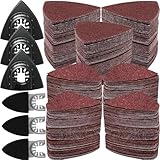
| Occasional DIY, a few jobs a year | One universal pad + 50-piece assorted sheets (~$15–25 total) | Cheapest coverage; pad will outlast your needs |
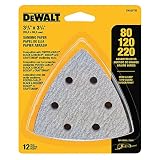
| Regular remodel work | DeWalt OEM pad ×2 + bulk sheets in 80/120/220 | Denser hooks survive daily sheet swaps; spare pad avoids downtime |
| Curved trim, profiles, contours | Add a foam interface/contour pad | Conforms to profiles a rigid pad bridges over |
| You own a Makita (or Milwaukee) multi-tool too | Universal pads and 93mm sheets only | One consumable stock fits every clamp in the kit |
| Mostly large flat surfaces | Minimal delta sheets; put the money toward a 5″ ROS | 3× the coverage, better finish — the delta pad is the wrong tool there |
Quick answers
Do Starlock pads fit a DeWalt multi-tool?
No. Starlock’s closed center can’t clear the clamp pin. Only open-back universal-mount accessories fit, on both DeWalt and Makita lever-clamp tools.
Does a DeWalt pad fit a Makita multi-tool?
Yes — both clamps use the same open-center universal standard, so 93mm triangular pads and sheets interchange freely between them.
Does the sheet’s hole pattern have to match the pad?
Only if your tool has a dust-extraction shoe. On standard DeWalt and Makita oscillating tools there’s no extraction through the pad, so perforated and solid sheets perform identically.
How many sheets does a typical job use?
Budget one to two sheets per stair tread, one per door edge, and three to four for a small cabinet interior, assuming you swap as soon as cutting slows rather than pushing harder.