Best Jointers with Spiral Cutterheads for Small Shops
What's inside
As an Amazon Associate I earn from qualifying purchases. This post may contain affiliate links at no extra cost to you.
Contents
Why a Spiral Cutterhead Matters on a Jointer
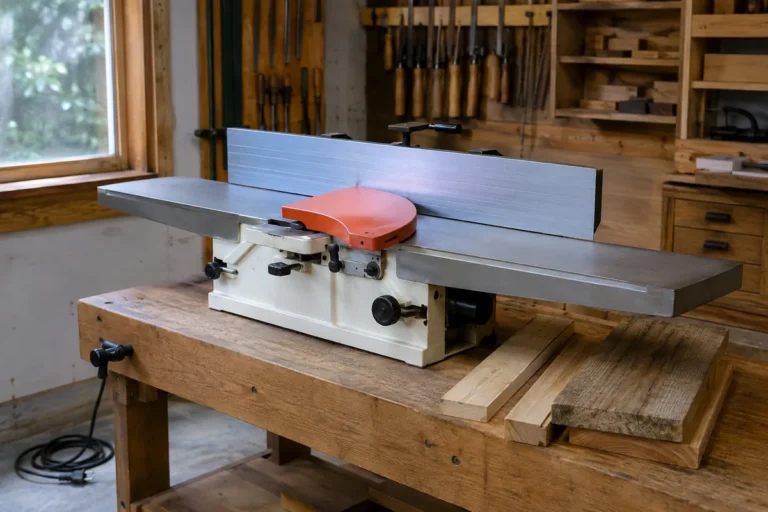
A spiral or helical cutterhead doesn’t make a jointer cut flatter. Flat comes from bed length and table co-planarity. What it does change is surface quality, noise, and maintenance, and on a jointer those three matter more than on almost any other machine.
A traditional straight-knife jointer has 3 knives that take a full-width shaving. A spiral head has 26 to 40 small carbide inserts arranged in a spiral pattern, each taking a small, shearing cut. The practical differences are immediate. Tearout on figured maple, cherry, or reversing grain drops dramatically. Noise drops by roughly 8-12 dB — you can joint without hearing protection for a few seconds and not regret it, though you should still wear it. And when you hit a staple or a hard knot, you rotate the damaged inserts, not resharpen and reset three long knives.
As an Amazon Associate we earn from qualifying purchases at no extra cost to you.
The cost is higher upfront. Expect a $80 to $150 premium over straight knives on a 6-inch benchtop and $200 to $400 on an 8-inch floor model. Carbide inserts last 10x to 20x longer than HSS knives in clean hardwood, but they are not immortal. Budget $55 to $90 for a full set of 4-sided inserts and expect to rotate them every 300-500 board feet in abrasive woods like white oak or hickory. Failure mode to watch: an insert not fully seated or torqued correctly leaves a distinct line down the board. Always clean the pocket, use a torque driver if the manual specifies one (typically 45-55 in-lbs), and check that each insert sits flat.
6-Inch vs. 8-Inch: The Real Small-Shop Decision
For most small shops, this is the only choice that really matters. A 6-inch jointer can face-joint boards up to 5-3/4 inches wide. An 8-inch handles 7-3/4 inches. That 2-inch difference determines whether you can flatten a typical 6 to 8 inch wide hardwood board in one pass or have to rip it, joint in two passes, or use a planer sled.
Bed length is the second constraint. Benchtop 6-inch jointers have beds around 30 to 36 inches long. A floor-standing 8-inch jointer is 72 to 76 inches long. On a 30-inch bed, you can reliably flatten stock up to about 36 inches long. Beyond that, the board tips and you introduce bow. On a 72-inch bed, you can handle 5 to 6 foot boards without roller stands and tricks.
Power and circuit are the trade-off. Most 6-inch benchtop spiral jointers run on a 10-13 amp, 120V universal motor (roughly 1 HP). They will joint 1/16 inch off soft maple all day, but take a 1/8 inch cut in 6-inch wide hard maple and they bog down and leave scallops. Floor-standing 8-inch machines use a 1.5 to 2 HP induction motor, often dual-voltage 120V/240V. On 240V they hold speed under load and cut cleaner in hardwoods. If you only have 120V/15A circuits and no 240V, a 6-inch is the practical ceiling unless you want to run a new circuit.
If you primarily build boxes, cutting boards, and small furniture from 4/4 stock under 48 inches long, a 6-inch spiral jointer is fine and saves 6 to 8 square feet. If you build tables, doors, or work with roughsawn 6 to 8 inch wide boards over 4 feet long, the 8-inch pays for itself in time and waste. The cheaper option is not underpowered — it’s just capacity-limited.
What to Look for Besides the Cutterhead
Not all spiral heads are equal. The best value heads use 4-sided carbide inserts, 15x15x2.5mm, available from multiple suppliers. Two-sided inserts are cheaper to replace per edge but you get half the rotations. Also check insert layout: more inserts (36-40 on an 8-inch) gives a finer finish with less scalloping, especially at higher feed rates.
Tables and fence matter more than marketing suggests. Look for cast iron tables, not aluminum, on any floor-standing machine. Cast iron stays flatter and damps vibration. Check that the infeed table moves smoothly with minimal backlash and locks solid without lifting. A common failure on benchtop jointers is table sag at full extension — put a straightedge across both tables, it should be co-planar within 0.003 to 0.005 inch end-to-end. If not, you will never get a flat board regardless of cutterhead.
Fence quality separates usable from frustrating. A good fence locks at 90 degrees without deflection and stays there. On benchtop models, the aluminum fence often flexes 0.010 inch or more when you press stock against it, which creates tapered edges. Test it by locking at 90, then pushing laterally near the top. If it moves visibly, you will be fighting it forever. Floor models with a rack-and-pinion or heavy cast fence are worth the floor space for this reason alone.
Dust collection is not optional with a spiral head. The small chips pack densely and will clog a 2-1/2 inch port quickly. A 4-inch port connected to a 400+ CFM collector keeps the cutterhead cavity clear. Without it, chips recut, inserts dull faster, and you get a hazy finish.
Comparison: Benchtop 6-Inch vs Floor 6-Inch vs Floor 8-Inch Spiral Jointers
| Type | Bed Length | Motor / Power | Cutterhead | Best For | Downsides |
|---|---|---|---|---|---|
| 6-Inch Benchtop Spiral | 30-36 in. | 10-13A, 120V (~1 HP) universal | 26-30 inserts, 2 or 4-sided | Tight shops, boards <48 in., budget under $600 | Short bed, fence flex, bogs on wide hardwoods |
| 6-Inch Floor Spiral | 55-60 in. | 1-1.5 HP induction, 120V/240V | 30-36 inserts, 4-sided | Small furniture, longer boards on a budget | Still limited to 6 in. width |
| 8-Inch Floor Spiral | 72-76 in. | 1.5-2 HP induction, 240V preferred | 36-40 inserts, 4-sided | Full-size furniture, 6-8 in. roughsawn stock | Needs 240V, 250+ lbs, $900-$1,500+ |
If you can fit the 72-inch bed and have 240V, the 8-inch floor model is the buy-once choice. If you cannot, the benchtop 6-inch spiral still gives you 90% of the cut quality in half the footprint. The 6-inch floor model makes sense only if you find one used for close to benchtop pricing — new, the jump to 8-inch is usually only $200 to $300 more.
Which Jointer Should You Buy for a Small Shop?
For a shop under 200 square feet with a single 120V circuit, get a 6 inch benchtop spiral jointer. You will be able to mill S4S lumber and flatten narrow roughsawn boards without wrestling a 300-pound machine. Keep cuts to 1/32 to 1/16 inch per pass, let the motor recover, and use a slow, steady feed. The limit is not finish quality — it is board width and length.
For a one or two-car garage shop where you can dedicate floor space, a 8 inch spiral cutterhead jointer with a long cast-iron bed is the most versatile. You can face-joint a 7 inch wide walnut board and edge-joint 6-foot rails without support tables. Look for a model with a 4-inch dust port, a cast-iron fence that locks with a lever rather than knobs, and 4-sided inserts. Wiring it for 240V is worth the effort — starting current drops and the motor holds RPM under load.
Do not pay extra for a spiral head on a machine with aluminum tables and a weak fence if a straight-knife cast-iron machine is available for the same money. The cutterhead cannot fix a flexible system. And if you already own a straight-knife jointer that is flat and solid, consider a helical spiral cutterhead upgrade for jointer heads — most 6-inch and 8-inch imports have drop-in replacements for $250 to $400. Installation takes 2 to 3 hours, requires bearing pullers and careful torque, but is cheaper than a new machine.
Final check before you buy: measure your longest typical board, add 12 inches, and compare to bed length. If your boards are longer than the bed, you will fight snipe and bow. Also verify your dust collector hose size and your circuit — a 2 HP jointer on a 15A 120V circuit shared with lights will trip breakers on startup. Buy for capacity and infrastructure first, cutterhead second.