Best Band Saws for Resawing Dense Exotic Hardwood
What's inside
As an Amazon Associate I earn from qualifying purchases. This post may contain affiliate links at no extra cost to you.
Resawing dense exotic hardwood is one of the hardest jobs for a woodworking band saw. The cut is tall, the blade stays engaged for a long time, and species such as ebony, jatoba, ipe, cocobolo, and bubinga punish weak machines. A saw that handles pine comfortably can stall, wander, or overheat when asked to split a 10-inch board.
The best choice is usually a stationary saw with a rigid frame, a large cast-iron table, strong blade tension, and enough motor power to maintain blade speed under load. For serious work, start by comparing 14-inch band saws with 1.5-hp motors. Smaller benchtop machines can work for thin stock, but they are a poor fit for repeated tall resawing.
As an Amazon Associate we earn from qualifying purchases at no extra cost to you.
Contents
What Makes Exotic Hardwood Difficult to Resaw
Dense hardwood demands more cutting force than ordinary domestic species. The blade must remove a continuous kerf through the full height of the board, so friction and heat build quickly. A 1-inch-thick cut in maple is manageable on many machines; an 8-inch cut in dry ipe is a different job entirely.
The common failure modes are easy to recognize. The motor slows and the blade begins burning the wood. The blade deflects away from the fence, producing a tapered board. Teeth dull quickly, increasing heat and feed pressure. A poorly tensioned blade may flutter or come off the wheels. Dense lumber can also contain internal stress that causes the kerf to close and pinch the blade near the end of the cut.
Dust is another concern. Exotic hardwood dust can be irritating or allergenic, and some species produce very fine particles. Use a dust collector connected at the lower wheel housing, wear eye protection, and use respiratory protection appropriate to your shop.
Features That Matter Most
Motor power: A true 1.5-hp motor is a practical minimum for frequent resawing of dense stock. A 2-hp machine gives more margin when cutting 8- to 12-inch boards, especially if the wood is wet, twisted, or unusually hard. Motor horsepower alone is not decisive; belt drive, wheel diameter, blade speed, and mechanical rigidity matter just as much.
Frame rigidity: A cast-iron or welded-steel frame resists flex when the blade is tensioned properly. Flexing changes the wheel alignment and can make a straight cut impossible. Be cautious with lightweight saws that advertise large cutting capacity but have thin stamped stands or small adjustment hardware.
Resaw height: Look for at least 10 inches of usable capacity for furniture work. Twelve inches is more useful if you routinely work with thick slabs. Capacity is only valuable if the upper guide post, blade guides, and frame remain rigid at full extension.
Blade tension: The saw should have a reliable tensioning mechanism and a frame capable of holding tension without bowing. Many built-in tension scales are approximate, so verify tension with a gauge if you do demanding work. A wide blade typically needs more tension and benefits from a sturdier frame.
Wheel size and tires: Fourteen-inch wheels are a sensible starting point. Larger wheels generally produce a smoother blade path and reduce fatigue on wide blades, although they make the machine larger and more expensive. Tires must be crowned, clean, and properly seated; a damaged tire can cause tracking problems that look like a blade defect.
Which Band Saw Size to Buy
| Machine type | Best use | Typical limitation | Verdict for dense hardwood |
|---|---|---|---|
| 9- to 10-inch benchtop | Small parts and curves | Low power, limited resaw height | Fine for occasional cuts under about 4 inches |
| 14-inch, 1 to 1.5 hp | General furniture work and moderate resawing | May struggle with very tall, hard stock | Best value for most serious hobby shops |
| 14-inch, 1.75 to 2 hp | Frequent resawing and thick exotic lumber | Higher cost and electrical demand | Strong all-around choice |
| 18-inch, 2 to 3 hp | Wide slabs and production resawing | Large footprint and more expensive blades | Worthwhile for sustained heavy use |
A quality 14-inch machine with a 1.5- to 2-hp motor is usually the sweet spot. The cheaper option is fine if your work consists of occasional veneer cuts, instrument parts, or boards no thicker than 4 to 6 inches. Spend more on an 18-inch saw only when you need its extra resaw height, wheel capacity, or production durability.
Blade Selection Is as Important as the Saw
For resawing, use a wide blade with a low tooth count. A 1/2-inch, 3-tooth-per-inch blade is a useful general choice for stock around 6 inches thick. A 3/4-inch blade with 2 or 3 teeth per inch can track more steadily in taller cuts, but it requires a machine that can tension it correctly. If the saw is marginal, a 1/2-inch blade may cut better than an under-tensioned 3/4-inch blade.
Skip-tooth or hook-tooth blades clear chips more effectively than fine-tooth blades. Hook teeth feed aggressively, but they also increase the chance of grabbing thin or stressed stock. For very dense material, a premium bi-metal blade can justify its price because it stays sharp longer and tolerates heat better than a basic carbon-steel blade. Keep several blades available rather than forcing one dull blade through every species; bi-metal resaw blades are a sensible upgrade for repeated work.
Setup and Cutting Technique
Before cutting, flatten one face and joint one edge if possible. Mark the intended cut on both ends of the board. Install the blade with the teeth pointing in the correct direction, tension it, and set the side guides and thrust bearing just behind the blade without touching it during free running.
Use a tall resaw fence or a point fence, depending on the cut. A tall fence provides support for stable boards; a point fence can make it easier to steer around natural drift. Do not rely on the factory fence if it is too short or flexes under hand pressure. A featherboard can help on narrow, uniform stock, but never use one if it could trap a closing kerf against the blade.
Feed steadily rather than slowly stopping and starting. A practical starting rate is roughly 1 to 3 inches per second, then adjust by sound and motor load. If the motor note drops sharply, reduce feed pressure. If the cut burns despite a sharp blade and moderate feed, check blade tracking, guide adjustment, dust buildup, and whether the blade is too fine.
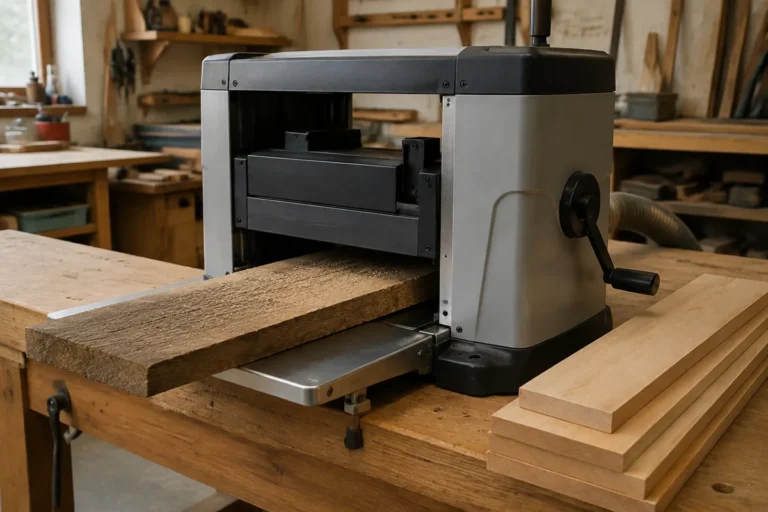
For boards wider than the machine’s comfortable capacity, make a shallow relief cut first or reduce the stock thickness at the planer. A planer can also remove the saw marks after resawing, but allow extra thickness for cleanup—often 1/16 to 1/8 inch per face depending on the cut quality.
Buying Recommendation
For most woodworkers, choose a rigid 14-inch floor-standing band saw with at least 1.5 hp, 10 inches or more of resaw capacity, a 1/2- to 3/4-inch blade capability, and a solid cast-iron table. If you regularly resaw thick ipe, ebony, or large slabs, move to a 2-hp machine rather than expecting a small saw to compensate with a slower feed. A 2-hp 18-inch band saw is justified for high-volume work, but it is unnecessary for occasional hobby use.
Do not overlook used machines. A clean older saw with rigid wheels, good bearings, and a solid frame can outperform a new lightweight model. Budget for new tires, a quality blade, and possibly a better fence. Those parts often improve resawing more than a modest increase in advertised horsepower.