Table Saw Sliding Table vs Crosscut Sled for Furniture Parts
What's inside
As an Amazon Associate I earn from qualifying purchases. This post may contain affiliate links at no extra cost to you.
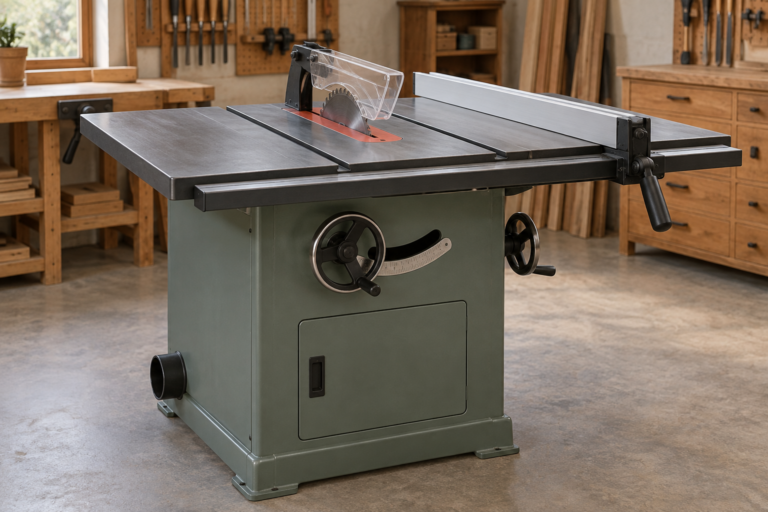
For furniture parts, both a table saw sliding table and a crosscut sled can produce accurate 90-degree cuts. They do not solve the same problems, though. A sliding table is better for supporting large panels and feeding awkward work smoothly. A well-built crosscut sled is usually the better value for repeatable crosscuts on smaller parts.
The right choice depends less on the saw’s advertised capacity than on the size, weight, and number of parts you cut. A sled can make a contractor-style saw behave like a precision crosscut machine. A sliding table can make cabinet panels and long boards safer and easier to control.
As an Amazon Associate we earn from qualifying purchases at no extra cost to you.


Contents
How the Two Systems Work
A crosscut sled is a plywood or phenolic platform that rides in the table saw’s miter slots. The workpiece rests on the platform and is pushed through the blade with a fixed fence holding the cut line square. The sled stays on the saw table while the stock moves with it.
A sliding table is a separate carriage, usually mounted beside the blade or attached to the saw’s existing table. The workpiece is clamped to a fence on the carriage, and the carriage travels through the cut. Depending on the design, it may have a long crosscut fence, a telescoping extension, or a scoring blade for panel saw-style work.
Both systems improve control compared with using the stock miter gauge. The important difference is support: a sled supports the work on a broad platform, while a sliding table supports and carries the workpiece itself.
Comparison for Furniture Parts
| Factor | Crosscut sled | Sliding table |
|---|---|---|
| Typical cost | About $50–$200 in materials or for a ready-made sled | About $200–$1,500 or more, depending on saw and construction |
| Best work size | Small and medium parts, commonly up to 24 inches wide | Large panels, long rails, and heavy workpieces |
| Accuracy | Excellent after careful setup | Excellent, with less dependence on operator pressure |
| Setup | Build and calibrate once; easy to store | May require alignment, installation, and floor space |
| Repeat cuts | Very good with a stop block or flip stop | Excellent with a built-in scale and stop system |
| Small parts | Very good, especially with a zero-clearance kerf | Good, but clamping and keeping parts against the fence can take longer |
| Large panels | Awkward unless the panel is already well supported | Much easier and safer |
When a Crosscut Sled Is the Better Buy
Choose a sled if your furniture work consists mainly of drawer parts, cabinet rails and stiles, face-frame pieces, shelves, and small case components. A 24-inch-wide sled is enough for many of these jobs, while a 30-inch sled gives more support but becomes heavy and harder to store.
The main advantage is repeatability at low cost. A properly calibrated fence can hold cuts within a few thousandths of an inch across a typical furniture part. That accuracy is only useful if the sled remains square. Check it with the five-cut method, then lock or glue the fence after calibration. Do not trust the edge of a cheap plywood fence to stay straight forever; a hardwood or aluminum-reinforced fence is more stable.
A zero-clearance sled also reduces tear-out on the underside of plywood and helps prevent narrow offcuts from falling into the throat opening. Add a replaceable insert or sacrificial top layer if you expect to cut many parts.
For a ready-made option, compare table saw crosscut sleds. A purchased sled saves building time, but inspect the runner adjustment and fence before assuming it is square. Many need final calibration on your saw.
When a Sliding Table Makes Sense
A sliding table earns its cost when you regularly cut full or half sheets, wide cabinet sides, long boards, or heavy hardwood parts. Supporting a 30-by-60-inch panel on a conventional table saw can require an outfeed table, side table, and a second person. A sliding carriage keeps the panel supported as it approaches and passes the blade.
It also reduces a common failure mode: the operator pushes hard against the fence near the end of a cut, causing the panel to pivot or the cut to drift. With the work clamped to a sliding fence, the carriage controls the travel and the operator applies less sideways pressure.
Look for a carriage with a rigid fence, a positive 90-degree stop, an adjustable scale, and enough travel for your parts. A short carriage may be little more useful than a sled. For cabinet work, at least 40 inches of usable crosscut capacity is practical, while larger panels may justify 60 inches or more.
Full-size sliding tables also need room around the saw. A carriage that extends 5 feet to the left or right can make a cramped shop difficult to use, even when it performs well. Before buying, measure the carriage’s travel in both directions and account for the panel overhang.
Accuracy and Safety Limitations
Neither accessory automatically makes a saw accurate. Check the blade parallelism to the miter slots, inspect the blade for runout, and make sure the fence is aligned so the work does not pinch the blade. A sled with loose runners can produce a tapered cut; a sliding table with poor adjustment can rock or bind during travel.
Do not use a stop block on the offcut side of a through-cut. The trapped offcut can bind between the blade and stop, creating kickback. Put the stop on the side that remains attached to the workpiece, or use a stop that ends before the blade path. For narrow parts, keep fingers well away from the blade and use a hold-down or clamp where practical.
Crosscut sleds can be particularly safe for small parts because the operator’s hands stay on the platform and fence area. However, a very large sled becomes tiring to push and can catch on an uneven saw table. Sliding tables reduce handling problems with large stock, but the blade is still exposed and the work must be clamped securely.
Which One Should You Buy?
For most furniture makers with a limited budget, build or buy a quality crosscut sled first. Spend the savings on a sharp combination or crosscut blade, a reliable stop block, and adequate outfeed support. This setup is sufficient for accurately cutting most rails, stiles, shelves, drawer boxes, and small panels.
Consider a table saw sliding table attachment when large panels are a regular part of your work, not an occasional inconvenience. If you routinely process sheet goods, a panel-cutting sliding table can save handling effort and reduce damaged edges.
The cheaper option is fine when your parts are short, your material is manageable, and you are willing to build a sled accurately. A sliding table is a productivity and support upgrade, not a requirement for precision furniture work.