How to Choose Jointer Table Width for Cabinet Stock
What's inside
As an Amazon Associate I earn from qualifying purchases. This post may contain affiliate links at no extra cost to you.
Contents
Why Jointer Width Matters
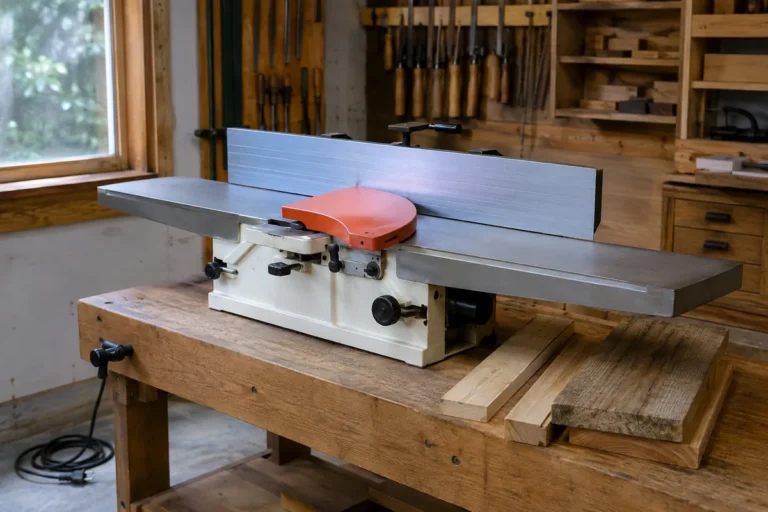
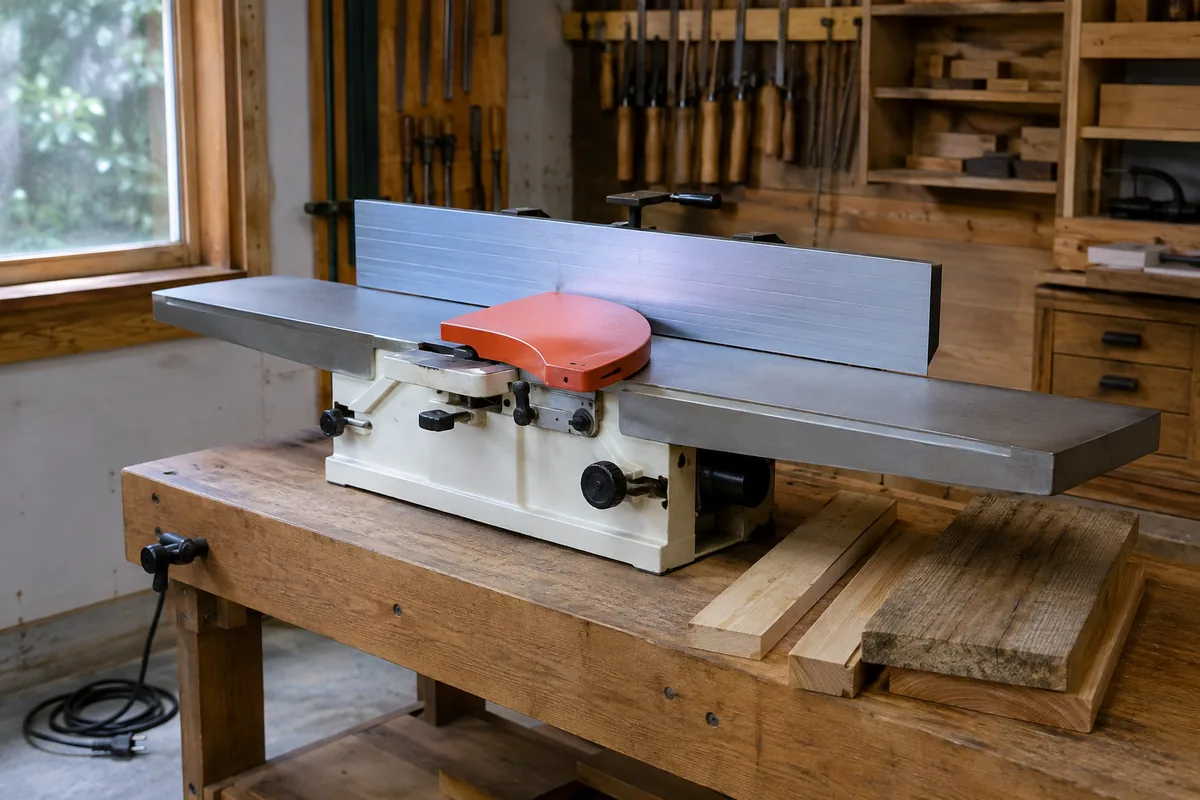
A jointer establishes one flat face and one straight edge on rough lumber. Its table width determines the widest board you can safely and accurately flatten in a single pass. For cabinet work, that number matters most when you are preparing wide door parts, case sides, shelves, and glue-up panels.
The common mistake is buying a jointer based only on the width of individual boards. A 6-inch jointer may handle most narrow cabinet rails, stiles, and face-frame stock, yet become limiting when you work with 8-inch or wider boards. An 8-inch jointer gives substantially more room without requiring the floor space, electrical service, and budget of a 12-inch machine.
Jointer width is not the same as cutting capacity on a planer. A planer can reduce thickness on boards wider than its stated capacity only if they fit under the cutterhead. A jointer cannot flatten a board wider than its tables and cutterhead in one normal operation.
Match Jointer Width to Cabinet Parts
Start with the widest solid boards you expect to use, not the finished width of the cabinet. If a cabinet side will be made from a 9-inch board, you need a method for flattening a board at least that wide before it reaches the planer. If you buy rough boards at 6 inches wide or less, a 6-inch jointer may be entirely adequate.
| Jointer width | Typical cabinet work | Main limitation |
|---|---|---|
| 6 inches | Face frames, narrow rails and stiles, small panels, most milled strips | Cannot flatten many wide case sides or door boards in one pass |
| 8 inches | General cabinetmaking, wider door parts, shelves, and moderate panel stock | Still too narrow for some 10- to 12-inch boards |
| 12 inches | Wide cabinet sides, large doors, furniture panels, and frequent solid-wood production | Higher cost, larger footprint, and more demanding material handling |
| 16 inches or more | Large furniture parts and production work | Usually excessive for a small cabinet shop or occasional projects |
Remember that a nominal 8-inch jointer may have a practical capacity slightly below 8 inches, depending on the cutterhead design and manufacturer. Leave some margin rather than planning to flatten material exactly at the advertised limit.
Why an 8-Inch Jointer Is Often the Sweet Spot
For a serious home shop, an 8-inch jointer is often the most balanced choice. It handles common rough-sawn cabinet lumber while remaining manageable in a garage or basement shop. Its tables are usually long enough for cabinet parts, and replacement knives or cutterhead inserts are easier to source than parts for less common sizes.
An 8-inch machine is especially sensible if you buy rough lumber in the 6- to 8-inch range and build cabinets from multiple narrow boards. It also gives useful flexibility for solid-wood doors and shelves without forcing you to move a much heavier machine.
If most of your stock is already surfaced or comes from a supplier in narrow widths, a 6-inch machine can save money and space. The cheaper option is fine when you are willing to design around narrower boards, joint one edge at a time, or glue up panels from strips that fit the machine.
Browse 8-inch jointers carefully, since “8-inch” does not tell you whether the machine has enough table length, a rigid fence, or reliable adjustment controls.
When a 12-Inch Jointer Is Worth Buying
Choose a 12-inch jointer when wide solid stock is a routine part of your work rather than an occasional problem. It can flatten many boards used for cabinet sides, wide doors, and furniture tops without resorting to workarounds. The extra width also reduces the need to rip a rough board into narrower pieces before jointing.
The trade-off is substantial. A 12-inch machine is heavier, more expensive, and harder to move. Long tables need clear space on both sides, and the cutterhead may require a larger dust collector. You also need enough outfeed room to support long boards without letting them tip as they leave the table.
Do not buy a 12-inch jointer merely because wider sounds better. A jointer does not replace a planer, and it does not make wide boards easy to handle. A twisted 12-inch board still requires careful support and multiple light passes. If you rarely process boards over 8 inches, the money may be better spent on a good planer, dust collection, or a more rigid 8-inch jointer.
Ways to Handle Stock Wider Than the Jointer
The most practical alternative is to rip a wide board into narrower pieces, joint the pieces, plane them to equal thickness, and glue them back together. This works well for cabinet sides and panels, but it changes the appearance of the grain and adds glue joints. It also wastes some material at the saw kerf and may expose internal defects.
Another option is a router sled. A sled and surfacing bit can flatten panels wider than the jointer, but the process is slower and leaves ridges that require sanding or a light planer pass. The panel must be supported so it cannot rock, and a dust collector is strongly recommended.
A thickness planer with a sled can also flatten wide boards. This is useful when the board is too twisted to sit securely on a jointer, but the setup takes time and reduces the planer’s normal production speed. A hand plane remains effective for small parts and corrections, although it requires practice and sharp blades.
For occasional oversized work, using a local cabinet shop or lumber supplier for flattening is often cheaper than buying a larger machine.
Width Is Not the Only Specification
Table length matters when jointing cabinet boards. A short table may handle a wide board but struggle to straighten a long one. For typical cabinet stock, longer infeed and outfeed tables make it easier to maintain a consistent cut and avoid a tapered edge.
Fence rigidity is equally important. A fence that flexes when you press a board against it can produce an edge that is not square to the face. Look for a fence that locks solidly at both ends and stays square through its adjustment range.
Cutterhead style affects maintenance rather than maximum width. A helical cutterhead jointer generally runs more quietly and makes insert replacement convenient, while straight knives are often cheaper to sharpen or replace. Neither design allows you to joint stock wider than the machine’s stated capacity.
Finally, measure the complete machine footprint, including infeed and outfeed clearance. A jointer that fits against a wall may be unusable if a 7-foot cabinet board cannot pass through it. For most cabinetmakers, choose the narrowest jointer that comfortably handles the widest stock you routinely buy, then use ripping, glue-ups, or a router sled for rare exceptions.