Ball-Bearing Band Saw Guides vs Block Guides for Hardwood
What's inside
As an Amazon Associate I earn from qualifying purchases. This post may contain affiliate links at no extra cost to you.
For hardwood band-saw work, the guide system affects cut accuracy, blade life, and how often you have to stop and adjust the machine. Ball-bearing guides are the common upgrade on mid-range and premium saws, while traditional block guides remain useful because they are simple, inexpensive, and forgiving of dust.
Neither system automatically makes a band saw cut straight. Blade tension, wheel alignment, drift, tooth selection, and the condition of the tires matter just as much. But the guide choice becomes noticeable when resawing wide boards, cutting dense species such as maple or hickory, or using a narrow blade for curves.
As an Amazon Associate we earn from qualifying purchases at no extra cost to you.



Contents
How the Two Guide Systems Work
Block guides support the blade with small blocks above and below the table. The blocks may be graphite-impregnated hardwood, composite material, ceramic, or another wear-resistant material. They are adjusted close to the blade, usually with a small clearance on each side and behind the blade.
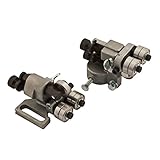
Ball-bearing guides use rotating bearings to contact, or nearly contact, the blade. Most systems have two side bearings and a thrust bearing behind the blade, with a matching set below the table. The bearings support the blade while allowing it to move with less sliding friction.
Both systems are designed to prevent the blade from twisting or wandering under load. They are not substitutes for correct blade tension. If the blade is under-tensioned, has damaged teeth, or is too narrow for the job, better guides only make the resulting problem more expensive.
Performance in Hardwood
Ball bearings generally handle sustained hardwood cutting better. When resawing a 6-inch or 8-inch board, the blade can press firmly against the side guides for long periods. A bearing rolls against that load, while a block rubs continuously. The difference is most obvious during long cuts in dense stock and when the guides must be set very close to the blade.
Blocks can still produce excellent results. Properly adjusted blocks support the blade over a broad contact area and can damp vibration effectively. Many experienced woodworkers prefer them for resawing because they are quiet, uncomplicated, and inexpensive to replace. A clean, correctly set block guide is more accurate than a poorly adjusted bearing guide.
Bearings also have limits. Fine hardwood dust can work into inexpensive sealed bearings, and a bearing that develops play can push the blade sideways rather than guide it. A seized bearing acts much like a block, but with a small hard contact area that can heat the blade or mark its surface. Check that every bearing spins freely before using the saw.
Ball-Bearing vs. Block Guides
| Factor | Ball-bearing guides | Block guides |
|---|---|---|
| Hardwood resawing | Good for long, continuous cuts and high side loads | Good when adjusted correctly; may wear faster |
| Adjustment | Usually quick, but several bearings must be aligned | Simple, though clearances must be set carefully |
| Dust tolerance | Bearings can eventually become noisy or rough | Blocks tolerate dust well but need cleaning |
| Noise and friction | Low friction when bearings are healthy | More rubbing, especially during heavy cuts |
| Cost | Higher initial and replacement cost | Usually the cheaper option |
| Maintenance | Inspect for play, seized bearings, and loose hardware | Replace worn or burned blocks and reset clearance |
When Block Guides Are Enough
Choose blocks without hesitation if you mostly cut curves, resaw boards under about 4 inches wide, or use the band saw intermittently. For a hobbyist cutting pine, oak, walnut, and ordinary furniture parts, the performance difference may not justify an upgrade.
Blocks are also a sensible choice on a smaller saw with limited power. A guide upgrade cannot compensate for a motor that stalls in 6/4 hardwood. Put the money toward a sharp blade, a properly sized dust-collection hose, or a stronger fence first. A quality band saw block guide set is often all that is needed for routine work.
Use the clearance recommended by the guide manufacturer, commonly around 0.005 to 0.015 inch for the side guides, rather than clamping the blocks against the blade. The rear guide should sit just behind the blade’s teeth and move toward the blade only when cutting pressure makes contact necessary. Blocks that are too tight create heat and unnecessary friction.
When Ball Bearings Are Worth It
A bearing system is worth considering when you regularly resaw hardwood, run the saw for long periods, or need quick repeatable adjustments for different blade widths. It is particularly useful if the factory blocks are soft, difficult to align, or prone to burning during heavy cuts.
Look for a system with rigid mounts, properly sized bearings, and enough adjustment range for the blades you use. A guide that accepts only one narrow blade is a poor upgrade if you switch between a 1/4-inch curve blade and a 3/4-inch resaw blade. Universal band saw ball-bearing guide kits can work, but verify the mounting dimensions and shaft arrangement before ordering.
Do not assume more bearings always means better support. The side bearings should be aligned with the blade body, not the teeth, and the thrust bearing should contact the back of the blade only under cutting load. If the side bearings sit against the teeth, they can damage the set and make the blade cut narrower than intended.
Setup and Failure Modes
Before adjusting either guide type, install the blade you intend to use, tension it correctly, and track it on the wheel. Set the guides close to the blade only after the blade is tracking properly. Rotate the wheels by hand and confirm that the blade does not strike a guide every revolution.
A common hardwood failure is a blade that drifts toward the fence halfway through a resaw cut. Guides may reduce the movement, but the usual causes are insufficient tension, a dull or unevenly sharpened blade, excessive feed pressure, or a fence that is not aligned for the blade’s drift. Another failure is a burn mark on one side of the cut. Check for a seized bearing, a block set too tight, or a blade with too few teeth for the material.
For most stationary woodworking machines, the practical buying decision is simple: keep blocks when the saw is used for ordinary curves and occasional resawing; choose bearings when hardwood resawing is frequent and guide friction is a real limitation. In either case, pair the guides with a sharp, appropriate blade—often a 3- or 4-teeth-per-inch hook or variable-tooth resaw blade for thick hardwood—and clean the guide area after each session.