Best Jointers for Flattening Boards with Mild Cup
What's inside
As an Amazon Associate I earn from qualifying purchases. This post may contain affiliate links at no extra cost to you.
Contents
What a Jointer Can—and Cannot—Do
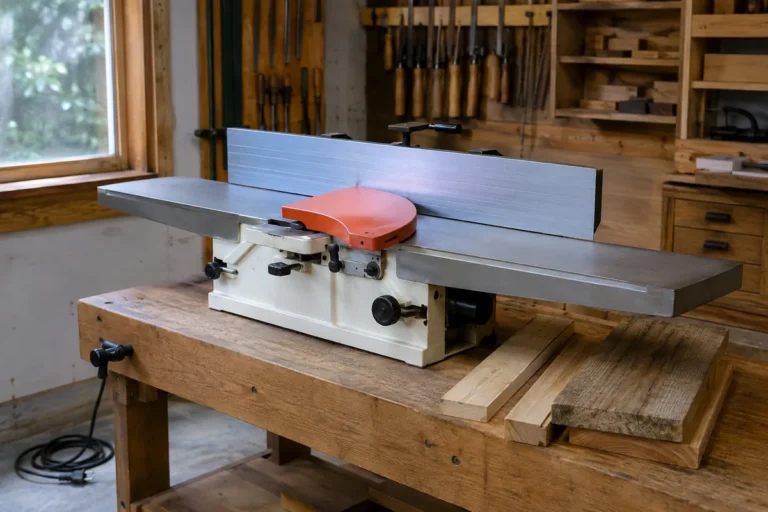
A jointer is useful for flattening a board with a mild cup, but only when the cup is shallow enough to control safely. The machine flattens one face and creates a straight reference edge. It does not reliably flatten badly warped stock, and it is not a replacement for a planer when both faces need to be parallel.
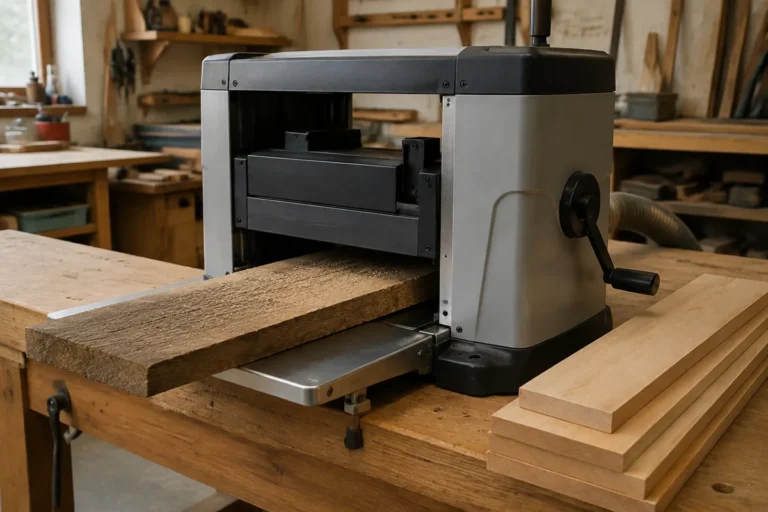
For a board that rocks slightly on a flat surface but has no severe twist, a jointer with a 6-inch or wider cutterhead is usually the right stationary machine. The jointer removes material from the underside of the cup until the board sits flat. You then run that reference face against the planer bed to bring the opposite face parallel.
As an Amazon Associate we earn from qualifying purchases at no extra cost to you.

Do not try to joint a board with a deep cup by pressing it flat over the knives. The pressure disappears as the board leaves the infeed table, and the cutter can lift or grab the stock. The result may be a tapered board, an uneven surface, or a dangerous kickback.
Best Jointer Types for Mild Cup
| Jointer type | Typical width | Best use | Main trade-off |
|---|---|---|---|
| Benchtop jointer | 6 inches | Short boards, occasional flattening, limited shop space | Short tables and limited depth control make long boards harder |
| Floor-standing parallelogram jointer | 6 to 8 inches | Furniture parts, cabinet stock, regular use | Costs more and takes permanent floor space |
| Helical or spiral-head jointer | 6 to 8 inches | Frequent use, figured wood, lower noise | Higher purchase price; inserts still need occasional replacement |
| Wide jointer | 10 to 12 inches | Wide panels and large solid-wood parts | Expensive, heavy, and often unnecessary for ordinary boards |
For most home shops, a 6-inch benchtop jointer is the least expensive workable choice. It is fine for table legs, shelves, face frames, and boards under roughly 4 feet long. The short tables become a limitation on longer lumber because the machine gives the board less support before and after the cutterhead.
A floor-standing parallelogram jointer is the better buy if you regularly process 6- to 8-foot boards. Its longer tables make it easier to maintain a straight face, and the table adjustment is generally more convenient. Look for a model with tables at least 60 inches long, a usable fence that locks square, and a dust port that matches your collector.
Straight Knives or Helical Head?
Straight knives are not automatically a poor choice. A properly aligned two- or three-knife cutterhead cuts quickly and is inexpensive to sharpen or replace. For common pine, poplar, oak, maple, and construction lumber, straight knives can produce an excellent surface.
A helical or spiral cutterhead uses many small carbide inserts. It usually runs quieter, handles reversing grain with fewer noticeable tear-outs, and lets you rotate an insert when one edge is damaged. Those advantages matter when flattening figured hardwood or reclaimed boards. They do not make a jointer immune to poor technique, and they add substantially to the price.
If you use the machine only a few times a month, put the money into longer tables and a better fence before upgrading to a cutterhead. If noise, tear-out, and frequent knife maintenance are persistent problems, compare 6-inch helical-head jointers.
How to Flatten a Mild Cup
Start by checking the board with winding sticks, a straightedge, or a flat workbench. Mark the concave face with pencil lines. A mild cup is generally manageable when the board has about 1/16 inch of gap across its width and does not rock significantly from corner to corner. There is no universal cutoff, but a board with a 1/4-inch cup needs a different plan, not more aggressive passes.
Place the concave face down on the infeed table. The two edges should rest on the table while the center remains slightly raised. Use push blocks that apply pressure over the supported area, not directly over the unsupported center. Take light cuts—about 1/32 inch at first, then 1/64 inch as the board begins to stabilize.
At the beginning of the cut, keep downward pressure on the infeed side. Once about 6 inches of board has passed the cutterhead, shift pressure to the outfeed table. Do not push down on the still-uncut section after it reaches the cutter; that can force a hollow into the face.
Make repeated passes until the pencil marks disappear from the high areas. Stop as soon as the face is flat enough for the planer. Removing an extra 1/8 inch simply to make the surface look perfect wastes material and can leave you with a board too thin for the project.
Features Worth Paying For
Table flatness and alignment matter more than motor horsepower. A 1-1/2 to 2 horsepower motor is adequate for a 6-inch jointer in a small shop. The infeed table should adjust smoothly and hold its setting without creeping. Check that the outfeed table is level with the knife cutting circle; a low outfeed table creates a snipe-like dip at the end of the board.
The fence should tilt at least 45 degrees and lock without moving as pressure is applied. A narrow, flexible fence is frustrating when jointing an edge. A machine with a 2-1/2-inch dust port can work with a shop vacuum for light shavings, but a 4-inch port is preferable for a floor-standing machine and sustained use.
For longer stock, prioritize 8-inch floor-standing jointers over extra motor power. The wider cutterhead lets you flatten wider boards in fewer passes, but it does not solve twist. Check twist separately and remove it gradually rather than chasing one corner with deep cuts.
When a Jointer Is the Wrong Tool
A board with severe cup, bow, or twist may be unsafe or wasteful on a jointer. For those pieces, use a planer sled to establish one flat face, or rip the board into narrower strips at the table saw and glue them back together. A sled supports the board while shims hold it stable; once one face is flat, remove the shims and plane the opposite face.
If you mostly buy already-flat boards, a planer may be more useful than a jointer. If you build from rough lumber, a jointer is the better first machine for establishing a reference face and edge. The cheaper benchtop option is fine when your boards are short and your expectations are modest. Buy the floor-standing machine when table length, repeatability, and daily use justify its footprint.