Best Jointers with Quiet Cutterheads for Shared Workshops
What's inside
As an Amazon Associate I earn from qualifying purchases. This post may contain affiliate links at no extra cost to you.
A jointer can be one of the louder machines in a shared shop. The cutterhead is a major part of the sound, but the motor, belt, dust collector, workpiece and room all contribute. A “quiet” cutterhead can reduce the sharp impact noise of conventional straight knives; it cannot make a jointer suitable for use beside someone trying to hold a conversation.
For most buyers, the practical choice is a helical or spiral-style head with small, replaceable carbide inserts. Those terms are often used loosely, so check what the head actually contains: rows of small inserts, usually set at an angle, rather than long straight knives. The angled cuts tend to sound less harsh and leave a smoother surface, but the head costs more and still needs proper dust collection and hearing protection.
As an Amazon Associate we earn from qualifying purchases at no extra cost to you.

Contents
What “quiet” means in a jointer
Rotating inserts engage the wood gradually, instead of a full-width straight knife striking across the board at once. That can soften the cutter’s cutting noise and reduce the amount of vibration transmitted through the machine. It can also make tear-out less noticeable, particularly in figured grain. The difference varies with the head, stock and setup; published noise figures are not always measured under comparable conditions.
Do not treat a quiet cutterhead as a soundproofing fix. A jointer’s motor and dust extractor remain audible, and a board can amplify noise as it vibrates on the tables. Keep hearing protection available, especially during long sessions. If noise is the main concern, also consider where the machine sits, whether its stand is stable, and whether the dust collector can be placed farther away.
Cutterhead choices and trade-offs
| Cutterhead type | Noise and finish | Cost and upkeep | Best fit |
|---|---|---|---|
| Straight knives | Sharper cutting sound; can leave fine ridges if knives are not aligned | Lowest initial cost; sharpening or replacement and careful setting required | Budget shops and occasional use |
| Helical or spiral insert head | Often less harsh; angled cuts can improve finish on difficult grain | Higher purchase cost; rotate or replace individual inserts | Frequent use, shared spaces or figured stock |
| Aftermarket insert head | Depends on the head and installation | Can be less expensive than buying a new machine, but compatibility matters | Owners whose existing jointer is worth upgrading |
“Helical” does not guarantee a particular noise level or finish. Insert shape, spacing, cutterhead diameter, machine rigidity and feed rate matter. A poorly aligned straight-knife head can perform worse than a well-set one, while a chipped insert can leave a visible line. Before buying, check whether replacement inserts are readily available, whether each insert can be rotated independently, and what the required mounting dimensions are.
Which jointer makes sense?
For a shared workshop where the jointer sees regular use, start with a benchtop or floor-standing machine fitted with an insert head, chosen for the board width and available space. A 6-inch jointer handles many furniture parts and narrow boards; wider stock requires multiple passes on a narrower machine or a wider jointer. A wider table helps, but it also means a larger, heavier and usually more expensive machine. Check the actual table length as well as width: longer tables support long boards more reliably.
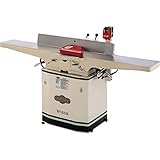
Browse 6-inch jointers with helical-style cutterheads if you want a compact machine for common small-shop work. Compare fence rigidity, table-flatness adjustment, guard movement and dust-port size—not just the cutterhead description. A fence that shifts under pressure makes accurate edge jointing difficult regardless of how quiet the head is.
If you already own a sound, compatible jointer, an insert-head conversion may be better value than replacing the whole machine. Verify the exact model, cutterhead length, bearing arrangement and drive configuration before ordering. “Fits a 6-inch jointer” is not enough to establish compatibility. Ask the cutterhead maker or seller when dimensions are unclear. An incorrectly sized head can create alignment, clearance or safety problems.
For occasional flattening of short boards, a conventional straight-knife jointer is often the sensible cheaper choice. Sharp knives set at the same height can produce very good results, and a careful setup costs less than an insert conversion. The trade-off is more involved knife maintenance and a harsher cutting sound. Consider a straight-knife benchtop jointer if purchase price and portability matter more than reducing cutter noise.
Setup matters as much as the head
Secure the jointer to a rigid stand or bench. A loose machine can rattle and make the whole room sound louder. Check the belt for wear and correct tension, tighten accessible fasteners with the machine unplugged, and make sure the fence locks firmly. Follow the manual for cutterhead and guard inspection; never run the machine with a guard removed or reach near a moving head to check for vibration.
Use sharp inserts and avoid taking unnecessarily deep cuts. For ordinary flattening and edge jointing, a light pass around 1/32 inch is a reasonable starting point; reduce it for difficult grain or a machine that struggles. Feed steadily, keep the board supported, and do not force stock through a slowing cutterhead. A dull or damaged insert can increase noise, burn the wood and leave a rough surface. Stop and inspect if the sound changes suddenly.
Dust extraction is part of the setup, not an optional accessory. Chips trapped around the cutterhead can interfere with airflow and create a mess, while a loud collector may erase some of the perceived benefit of a quieter head. Check the jointer’s port size and the collector’s airflow requirements. A reducer may connect the hose, but it does not make an undersized collector perform like a larger one.
A practical buying checklist
Before choosing, measure the longest boards you commonly joint and the space needed to feed them safely. Compare cutterhead width, table length, fence travel, machine weight and dust-port diameter. Then check the cost and availability of inserts or knives over several years, not just the sticker price. A replacement head is a poor bargain if its inserts are difficult to source.
In a shared shop, prioritize a stable machine, available replacement parts and a cutterhead that suits the amount of use. A helical-style head is a worthwhile upgrade when the jointer runs often, figured wood is common or harsh cutting noise is a real problem. For light work, a properly maintained straight-knife machine remains capable, economical and accurate. Neither option removes the need for safe feeding, dust collection and hearing protection.