How to Check Band Saw Table Squareness to the Blade
What's inside
As an Amazon Associate I earn from qualifying purchases. This post may contain affiliate links at no extra cost to you.
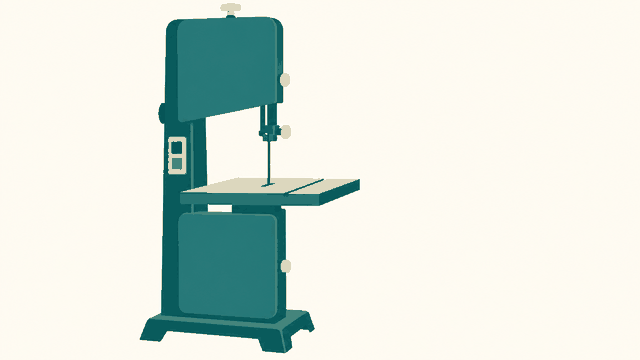
A band saw table can look square while sitting a few degrees out of alignment. That matters most when you need a cut perpendicular to the blade, such as trimming stock to length or resawing a board with a square edge. A small error can also make a supposedly straight cut drift or leave the blade rubbing one side of the table insert.
Check the table against the blade itself, not the blade guard or the saw’s frame. The blade must be properly tensioned and tracking in its normal position first; otherwise, you may square the table to a blade that moves as soon as you start cutting.
Contents
Tools to check band saw table squareness
You need a reliable square, a wrench for the table trunnion or tilt lock, and a way to hold the blade steady. A small machinist’s square is handy for fitting close to the blade, but a good combination square is usually enough. Check the square against a known straight edge or flip it against itself on a flat surface: if the edges don’t line up, don’t trust it.
A digital angle gauge can make adjustments faster, but it measures angle relative to gravity or its own reference surface—not directly between table and blade. It works well for repeating a setting after you establish a reference. For a direct check, a square is simpler. A machinist’s square is a useful upgrade if your combination square is too bulky to sit close to the blade.
| Tool | Best use | Trade-off |
|---|---|---|
| Combination square | General setup and checking 90 degrees | Inexpensive; head may be too large near some blades |
| Machinist’s square | Close, direct contact with the blade | Costs more; a small blade can still make positioning awkward |
| Digital angle gauge | Repeating a known table angle | Needs a dependable reference and can be affected by dirt or burrs |
Prepare the saw before measuring
Unplug the saw. Remove the blade guard or other parts that prevent access, following the manual. Brush sawdust from the table, insert, and blade. Check that the blade is in good condition, correctly tensioned, and tracking where you normally run it on the wheels. A dull, kinked, or poorly tensioned blade can deflect under light pressure and give a misleading reading.
Bring the table close to level, then lock it firmly. The table does not have to be level with the floor to be square to the blade; level is a convenient starting point, not the standard you are checking. If the saw has a 90-degree stop, back it off slightly so it will not force the table against an inaccurate stop during the measurement.
Use the back of the blade, or the flat face of the blade plate, as your reference. Avoid the teeth: their set makes the blade wider and uneven from side to side. If the blade is too narrow for your square to sit securely against its flat face, use the broadest straight section you can reach and keep the contact light.
Check the table against the blade
Place the square’s base flat on the table. Bring its blade against the flat side of the band saw blade near the table, without pushing hard enough to flex the blade. Look for a gap between the square and blade, or for contact at the top and bottom with a gap in the middle. Check at more than one point along the blade’s exposed length.
If the square touches only at one end, the table is not at 90 degrees to the blade. Loosen the table tilt lock just enough to move the table, then adjust it until the square meets the blade evenly. Tighten the lock and check again. Locking can shift the table slightly, so the measurement that matters is the one after the lock is tight.
For a rough estimate of the error, measure the gap over a known height. For example, a 1/16-inch gap across 3 inches of blade height is about 1.2 degrees out of square. You do not need to chase tiny fractions for ordinary woodworking, but visible gaps usually deserve correction before a precision cut.
Adjust the stop and confirm the setting
Once the table is square, bring the 90-degree stop screw or bolt into contact with its stop point, if your saw has one. Tighten the stop locknut and recheck the square. The stop is a repeatable reference, not proof of accuracy; it may have shifted, or the stop surface may be worn. Marking the verified position can help you return to it after tilting the table.
Also inspect the table insert. It should sit flush with the surrounding table. A proud insert can catch a square or workpiece and imitate a table-angle problem. If the insert is damaged or does not fit, replace it before relying on the setup.
Finish with a test cut in scrap. Cut a short piece of straight, flat stock, then check the cut end with a trusted square. This does not replace the blade check: blade drift, feed pressure, and fence alignment can make a cut out of square even when the table is set correctly. If the square check passes but the cut does not, investigate those other causes rather than tilting the table to compensate.
If the reading keeps changing
A reading that changes when you touch the blade usually means the blade is flexing. Check tension and tracking, use lighter contact, and measure against the blade’s flat face. If the reading changes after tightening the table lock, inspect the trunnions and locking hardware for dirt, looseness, or wear. Clean mating surfaces and tighten the mechanism evenly; do not force a damaged lock to hold an angle.
If you need to set several angles repeatedly, a digital angle gauge can save time once calibrated against the table or another verified reference. For occasional 90-degree checks, a sound square is the cheaper and more direct choice. Spend money on a better measuring tool only if your current one is hard to position or cannot give repeatable readings.