Best Table Saws with Dust Collection for Indoor Woodshops
What's inside
As an Amazon Associate I earn from qualifying purchases. This post may contain affiliate links at no extra cost to you.
Contents
What dust collection can—and can’t—do
A table saw makes dust in two places: the teeth throw chips below the table, while the exposed blade sends fine dust up and out. A cabinet or shroud connected to a dust collector can capture much of the first stream. A blade guard with an overhead hose helps with the second. Neither setup makes a saw dust-free, and a small shop vacuum alone often struggles with the volume of chips from ripping.
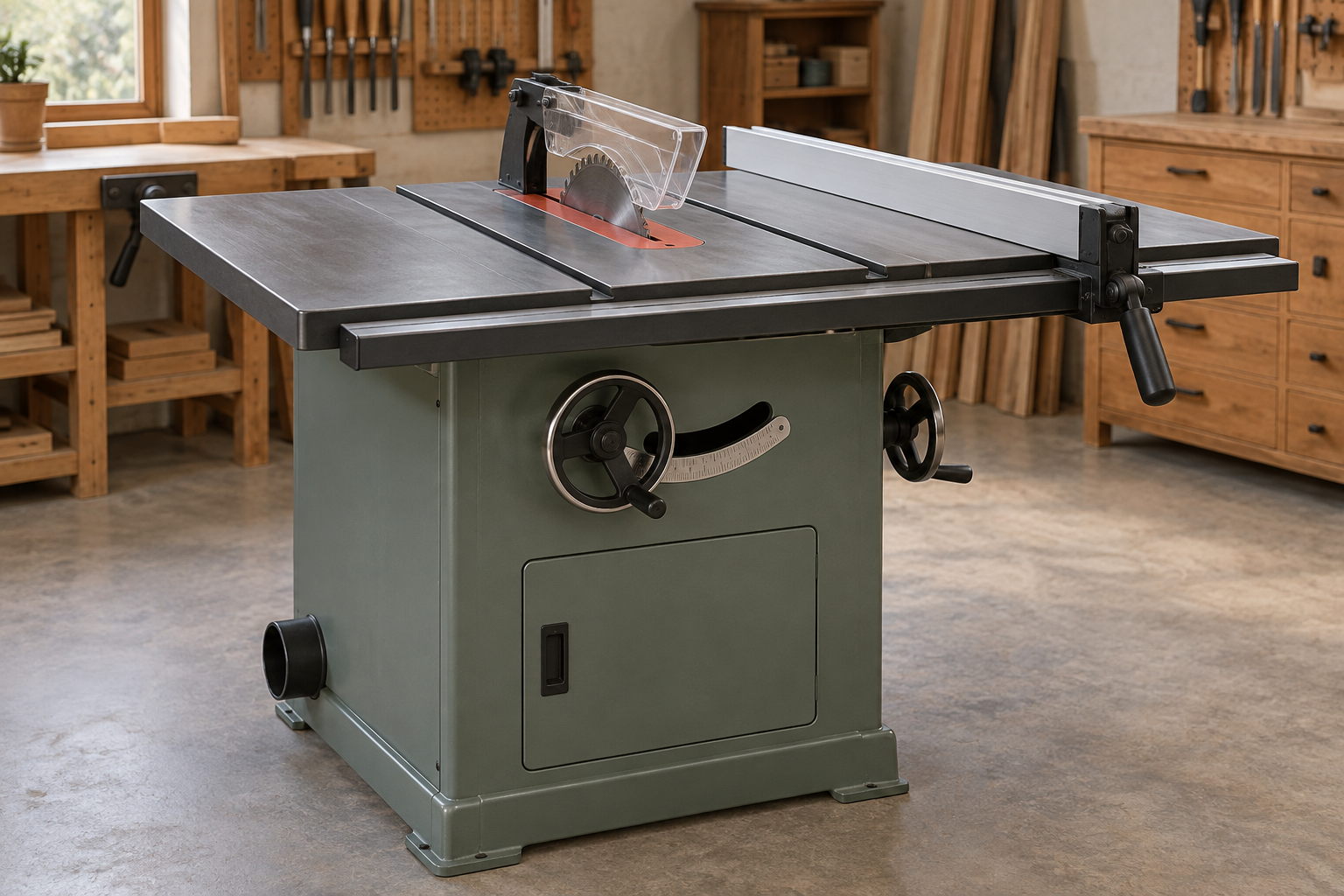
For indoor use, look for a saw with an enclosed base, a dust port sized for a 4-inch hose, and a guard that can accept a separate overhead pickup. A good collector still matters: many saws need roughly 350–450 cubic feet per minute at the machine for useful chip collection. Check the collector’s delivered airflow, not just its advertised rating, which may be measured without a hose or filter attached.
Compare the main saw types
| Saw type | Dust setup | Best fit | Main trade-off |
|---|---|---|---|
| Cabinet saw | Enclosed cabinet and 4-inch port; often easiest to connect | Dedicated shop, frequent work | Heavy, expensive, needs floor space |
| Contractor saw | Varies; open stand can leak chips | Budget-conscious shop with room for a shroud | May need dust-control upgrades |
| Hybrid saw | Partially enclosed base, usually with a 4-inch port | Indoor shop needing a balance of size and capacity | Collection varies by enclosure and guard |
| Jobsite saw | Small port, often suited to a shop vacuum | Portable work or occasional cuts | More dust escapes during long ripping sessions |
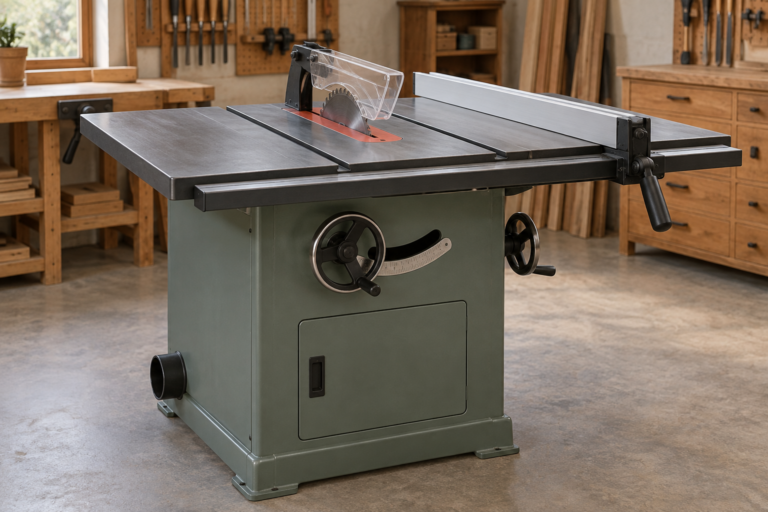
For a permanent indoor shop, a cabinet table saw with a 4-inch dust port is the strongest starting point when budget and floor space allow. Its closed base gives suction a better chance of reaching the blade area than an open stand does.
Choose the saw around the work
Buy the saw for its capacity, fence, and safety features first; dust collection is only one part of the decision. A cabinet saw suits regular sheet-goods work and hardwood milling, but it can weigh several hundred pounds. Plan its route into the shop and leave clearance for long stock. A hybrid saw is a sensible compromise for a smaller permanent shop, provided its base is actually enclosed rather than mostly open.
Contractor saws can be good value. Their open undersides may let chips fall to the floor instead of into the port, but a fitted lower shroud can improve capture. If you already own a capable collector and do not mind fabricating or buying an enclosure, the cheaper saw may be entirely adequate. Before buying, look for reports or photos showing the base interior, port diameter, and how the guard attaches; a 4-inch port is not proof that the whole saw is well sealed.
A jobsite saw makes sense if it must move between locations or if cuts are occasional. Many connect conveniently to a shop vacuum, but their small ports and compact housings are less suited to continuous ripping indoors. If choosing one for a fixed shop, budget for a compatible hood or aftermarket shroud and expect to sweep more often. A hybrid table saw with an enclosed base can be a better indoor-shop choice without the bulk of a cabinet saw.
Match the collector and hoses
For a 4-inch saw port, use a dust collector with a 4-inch main hose and as few reductions, bends, and quick-connect leaks as practical. A long, narrow shop-vac hose adds resistance; its suction can be useful at a small port, but it may not move enough air to carry heavy chips through a full-size saw cabinet. Conversely, a collector with a large impeller will not perform well if a restrictive filter is clogged or the duct is undersized.
Some saws have a second port on the blade guard, commonly around 1½ inches. Connect it with a separate branch or a properly designed splitter, not a loose hose that can snag the work. If the guard port is optional, confirm that it fits your blade guard and does not interfere with raising the blade or beveling it. For a saw without an overhead pickup, a separate hood can reduce airborne dust, but it must stay clear of the stock and riving knife.
Setup, testing, and common failures
Start with the blade and guard installed. Confirm the riving knife is aligned, the guard moves freely, and hoses cannot catch on a push stick or board. Make a short test cut in scrap, then inspect the cabinet, floor, and air around the blade. A pile of chips below the saw usually points to leaks or poor lower-cabinet airflow; a visible plume above the table calls for better guard pickup, not simply a larger cabinet port.
Common collection failures are simple: a disconnected hose, a full drum, a clogged filter, or a port narrowed by an adapter. Check these before replacing the collector. Keep the collector’s filter clean and empty the bin before it is packed full; either condition can sharply reduce airflow. Fine dust can remain airborne even when the floor looks clean, so wear a properly fitted respirator during cutting and cleanup, and do not use compressed air to blow dust around the shop.
Do not remove a blade guard to make a cut easier and then assume the lower port will catch everything. For cuts where the guard must come off, use appropriate push devices and keep hands clear, then account for the increased exposure with local extraction and respiratory protection. Dust control reduces exposure; it does not replace safe saw operation or a clean-air plan.