How to Flatten a Board Face Before Jointing Its Edge
What's inside
As an Amazon Associate I earn from qualifying purchases. This post may contain affiliate links at no extra cost to you.
Contents
Why flatten the face first
A jointer can make one face flat and then use that face to make an adjacent edge square. But a board that rocks, twists, or bows on the jointer’s infeed table is not a reliable starting point. The cutters may remove material near the ends while leaving a hollow in the middle, or flatten a twisted board into a thinner, still-twisted shape. Once you joint an edge against an unreliable face, that edge may not be square to the face you actually need.
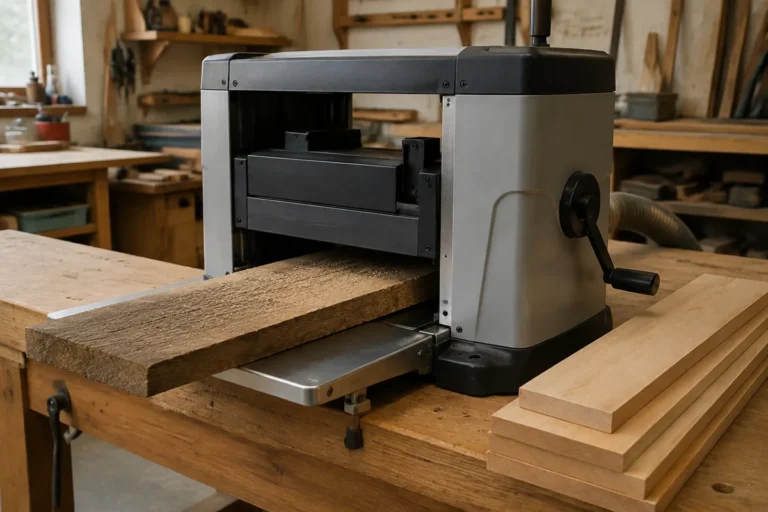
For a typical home shop, the practical sequence is: flatten one face, joint one edge, then use the planer and table saw to bring the opposite face and edge parallel. A planer alone does not flatten a warped board; its rollers can press the board flat during the cut, then let it spring back afterward.
Check the board before choosing a method
Use a straightedge to check along the length, across the width, and diagonally. Look for cup (curved across the width), bow (curved along the length), and twist (opposite corners out of plane). Mark high spots in pencil. Also check that the board is not so short, thin, or narrow that it cannot be held safely on your chosen setup.
Measure thickness at several points. Flattening removes wood, and severe twist can take more off than expected. If the board is only 3/4 inch thick and has 1/4 inch of twist, you may not be able to flatten it and still get the finished thickness you want. For a valuable or thin board, consider cutting it into shorter pieces or accepting a small amount of unevenness where the design allows.
Choose a flattening method
| Method | Best for | Trade-off |
|---|---|---|
| Jointer | Boards that fit the machine and are within its safe working limits | Fast and direct, but a narrow jointer may not handle wide stock |
| Router sled | Wide boards or stock too awkward for a small jointer | Versatile, but slower to set up and leaves ridges that need cleanup |
| Hand plane | Small boards, fine correction, or shops without a wide jointer | Quiet and inexpensive, but requires a sharp iron and practice |
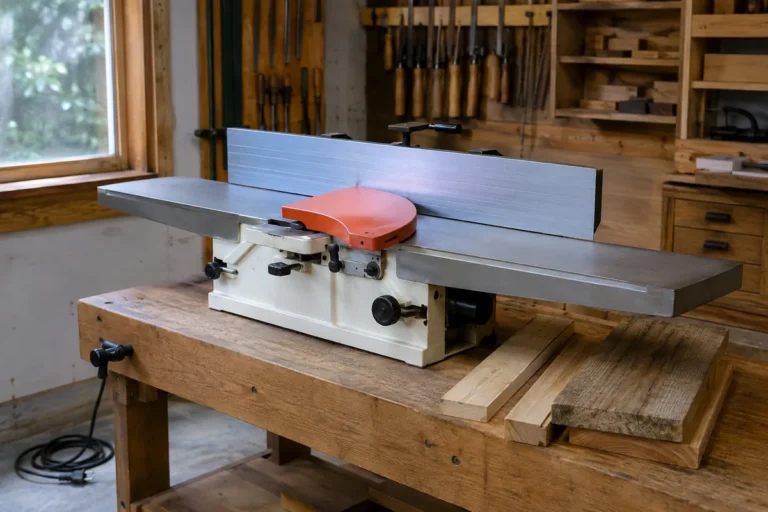
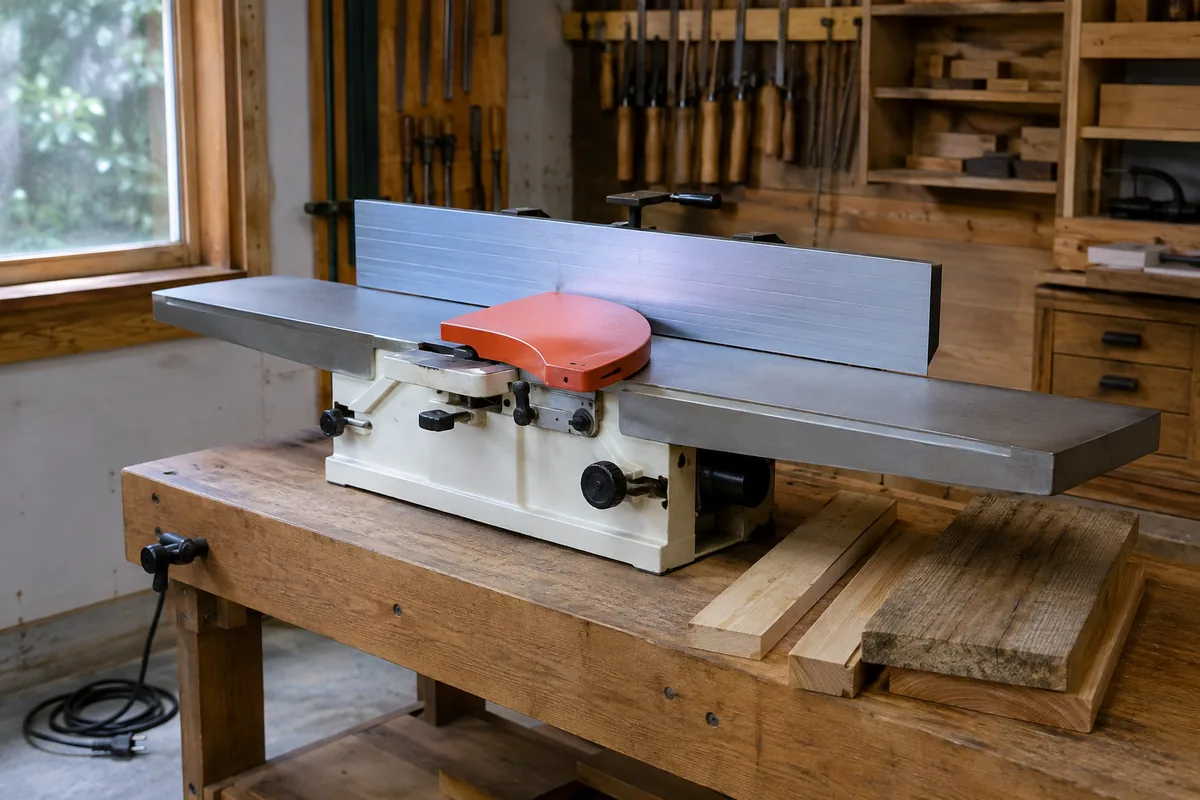
If the board fits your jointer’s capacity, a jointer is usually the simplest option. Check the machine’s manual for minimum stock length, width, and thickness; do not assume that a board which physically fits is safe to feed. For buying, a benchtop jointer can suit small projects, but its narrow capacity rules it out for many tabletops and cabinet panels.
For wide stock, a router sled is often the more economical solution than buying a wider jointer. A router flattening sled needs a rigid base, stable rails, and a router bit wide enough to reduce passes. A basic sled can work well; a flimsy base that sags or rails that shift will produce a surface that is not flat.
Flatten the face on a jointer
Set the depth of cut shallow—about 1/32 inch is a sensible starting point for many boards. Reduce it for hard, figured, or very warped wood. Make sure the guard works, use push blocks, and keep hands away from the cutterhead. Never joint stock shorter or thinner than the manual permits, and do not try to flatten a loose, rocking board by forcing it down onto the tables.
Start with the board’s hollow or cup facing down when possible, so the ends or outer edges have stable contact on the infeed table. Feed with steady pressure, pressing down over the infeed table before the cutter and shifting pressure to the outfeed table after the cut begins. Avoid pushing hard enough to bend the board. Take repeated passes, checking with a straightedge after each one. Stop when the face is flat enough to sit without rocking; extra passes only waste thickness.
For twist, identify the high corners and take light cuts until the board sits more consistently. If the board is badly twisted, it may be safer and more efficient to remove the worst high spots with a hand plane or sled first. A jointer is not a magic thickness-removal machine: careless passes can turn a twisted board into a thinner board with the same problem.
Flatten with a sled or hand plane
For a router sled, shim the board so it cannot rock, then secure it without bowing it. Set the router rails level and check their height at several points. Use shallow passes, roughly 1/16 inch or less, and overlap each pass slightly. Keep the router base supported throughout the cut. When one face is flat, remove the ridges with a hand plane, scraper, or sander; sanding alone is a slow way to correct substantial unevenness.
With a hand plane, mark the face with pencil lines. Plane diagonally across the grain to knock down high spots, then work along the grain to refine the surface. Check often with a straightedge and winding sticks, which make twist easier to see. This costs less than a sled if you already own a suitable plane, but a dull blade can tear the grain and make the job frustrating.
Joint the edge only after the face is flat
Mark the flattened face as your reference face. Put that face against the jointer fence while jointing the adjacent edge. Use a square to check that the edge is close to 90 degrees; adjust the fence if it is not. Take light passes until the edge is straight and continuous, then use the planer to make the opposite face parallel to the reference face.
If the board is wider than your jointer can safely handle, flatten it with a sled or plane first. You can then use the reference face against the table saw or a suitable sled to rip a straight, parallel edge. Do not compensate for a cupped or twisted reference face by leaning the board harder against a fence: pressure can hide the defect during the cut and let it return afterward.