Best Jointers for Milling Narrow Cabinet Rails
What's inside
As an Amazon Associate I earn from qualifying purchases. This post may contain affiliate links at no extra cost to you.
Narrow cabinet rails need straight, parallel edges and consistent width. A jointer can make one edge straight, but it does not set the rail’s final width; that job belongs to a table saw or planer with a suitable jig. The useful question is whether a jointer can safely and accurately prepare the stock you have—not whether a larger machine is automatically better.
As an Amazon Associate we earn from qualifying purchases at no extra cost to you.

Contents
What the jointer does—and does not do
A jointer flattens one face and makes one edge square to that face. For rails, the usual sequence is to joint a face, then joint one edge while holding the flattened face against the fence. Rip the opposite edge on the table saw to final width, using the jointed edge against the fence. If the stock is already flat and has one straight edge, you may not need to joint it at all.
Do not try to use a jointer as a thickness planer or as a way to bring several rails to identical width. The cutterhead removes material from the bottom face, so it cannot make the top and bottom faces parallel by itself. A planer, a table saw, or a router setup is needed for those jobs.
Choosing a jointer size
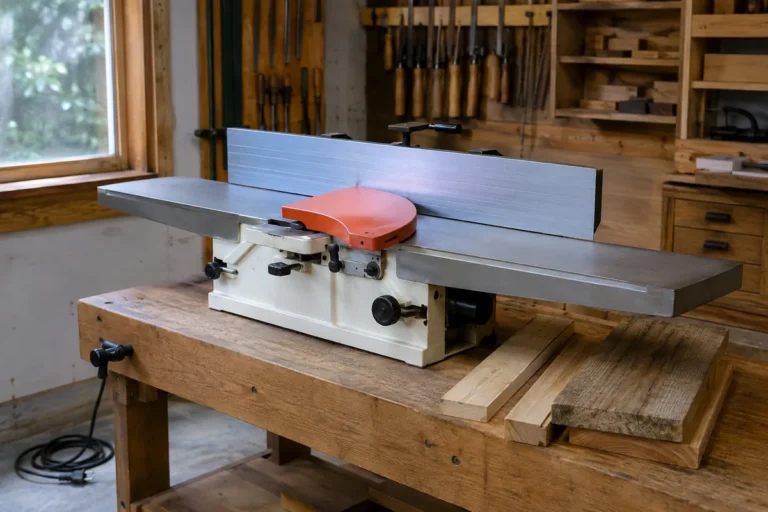
For typical cabinet rails made from stock around 1 to 3 inches wide, a 6-inch benchtop jointer is usually sufficient. Its cutter capacity comfortably covers the edge, and its shorter tables are less convenient for long boards but manageable for short parts. It is often the sensible buy for a shop that joints occasional cabinet components rather than long, wide lumber.
A 6-inch floor-standing jointer generally has longer infeed and outfeed tables. That extra support helps when straightening longer material, but it takes more floor space and costs more. An 8-inch machine adds capacity for wider stock and often longer tables; it is worthwhile if you routinely process wide boards, not simply because cabinet rails are important. For narrow rails, a properly set-up 6-inch machine can produce the same edge quality.
Check the actual table length, fence height and rigidity, cutterhead type, dust-port size, and available replacement knives before buying. A helical cutterhead can make quieter cuts and leave a cleaner finish on difficult grain, but it raises the purchase price. Straight knives are less expensive to replace and work well on clear, straight-grained stock when sharp and aligned.
Jointer options for narrow rails
| Type | Best fit | Trade-off |
|---|---|---|
| 6-inch benchtop | Short rails and occasional cabinet work | Compact and lower cost, but limited table length and often lighter fence |
| 6-inch floor-standing | Regular work with longer boards | More table support and stability; needs floor space |
| 8-inch floor-standing | Wide stock and frequent milling | More capacity, weight, and cost than narrow rails require |
For a first jointer, compare a 6-inch benchtop jointer against the cost of having a local shop mill stock for you. If long pieces are common, look at a 6-inch floor-standing jointer. The benchtop option is fine for short rails if it is securely mounted and its tables and fence are aligned; its limitation is support, not the nominal width capacity.
Mill narrow parts safely
Short, narrow pieces demand more care than broad boards. Keep hands clear of the cutterhead, use push blocks or push pads, and follow the machine manual’s minimum workpiece dimensions. Do not joint a piece so narrow or short that you cannot maintain control with the supplied guards and push devices. If a rail is below the machine’s safe minimum, use a larger carrier or another method rather than forcing it through.
For rails that are still oversize, first joint the face and then the edge. Take light passes—about 1/32 inch is a practical starting point, with smaller cuts on figured or brittle wood. A heavy cut can tear out the far end, make the piece harder to control, or cause a bowed board to rock on the table. Joint only enough to remove the defect; excessive passes waste the width you need for the finished part.
Support long stock level with the jointer tables. A sagging or lifting end can make the edge tapered or bowed. Feed at a steady pace, keep the reference face or edge firmly against the table or fence, and do not stop with the work over the cutterhead. For very short rails, a carrier can improve support, but it must be stable and must not create a tipping or trapping hazard.
Setup matters more than capacity
Before milling a cabinet set, check that the tables are coplanar and that the fence is square to the tables. Verify the fence with a reliable square, then make a test cut on scrap. If one end of a test edge is straight but the other shows a taper, check table alignment, support, and feeding technique before blaming the cutterhead.
Use a straightedge to inspect the finished edge and measure rail width at several points after ripping. A difference of even 1/32 inch can show up as uneven gaps or mismatched frame parts. Keep the jointer knives sharp: dull knives increase tear-out and can leave a ridged surface. Check dust collection as well, since chips trapped under a narrow workpiece can lift it and spoil the cut.
If you already own a table saw, a jointing sled or a straight, stable reference board can be an economical way to straighten a rail edge, provided the setup is secure and the workpiece is supported. It is not a shortcut for warped stock that rocks dangerously, and it requires careful blade and fence setup. For occasional short rails, that may be enough; for repeated milling, a 6-inch jointer with a helical cutterhead is a comfort and finish upgrade, not a requirement.
A practical buying decision
Choose a 6-inch benchtop jointer if your rails are short, your workload is modest, and you can mount the machine rigidly. Step up to a floor-standing 6-inch jointer when you regularly straighten longer boards and need longer tables. Buy an 8-inch machine only when wider stock is a recurring need. In every case, prioritize a straight, adjustable fence, stable tables, available knives, and a safe way to support the work. Those factors matter more to narrow cabinet rails than extra cutter width.