Best Jointers with Helical Cutterheads for Difficult Grain
What's inside
As an Amazon Associate I earn from qualifying purchases. This post may contain affiliate links at no extra cost to you.
Choosing a jointer for difficult grain is less about maximum motor power than cutter geometry, table length, and how easily you can make a clean, repeatable cut. Figured maple, reversing grain, knots, and interlocked tropical hardwoods can tear out badly under a straight-knife head. A helical cutterhead reduces that problem by using many small carbide inserts set at a skewed angle, so each cutter takes a smaller bite.
That does not make tear-out impossible. Feed direction, cut depth, board support, and sharpness still matter. The right jointer gives you more control and more usable results, especially when flattening one face before sending a board through a planer.
As an Amazon Associate we earn from qualifying purchases at no extra cost to you.
Contents
What Makes a Helical Jointer Good for Difficult Grain
A true helical head uses rows of small carbide inserts arranged in a spiral or staggered pattern. Each insert cuts a short section of the board rather than striking across the full width like a straight knife. This usually produces less tear-out, lower impact noise, and longer edge life.
Look for inserts with four usable edges. When one corner becomes dull or nicked, you loosen the screw, rotate the insert, and reinstall it. Carbide also handles occasional hard spots and glue residue better than high-speed-steel knives, although a badly damaged insert still needs replacement.
Be careful with the term “helical.” Some machines use a genuine spiral arrangement; others use carbide inserts in rows but market the head as helical. Either can work well, but the number, size, and skew of the cutters affect finish quality. Smaller inserts generally leave a finer cut pattern, while larger inserts may remove stock faster with fewer cutters.
Size and Capacity Matter More Than Advertised Horsepower
A 6-inch jointer is adequate for many furniture parts, drawer components, and narrow cabinet stock. An 8-inch machine is more versatile because it accepts wider boards and usually has longer tables. The extra capacity is valuable when a wide board has severe grain changes and you need multiple passes to find the cleanest feed direction.
Table length is just as important. Short tables make long boards seesaw, which creates a hollow or tapered face even when the knives are perfectly aligned. For boards around 6 feet long, roughly 60 inches of combined table length is workable; longer infeed and outfeed tables are easier to control. A benchtop unit can be useful for small work, but its short tables and narrow capacity limit it on wide, twisted stock.
| Jointer type | Best use | Strengths | Important limits |
|---|---|---|---|
| Benchtop, 6-inch class | Small parts and occasional flattening | Lower cost, compact, easier to store | Short tables, less stable support, usually less capacity |
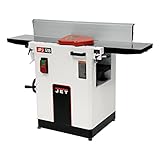
| Floor-standing, 6-inch | General furniture and cabinet work | Better tables, fence, dust collection, and stand | Cannot joint boards wider than about 6 inches |
| Floor-standing, 8-inch | Wide hardwood and regular production | More capacity and table length; better support | Higher price, larger footprint, heavier moving parts |
| 12-inch or wider | Large slabs and high-volume work | Handles broad stock and removes material quickly | Expensive, demanding power and shop space |
Best Buying Options
For most serious home shops, an 6-inch helical floor-standing jointer is the sensible starting point. It provides long tables, a stable fence, and enough capacity for typical furniture lumber without the cost or space requirements of an 8-inch machine. If you mostly work with boards under 6 inches wide, the cheaper option is fine; the helical head is more important than paying for extra width.
Choose an 8-inch helical jointer when you routinely buy 7- or 8-inch boards, need to flatten wide panels before ripping, or want a machine you will not outgrow quickly. It is not automatically better on narrow parts. The wider cutterhead adds expense and usually requires more room, while the improvement in surface quality comes mainly from the inserts and setup.
A benchtop helical jointer makes sense when storage is limited or your work consists of short boards. It is cheaper and often easier to carry, but do not expect it to flatten a badly twisted 7-foot board accurately. The machine may be capable of taking a cut, yet the board can rock between the tables and produce a misleadingly flat section rather than a flat reference face.
Using the Machine on Reversing Grain
Start with a shallow cut, usually around 1/32 inch or less. On highly figured material, begin with 1/64 inch if the machine allows a stable adjustment. Take a light test pass and inspect the surface under raking light. If tear-out appears, reverse the board and test the opposite feed direction. Grain direction can change several times along one board.
Keep the damaged or rough face down only when you are establishing a flat reference surface. Once that face is flat, place it against the fence to joint an edge. Maintain downward pressure over the infeed table until most of the board has crossed the cutterhead, then transfer pressure to the outfeed table. Pressing down over the cutterhead can force a hollow into the board.
Use push blocks with a low-friction sole and keep your hands away from the cutter opening. Never joint stock shorter than the manufacturer’s minimum, and do not attempt to flatten a board with a loose knot that may break free. A helical cutterhead reduces splintering, but it does not make unsafe stock safe.
Setup and Maintenance
Fence rigidity is critical. A fence that shifts by even a small amount can turn a square edge into a noticeable angle over a long board. Check the fence at 90 degrees with a reliable square, then verify that it stays parallel to the table as you move it.
Inspect insert screws periodically and clean pitch from the cutterhead area. If one insert chips, rotate it only after cleaning the seat and checking for damage. A single bad insert can leave a repeating ridge or click across the board. Keep spare inserts and the correct driver nearby; replacement availability is a practical reason to favor common cutterhead systems.
Finally, plan for dust collection. Fine carbide cutting dust and chips from difficult hardwoods quickly overwhelm a weak collector. A 4-inch port connected to a collector that can maintain useful airflow at the machine will keep the tables clearer and reduce airborne dust. For occasional narrow stock, a well-set-up 6-inch helical jointer is usually the best value. For wide lumber and frequent difficult-grain work, spend the extra money on an 8-inch floor-standing machine with long tables and a rigid fence rather than buying the largest motor alone.

