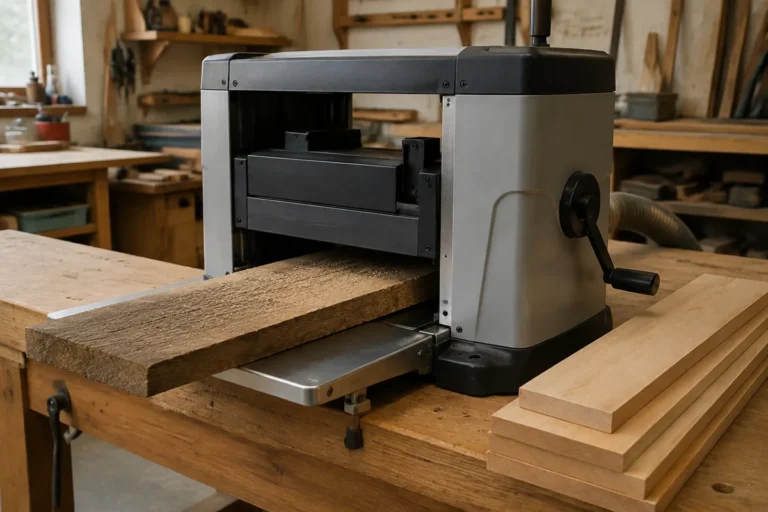
Best Jointers for Accurate Edge Jointing of Narrow Boards
What's inside
As an Amazon Associate I earn from qualifying purchases. This post may contain affiliate links at no extra cost to you.
Narrow boards are awkward on a jointer because the cutterhead can tip or shift them, and a small error at the edge can spoil a glue-up. The right machine depends less on the board’s width than on its length, thickness, and how much control you need. For occasional furniture work, a carefully set benchtop jointer may be enough. For repeated work or long stock, a heavier floor-standing machine is easier to keep accurate.
As an Amazon Associate we earn from qualifying purchases at no extra cost to you.


Contents
What a jointer needs to do
A jointer makes one face flat and one edge square to that face. It is not a thickness planer: a planer makes the opposite face parallel to the first, while a jointer cannot reliably correct a board that rocks on a cupped face. Flatten one face first, then joint an edge against the fence. That reference edge is what lets a table saw rip the board to final width.
For edge jointing, prioritize a straight fence that locks square, tables that stay aligned, and a cutterhead that leaves a clean edge. A long bed supports long boards; a stable base helps prevent the machine from shifting under pressure. A wider cutterhead is not automatically better for narrow stock. A 6-inch jointer can edge-joint boards narrower than 6 inches just as well as a larger machine, provided the stock is manageable and the fence is set accurately.
Benchtop or floor-standing?
Benchtop jointers cost less and take up little shop space, but their short beds make long boards harder to guide without dipping the ends. They are a reasonable choice for stock roughly 2 to 4 feet long, light-duty use, or a small shop where portability matters. Check whether the machine can be bolted to a rigid bench; a wobbling stand undermines accuracy.
Floor-standing jointers have longer beds and more mass, which makes them steadier on longer or heavier boards. They cost more, occupy permanent floor space, and usually need a suitable dust collector. A 6-inch model is enough for most furniture edges. An 8-inch machine gives room for wider face-jointing and can be useful if wide rough lumber is part of your regular work, but it is not a requirement for narrow-edge accuracy.
Compare the practical trade-offs
| Type | Best fit | Main advantage | Main limitation |
|---|---|---|---|
| Benchtop jointer | Short boards, occasional projects, limited space | Lower cost and easy storage | Short bed demands careful support on long stock |
| 6-inch floor-standing jointer | Regular furniture work and typical rough lumber | Longer support and stable operation | Costs more and uses permanent floor space |
| 8-inch floor-standing jointer | Frequent wide face-jointing as well as edge work | More capacity | Higher price; extra width does little for narrow edges |
For a first machine, compare a benchtop jointer with a 6-inch floor-standing jointer. Look beyond advertised capacity: inspect the fence adjustment, bed length, cutterhead access, dust port size, and availability of replacement knives or inserts. A helical cutterhead can reduce tear-out and make maintenance less frequent, but it raises the purchase price; sharp, correctly set straight knives can still produce excellent edges.
Choose for the stock you actually handle
Measure the boards you joint most often. A board 24 inches long and 3 inches wide is easy to control on many machines. A 6-foot board needs support at both ends, even on a long-bed jointer. If the infeed or outfeed end sags, the cut may taper; if you press down hard near the cutterhead, you can create a hollow. Roller stands or a helper can support long stock, but they must be level with the tables and must not push the board sideways.
Very thin strips need extra caution. Below about 1/4 inch thick, the stock may flex, chatter, or become unsafe to guide near the cutterhead. Joint a wider board before ripping it into narrow strips whenever the project allows. For short, narrow pieces that cannot be held securely, use a purpose-made push block or a carrier sled rather than putting fingers near the knives. If the piece is too small to control confidently, do not joint it on a standard machine.
Setup and technique that prevent bad edges
Start with a light cut, around 1/32 inch or less. Deeper cuts remove stock faster but increase the chance of tear-out, snipe-like ends, and loss of control. Set the fence square to the tables with a reliable square, then verify the angle at both ends of the fence. A fence that is out by even a small amount can leave an edge that will not meet its mating board cleanly.
Mark the edge with a pencil line so you can see where material is being removed. Feed the board with steady pressure against the fence and down on the infeed table ahead of the cutterhead; as the board reaches the outfeed table, transfer downward pressure there. Do not rock the board or push down over the cutterhead. Take repeated light passes, checking the edge with a straightedge or by bringing the mating edges together. A continuous gap in the middle usually means the edge is hollow; a gap at the ends suggests a crowned edge.
Use push blocks, eye and hearing protection, and dust collection. Keep hands clear of the cutterhead and never joint stock with loose knots, cracks, or loose bark at the edge. Inspect the board before each pass. A small defect can catch, and a narrow board gives you less room to recover than a broad one.
When a jointer may not be the right purchase
If you only need to straighten an edge now and then, a straight-line ripping jig on a table saw can be cheaper and more useful for other shop tasks. It needs a straight reference edge or a jig that holds the rough board securely, and the saw blade must be aligned with the fence. A track saw with a guide rail is another option for some sheet goods and wider stock, but it does not replace a jointer for flattening faces or correcting rough lumber reliably.
Buy a jointer when you routinely process rough boards and want a repeatable reference edge without building a setup for every cut. Pay for longer beds and heavier construction when your stock is long or your workload is frequent. If your boards are short and your budget or floor space is tight, a well-mounted benchtop machine is a sensible compromise—not a shortcut to skip careful setup.