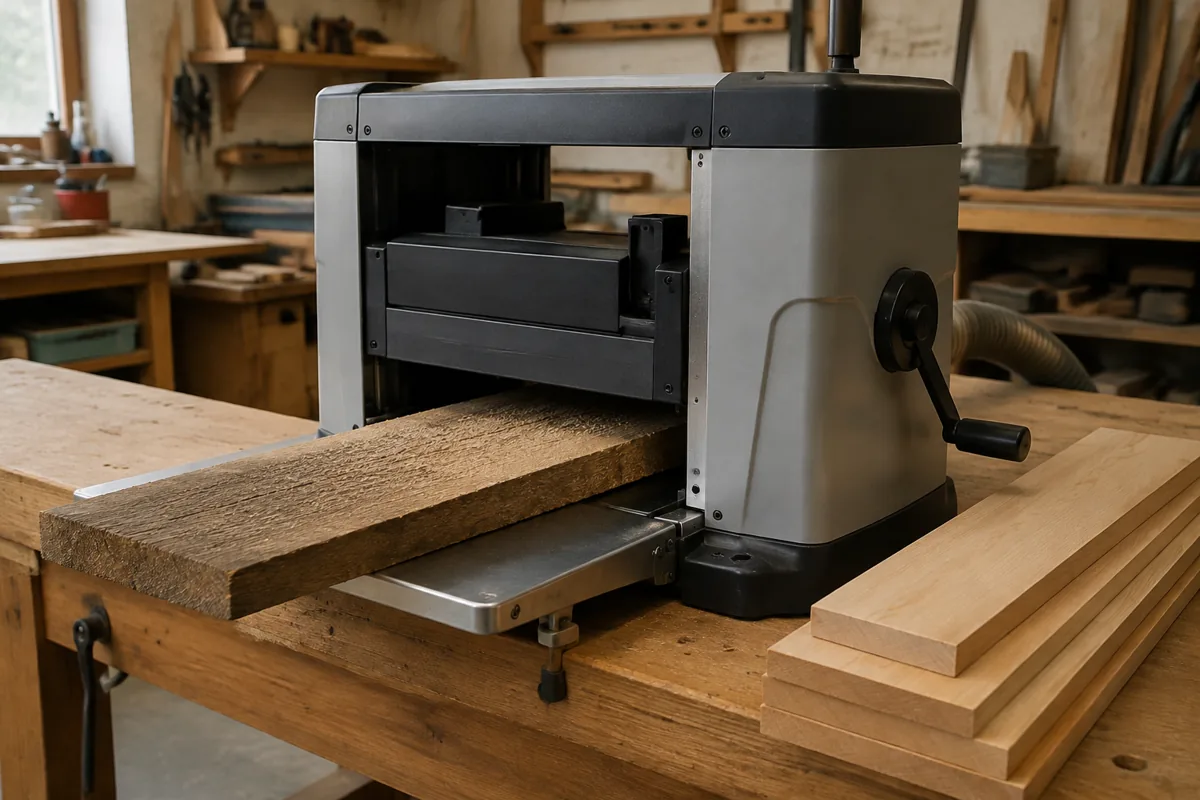
How to Choose a Planer Dust Hood for High-Volume Chip Removal
What's inside
As an Amazon Associate I earn from qualifying purchases. This post may contain affiliate links at no extra cost to you.
A planer can fill a small dust bin surprisingly quickly. Its cutterhead throws out bulky chips, so a hood that works on a table saw may clog, leak, or restrict the planer’s built-in chip ejection. Choose a hood by matching its opening and duct to the machine, then make sure the extractor can move enough air through the whole system.
Contents
Start with the planer’s chip outlet
Check the manual and measure the planer’s dust port, including its outside diameter, shape, and position. Common stationary-machine connections are 4 inches, while some planers use a larger outlet or an adapter. Do not assume a nominal 4-inch fitting measures exactly 4 inches; flexible hose and adapters vary. Measure the machine and the fitting you intend to use.
Some planers have a fan-assisted chip ejection system. The hood or adapter must let chips leave freely rather than forcing them through a narrow bend or undersized hose. Look for the manufacturer’s recommended duct size and any restrictions on connecting a collector. If the planer requires a specific adapter, use it. A generic hood is not a substitute for a part designed to clear that machine’s outlet.
Also check clearance around the hood. A large, rigid fitting can interfere with a nearby wall, stand, or outfeed support. A short flexible section may help with alignment, but long, sagging hose creates extra resistance and gives chips places to collect.
Match the hood opening and duct
The hood should capture chips close to the outlet without covering an opening the planer needs for ejection. For a planer with a dedicated port, the best choice is usually a close-fitting adapter or hood made for that port. For a machine without a usable port, a large canopy can catch falling chips, but it is less reliable: airflow drops with distance, and chips can escape around the edges.
Keep the duct as large as the machine and collector allow. A 4-inch hose has about 12.6 square inches of cross-sectional area; a 5-inch hose has about 19.6 square inches. That is roughly 56% more area, which can help move bulky chips with less restriction. But a larger hose only helps if the collector, fittings, and machine connection can support it. A reducer at the planer may still be necessary, and abrupt reducers can become choke points.
Choose smooth-walled duct where practical, especially for fixed runs. Flexible hose is convenient for a machine that moves or needs a short connection, but corrugations and tight bends increase resistance. Keep bends broad, avoid unnecessary tees, and secure joints so they do not leak or pull apart under vibration.
Compare common hood options
| Option | Best fit | Main trade-off |
|---|---|---|
| Machine-specific adapter | Planer with a defined chip outlet | Usually captures well; may cost more or fit only one machine |
| Universal planer hood | Machines with compatible outlet dimensions and enough clearance | More flexible, but fit and sealing can take adjustment |
| Open canopy or catch hood | Occasional use or a planer without a practical port connection | Easy to install, but captures less effectively and can spill chips |
If you are shopping, compare a planer dust hood or adapter against the machine’s measurements, not just the product photo. For a fixed workshop run, dust-collection duct fittings can be a better buy than adding a long stretch of flexible hose.
Size the collector for the whole path
Check the collector’s airflow rating, but treat a free-air rating as an optimistic figure. The actual airflow at the planer falls as resistance increases through hose, elbows, filters, and separators. A small shop vacuum may handle fine dust at a tool with a small port, yet struggle with a planer’s high volume of chips. A dust collector with a suitable inlet and filter area is generally a better match for sustained planing.
As a practical check, the planer should eject chips steadily without a growing pile at the outlet or chips backing up inside the hood. If the collector’s manual gives a required airflow or duct size, follow it. Do not solve poor pickup by blindly fitting a larger hood: first check for a full bag, clogged filter, blocked hose, leaking joints, or a sharp bend. Those faults are often the real restriction.
A cyclone or separator can keep bulky chips out of the filter and collection bag, which is useful when planing large boards. It also adds another stage of resistance, so the collector must still maintain adequate airflow. A separator is not automatically an upgrade if the existing collector is already marginal.
Avoid common failure modes
Chip bridges form where a duct narrows suddenly, turns sharply, or meets a poorly aligned adapter. If chips accumulate at the machine connection, inspect the transition and remove tight bends before replacing the collector. A hood that leaks at its joint may still collect much of the waste, but leaks reduce useful airflow and can blow chips into the work area on fan-assisted machines.
Check the system after a short test cut, then again after a longer run. Stop the planer before clearing a blockage; never reach into the hood or duct while the cutterhead is moving. Empty the bin before it reaches the inlet, since a full container can obstruct flow. Keep the filter clean according to the collector manufacturer’s instructions.
For occasional light planing, a correctly fitted 4-inch adapter and a modest collector may be adequate, especially with short duct runs. Spending more on a larger hood or fixed duct is unlikely to fix an undersized collector. For frequent, wide-board planing, prioritize an unrestricted machine-specific connection, a short and generously sized duct path, and a collector that can sustain airflow under load.