
Our Top Picks
What's inside
As an Amazon Associate I earn from qualifying purchases. This post may contain affiliate links at no extra cost to you.
A benchtop jointer can flatten a cutting board, but it starts to fight you the moment a board gets long, wide, or heavy. The short tables offer little support, the light body vibrates, and the fence flexes just when you need it square. A floor standing jointer with cast iron beds solves those problems at the root: long, ground tables carry the board through the cut, the mass of the machine damps vibration, and a rigid fence stays where you set it. For a home woodworking shop, that is the difference between fighting twist and actually removing it.
This guide covers four floor standing jointers with cast iron beds for home woodworking shops, chosen from the names and specifications shown on their Amazon listings. The lineup spans a compact 6-inch long-bed machine for a small garage shop up to 8-inch helical models built for regular furniture work. Every pick below stands on its own cabinet, runs on single-phase power, and uses a helical cutterhead, so the real choice comes down to width, bed length, and how much floor space and electrical capacity your shop can spare.
Contents
Quick Picks
As an Amazon Associate we earn from qualifying purchases
| Product | Best for | Key spec from title |
|---|---|---|
| Powermatic 8-Inch Jointer, Helical Cutterhead, 2 HP, 230V 1Ph (Model 60HH) | Home shops milling wide boards every week | 8-inch, helical cutterhead, 2 HP |
| Powermatic 8-Inch Parallelogram Jointer, Helical Cutterhead, 2 HP, 1Ph 230V (PJ-882HH) | Woodworkers who want the most precise table adjustment | 8-inch parallelogram, helical cutterhead, 2 HP |
| JET 6-Inch Long Bed Jointer, Helical Cutterhead, 1 HP, 115/230V 1Ph (JJ-6HHDX) | Small shops stepping up from a benchtop jointer | 6-inch long bed, helical cutterhead, 1 HP |
| Shop Fox W1858 8″ x 72″ Dovetail Jointer with Helical Cutterhead & Mobile Base | Shops that need to roll a big jointer aside between jobs | 8 x 72 inch, helical cutterhead, mobile base |
How to Choose
Bed Length and Cast Iron Construction
Bed length decides how long a board you can flatten with confidence. As a rule of thumb, a jointer handles boards up to roughly twice its bed length, so a 56-inch bed copes with most furniture parts while a 72- to 76-inch bed takes on longer table tops and door stock without the ends drooping mid-cut. Cast iron matters just as much as length: a ground cast iron table stays flat over years of seasonal humidity changes, resists dings from rough lumber, and adds the mass that keeps the machine steady. Check that both the infeed and outfeed tables are cast iron, not just the fence, and look at the total table size in the listing rather than the cutting width alone.
Cutterhead Type: Helical Versus Straight Knives
The cutterhead shapes both the surface finish and the maintenance routine. A helical cutterhead carries rows of small four-sided carbide inserts that shear the wood in a staggered pattern, which leaves a smoother surface on figured grain and runs noticeably quieter than straight knives. When one insert chips on a hidden knot, you rotate that single insert instead of removing and resharpening a full knife set. Straight-knife jointers cost less up front and their knives are cheap to replace, yet setting three knives to exactly the same height takes patience and a dial indicator. For a home shop milling cherry, walnut, or curly maple, the helical head earns its keep quickly.
Fence Quality and Adjustment
A jointer fence has one job: hold a board square to the table while you push it through, and it has to do that without flexing or drifting. Look for a cast iron fence with positive stops at 90 degrees and 45 degrees, plus a smooth tilt mechanism that locks firmly once set. Fence size matters too, since a tall, long fence supports wide boards on edge and keeps them from tipping during an edge joint. Before ordering, confirm the fence dimensions in the listing and think about the widest board you edge-joint regularly. A fence that is too short turns every wide glue-up into a balancing act.
Dust Collection and Shop Layout
Jointers throw a surprising volume of chips, and a floor standing machine will bury a small shop in shavings within a single milling session. A 4-inch dust port that connects to a collector or a shop vacuum keeps the tables clean, which in turn keeps boards sliding smoothly and cuts accurate. Beyond dust, measure the machine twice: the footprint on the listing is only the start, because you also need clear infeed and outfeed space for the longest board you plan to flatten, plus room to walk around the fence side. A built-in mobile base helps in a shared garage, but it adds height and must lock solidly before you cut.
The 4 Best Options
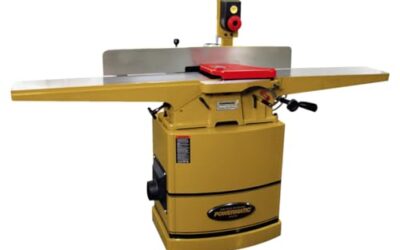
Powermatic 8-Inch Jointer, Helical Cutterhead, 2 HP, 230V 1Ph (Model 60HH)

The Powermatic 60HH suits the home woodworker who mills rough lumber every week and wants a machine that simply gets on with it. Its 8-inch width covers most furniture stock, the helical head keeps figured boards free of tearout, and the long cast iron tables support boards that would overwhelm a benchtop machine. Powermatic backs the jointer with a five-year warranty, which says something about how the company expects it to hold up in daily use. This is the pick for a shop that has settled on its layout and wants one jointer to serve for years.
Specs
- 8-inch cutting width
- Helical cutterhead with 54 four-sided carbide inserts
- 2 HP motor, 230V, single phase
- 74-inch table length
- 0.13-inch maximum cutting depth
- 7,000 RPM maximum rotational speed
Best for: Home shops milling wide boards every week and wanting a long-lasting 8-inch helical jointer.
Watch out for: The 60HH needs a dedicated 230V circuit, so check your panel before ordering, and as a heavy cast iron machine it needs a clear delivery path and a helper to position.
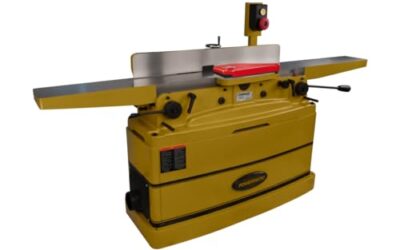
Powermatic 8-Inch Parallelogram Jointer, Helical Cutterhead, 2 HP, 1Ph 230V (PJ-882HH)
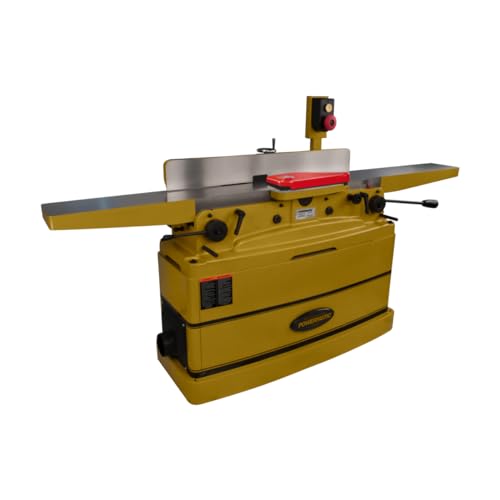
The PJ-882HH fits woodworkers who care about table adjustment as much as cutting power. Its parallelogram design moves the tables on pivoting arms rather than sliding them along dovetail ways, so the tables stay parallel to the cutterhead through their full range of travel and the gap beside the cutterhead stays constant. That geometry makes setup more forgiving and keeps the machine accurate after years of height changes. Combined with the helical cutterhead and 2 HP motor, it handles wide hardwood boards with a calm, steady cut.
Specs
- 8-inch parallelogram jointer
- Helical cutterhead
- 2 HP motor, 230V, single phase
- 87.5 x 28.75 x 43.25 inches
- 610 pounds
Best for: Woodworkers who want the most precise table adjustment and a jointer that stays accurate over years of use.
Watch out for: At 610 pounds and over 87 inches long, this is the heaviest machine in this guide, so confirm your floor, doorway width, and 230V supply before it arrives.
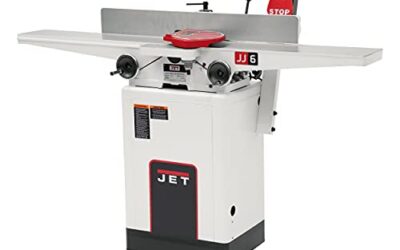
JET 6-Inch Long Bed Jointer, Helical Cutterhead, 1 HP, 115/230V 1Ph (JJ-6HHDX)

The JET JJ-6HHDX is the sensible first floor standing jointer for a small home shop. Its 6-inch width handles the boards most hobby furniture projects actually use, while the 56-inch cast iron bed is far longer than any benchtop table and makes flattening three- and four-foot boards realistic. The 1 HP motor runs on either 115V or 230V, so it plugs into a standard garage circuit without an electrician, and the helical cutterhead keeps noise down and tearout in check. If your shop is tight on space and power, this is the machine that fits without a remodel.
Specs
- 6-inch cutting width
- Helical cutterhead
- 1 HP motor, 115/230V, single phase
- 56-inch cast iron bed
- 56 x 21 x 36 inches
- 237 pounds
Best for: Small shops stepping up from a benchtop jointer and wanting a long cast iron bed on standard household power.
Watch out for: The 6-inch width will not flatten boards wider than six inches, so measure your usual lumber before choosing this over an 8-inch model.
Shop Fox W1858 8″ x 72″ Dovetail Jointer with Helical Cutterhead & Mobile Base

The Shop Fox W1858 suits a home shop where the jointer has to share floor space with a car, a table saw, or both. Its 72-inch cast iron bed and 3 HP motor give it the capacity of a serious furniture machine, yet the built-in mobile base lets one person roll it against a wall when the job is done. The helical cutterhead carries 36 carbide inserts, and the dovetail ways adjust with handwheels and a depth gauge. For a garage shop that needs full-size capability without a permanent footprint, this combination is hard to beat.
Specs
- 8 x 72 inch dovetail jointer
- Helical cutterhead with 36 carbide inserts
- 3 HP motor, 230V, single phase
- 1/8-inch maximum depth of cut
- 4-5/8 x 38 inch fence
- Built-in mobile base
- 5,500 RPM cutterhead speed
Best for: Shops that need to roll a big jointer aside between jobs and want 8-inch helical capacity on a mobile base.
Watch out for: The 3 HP motor needs a 230V circuit, and the machine weighs several hundred pounds, so plan the delivery route and lock the mobile base firmly before every cut.
Which One Fits Your Situation
You Have a Small Garage Shop and Standard Outlets
The JET JJ-6HHDX is the natural fit here. It runs on a 115V circuit, its 56-inch bed still flattens most furniture boards, and at 237 pounds it is the lightest machine in this guide, which makes installation far simpler. The helical cutterhead keeps the noise down for attached garages, and the 6-inch width covers the boards most small projects use. Choose this one when space and power are the limiting factors rather than board width.
You Mill Long Boards for Tables and Doors
Go with the Powermatic 60HH or the Shop Fox W1858, since both offer beds of 72 inches or more and 8-inch capacity for wide stock. The 60HH brings a longer track record and a five-year warranty, while the W1858 adds a mobile base and a stronger 3 HP motor. Either machine supports a six-foot board through the cut without the ends sagging, which is exactly where shorter beds start to produce a subtle bow instead of a flat face.
You Work Mostly with Figured Hardwoods
The Powermatic PJ-882HH earns this slot. Its parallelogram tables hold their alignment through every height change, and the helical cutterhead shears figured cherry and walnut instead of tearing it. That combination matters most when a board is expensive and there is no spare thickness to sand away mistakes. The 610-pound build also damps vibration, which shows up as a cleaner surface on wood that punishes any chatter.
Your Shop Doubles as a Parking Space
The Shop Fox W1858 is built for this situation. The built-in mobile base means the jointer rolls out for a milling session and tucks back against the wall afterward, so a full-size 8-inch machine does not permanently claim the middle of the garage. Just remember to lock the base before cutting and to leave enough clear floor for the infeed and outfeed runs when the machine is in position.
Common Mistakes
- Buying an 8-inch jointer without checking whether the shop has a 230V circuit to run it, then discovering the machine cannot be plugged in.
- Measuring only the machine footprint and forgetting the clear infeed and outfeed space a long board needs on both sides.
- Choosing the shortest bed that fits the budget, then finding that long boards come off the machine with a bow instead of a flat face.
- Skipping dust collection and letting chips pile on the outfeed table, where they lift the board and spoil the cut.
- Setting the fence by eye instead of checking it square to the table, which turns every edge joint into a glue-up gap.
Frequently Asked Questions
Is a 6-inch jointer enough for a home woodworking shop?
A 6-inch jointer covers most hobby furniture work, since the majority of boards in small projects are narrower than six inches and the long bed on a machine like the JET JJ-6HHDX handles typical furniture lengths. It falls short only when you regularly mill wide table tops, wide panels, or rough-sawn boards over six inches. If wide stock is a weekly event rather than a rare one, an 8-inch model saves you from ripping boards down before flattening them.
Do floor standing jointers need 230V power?
Most 8-inch floor standing jointers do, because their 2 HP and 3 HP motors are wired for 230V single phase. The exception in this guide is the JET JJ-6HHDX, whose 1 HP motor runs on either 115V or 230V. Before ordering any 8-inch machine, check your breaker panel for a spare 230V circuit and the cost of adding one. The circuit matters more than the motor size, since a jointer that cannot be plugged in is just furniture.
Are helical cutterheads worth it on a home shop jointer?
For most home shops, yes. A helical cutterhead cuts quieter, leaves a smoother surface on figured grain, and lets you rotate a single chipped insert instead of resetting a full set of knives. Straight knives cost less up front and replacement knives are inexpensive, so they still make sense on a tight budget. But if you mill cherry, walnut, or curly maple regularly, the helical head pays for itself in saved sanding time and fewer ruined boards.
How long should the bed be on a floor standing jointer?
A useful guide is that a jointer flattens boards up to about twice its bed length, so a 56-inch bed handles boards near eight feet in theory, though four- to six-foot boards are the comfortable reality. Beds of 72 inches and longer suit table tops, door stock, and long milling sessions where support matters most. Match the bed to the longest board you flatten often, not the longest board you might flatten once a year.
Related guides
More from Amazon
Programs that pair well with the guide above. Offers and eligibility are set by Amazon and may change.
A free business account with business pricing and bulk-buying tools for work, shop or home office.
Create a business accountFree shipping on eligible items, Prime Video and more. Eligible new members can start with a free trial.
Start a Prime free trialAudiobooks and podcasts to listen to on the go. Eligible new members can start with a free trial.
Try Audible freeAd-free music streaming. Eligible new subscribers can start with a free trial.
Try Music Unlimited freeAs an Amazon Associate we earn from qualifying purchases.
Write Your Review
No reviews yet. Be the first to share your experience!