
Key takeaways
- Compare the best benchtop band saws for furniture makers, from compact 9-inch saws for curves to a 10-inch two-speed saw for resawing chair and table parts.
What's inside
As an Amazon Associate I earn from qualifying purchases. This post may contain affiliate links at no extra cost to you.
A furniture maker choosing a benchtop band saw is really choosing how much shaping work the saw will do. Curves for chair backs, legs and aprons, arcs on table skirts and the occasional resawn board for a drawer front all pass through this one machine, and the wrong size turns every cut into a compromise. A saw too small stalls in thick hardwood, while one too large crowds out the assembly space a small shop needs. The decision is about capacity, control and footprint together, not about chasing the biggest motor on the page.
This guide is for hobbyist makers fitting a saw onto a shared workbench, small-shop makers who cut curves and resaw short boards most days, and beginners setting up a first bench. The three saws below were chosen from the names and specifications shown on their Amazon product pages, with throat size, cutting depth, blade speed and table size weighed against the furniture work each saw will do.
Contents
Quick Picks
As an Amazon Associate we earn from qualifying purchases.
| Product | Best for | Key spec from title |
|---|---|---|
| WEN BA3959 2.8-Amp 9-Inch Benchtop Band Saw | Small-shop curves and light resawing on a tight bench | 2.8-amp, 9-inch benchtop band saw |
| WEN 3962T 3.5-Amp 10-Inch Two-Speed Band Saw with Stand and Worklight | Resawing thicker furniture stock with two blade speeds | 3.5-amp, 10-inch two-speed band saw with stand |
| SKIL 3386-01 120-Volt 9-Inch Band Saw with Light | Straightforward curved cuts and first-saw simplicity | 120-volt, 9-inch band saw with light |
How to Choose
Throat size and resaw capacity
Throat size is the distance from the blade to the column, and it sets how wide a board you can curve-cut before the column gets in the way. A 9-inch throat handles chair parts, drawer fronts and most apron curves, while a 10-inch throat gives more room for wider panels and table-skirt arcs. Resaw capacity is the vertical limit, the thickest board the saw can slice into thinner pieces, and it matters when you want bookmatched panels or veneer from one board. A 3-1/2-inch limit suits legs and rails, but a 6-inch limit opens up seat blanks and wide drawer sides. Measure the widest and thickest pieces in your projects, then buy a saw whose limits sit above them.
Motor strength and blade speed
The motor decides whether the blade keeps its pace through dense hardwood or slows and wanders. A 2.5-amp motor copes with softwood and thin hardwood, yet it asks for a slower feed and a sharp blade when stock gets thick. A 2.8-amp motor gives a useful step up for regular work in oak, maple and walnut, while a 3.5-amp motor holds speed better on thicker cuts. Two-speed saws add a choice: slower for hardwoods and careful cuts, faster for softwoods and quick shaping. If you work mostly in dense species, favour the stronger motor and the slower speed, and remember that a dull blade will make even a strong motor feel weak.
Table size, tilt and fence
The table is the surface your work rides on, so its size and tilt range shape what you can cut safely. A table around 12 inches square supports small furniture parts well, and a tilt to 45 degrees lets you cut bevels and angled chair components without a separate jig. Check that the table locks firmly at 90 degrees, because a table that drifts even slightly will show up as a gap in every joint. A rip fence helps with straight cuts and resawing, keeping the board parallel to the blade instead of steering by eye. Before buying, picture your longest leg blank on the table and ask whether it will stay supported through the whole cut.
Size, weight and dust collection
A benchtop saw earns its place by fitting the bench you already own, so measure the bench before the saw. A machine around 40 pounds can be lifted onto a shelf, while a heavier saw with a stand wants a permanent corner of the shop. Allow room behind the saw for long stock to pass through and space beside it for the fence and your hands. Dust collection matters more than it looks: a 2-1/2-inch dust port connects to a shop vacuum and keeps fine sawdust off the table and out of the blade guides. Sawdust packed around the lower guides is a common cause of wandering cuts, so a clear dust path saves cleaning time.
The 3 Best Options
WEN BA3959 2.8-Amp 9-Inch Benchtop Band Saw

The WEN BA3959 suits the furniture maker whose bench is small but whose project list is not. Its 9-inch throat and 3-1/2-inch cutting depth cover chair rails, drawer fronts, curved aprons and small resawn panels, while the single-speed design keeps setup simple for makers who would rather cut than fiddle with settings. The tilting table handles bevelled parts, and the compact footprint leaves room on the bench for clamps and layout tools. It is a sensible first benchtop saw for a hobbyist, and a useful second saw for a small shop that wants a dedicated curve-cutting machine beside a larger floor saw.
Specs
- 2.8-amp motor
- 9-inch throat
- 3-1/2-inch cutting depth
- Blade speed up to 2,500 FPM
- Table measures 12-1/4 by 11-7/8 inches and bevels to 45 degrees
- Blade measures 59-1/2 inches, 1/8 to 3/8 inch wide
- 2-1/2-inch dust port
- Weight: 40 pounds
- 2-year warranty
Best for: hobbyist furniture makers cutting curves and light resawing on a small bench.
Watch out for: check that your bench has room for the full table plus the length of the longest board you plan to cut, and confirm a standard household outlet is within reach of the cord.
WEN 3962T 3.5-Amp 10-Inch Two-Speed Band Saw with Stand and Worklight
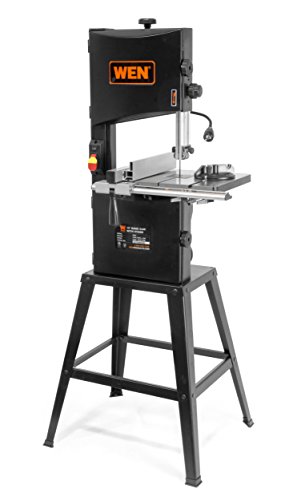
The WEN 3962T is the pick for makers who resaw more often and want extra capacity without a floor-standing machine. Its 10-inch throat and 6-inch resaw capacity handle thicker seat blanks, wide drawer sides and bookmatched panels that a 9-inch saw cannot reach, and the two blade speeds let you slow down for dense hardwood or speed up for softwood shaping. The included stand lifts the saw to a comfortable working height and frees the bench entirely, while the worklight helps when cutting lines on dark walnut or cherry. It fits a small shop that builds tables and chairs regularly and needs one saw to cover both curves and resawing.
Specs
- 3.5-amp motor
- 10-inch throat
- 6-inch resaw capacity
- Two blade speeds: 1,520 and 2,620 FPM
- Includes stand
- LED worklight
- 2-year warranty
Best for: small-shop furniture makers who resaw thick stock and cut wide curves in the same week.
Watch out for: measure the floor space for the stand and the saw together, since the stand makes this a semi-permanent setup rather than a saw you lift on and off a bench.
SKIL 3386-01 120-Volt 9-Inch Band Saw with Light
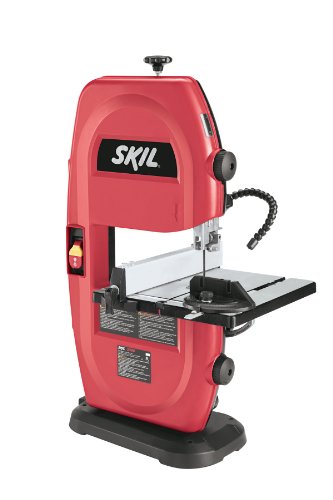
The SKIL 3386-01 fits the maker who wants a straightforward first band saw for curved furniture parts. Its 9-inch throat covers the usual range of chair and table components, the rip fence supports straight cuts and light resawing, and the built-in light makes the cut line easier to follow on pale woods where a pencil line can disappear. The 6-TPI blade supplied with the saw handles general wood cutting, and the compact body sits comfortably on a workbench beside a drill press or sander. It is best suited to softwood and thinner hardwood parts, and to makers who are learning curved cuts before committing to a larger machine.
Specs
- 2.5-amp motor
- 9-inch throat
- 120-volt operation
- Rip fence included
- 6-TPI band saw blade included
- Built-in light
- Work area measures 11 by 12-1/2 inches
Best for: beginners and occasional furniture makers cutting curves in softwood and thinner hardwood.
Watch out for: confirm the saw fits your bench with the fence attached, and check that you have a spare blade in the size this saw takes before starting a project with a deadline.
Which One Fits Your Situation
You build chairs and small tables in a spare room
Choose the WEN BA3959. Its 9-inch throat and 3-1/2-inch cutting depth cover chair rails, curved aprons and small resawn parts, and at 40 pounds it can be stored on a shelf when the bench is needed for assembly. The tilting table handles bevelled chair components, and the dust port keeps sawdust under control in a shared room.
You resaw boards for panels and drawer sides every week
Choose the WEN 3962T. The 6-inch resaw capacity and 10-inch throat handle thicker stock than either 9-inch saw, and the two speeds let you match the blade to dense hardwood or fast softwood work. The stand keeps the saw at working height and leaves your bench free for joinery and glue-ups.
You are buying your first band saw and learning curved cuts
Choose the SKIL 3386-01. The rip fence, built-in light and general-purpose blade make the first cuts easier to control, and the 9-inch size is forgiving to learn on. Start with softwood and thinner hardwood, keep the blade sharp, and move to thicker stock only once your feed rate feels steady.
You want one saw for curves, bevels and occasional resawing
Choose the WEN BA3959 again for the balance it strikes. The table bevels to 45 degrees for angled parts, the blade speed suits general furniture work, and the compact size leaves bench space for other tools. It does not resaw as deeply as the WEN 3962T, so keep thick resawing to short boards and let the blade do the work.
Common Mistakes
- Buying on throat size alone and forgetting resaw capacity, then finding the saw cannot slice a thick seat blank into veneer.
- Feeding dense hardwood too fast, which overheats the blade, burns the cut and pulls the line off course.
- Using a wide blade for tight curves, where a narrow blade would follow the line and leave less sanding to do.
- Skipping blade tension and guide adjustment after a blade change, which leads to drift on straight cuts and wavy resawn faces.
- Placing the saw where long stock hits a wall behind it, so every long cut stops halfway through.
Frequently Asked Questions
What size benchtop band saw do furniture makers need?
A 9-inch benchtop saw covers most furniture parts, including chair rails, aprons and drawer fronts, while a 10-inch saw adds room for wider panels and thicker resawing. Choose the 9-inch size for curves and light work in a small shop, and the 10-inch size when you resaw boards thicker than 3-1/2 inches regularly. Either way, check the resaw limit against the thickest board in your projects before buying.
Can a benchtop band saw resaw hardwood for furniture panels?
Yes, within its resaw limit. A saw with a 6-inch resaw capacity can slice thicker hardwood boards into thinner panels, while a 3-1/2-inch limit suits legs, rails and drawer sides. Use a sharp, narrow resaw blade, feed slowly and evenly, and support long boards so they do not tip. Dense species need a slower blade speed and a lighter feed than softwoods.
Is a two-speed band saw worth it for furniture work?
A two-speed saw is worth it when you cut both dense hardwood and softwood. The slower speed suits hardwoods and careful resawing, reducing burning and blade strain, while the faster speed suits softwood shaping and quick curve work. If you work in one species most of the time, a single-speed saw with the right blade will serve you well.
How do I keep curved cuts accurate on a benchtop band saw?
Start with a sharp blade matched to the curve radius, with narrower blades for tighter turns. Set the blade guides close to the work, keep the table square to the blade, and feed steadily without forcing the cut. Mark the line clearly, cut just outside it and sand to the line afterwards. A light that shows the line and a dust port that keeps it clear both help.
Related guides
More from Amazon
Programs that pair well with the guide above. Offers and eligibility are set by Amazon and may change.
A free business account with business pricing and bulk-buying tools for work, shop or home office.
Create a business accountFree shipping on eligible items, Prime Video and more. Eligible new members can start with a free trial.
Start a Prime free trialAudiobooks and podcasts to listen to on the go. Eligible new members can start with a free trial.
Try Audible freeAd-free music streaming. Eligible new subscribers can start with a free trial.
Try Music Unlimited freeAs an Amazon Associate we earn from qualifying purchases.
Write Your Review
No reviews yet. Be the first to share your experience!