
Key takeaways
- The best digital angle finders and T-bevels for woodworking, compared by measuring range, stated accuracy, blade length and miter functions.
What's inside
- Quick Picks
- Table of Contents
- GemRed 82305 Aluminum Digital Angle Finder Protractor
- Bosch GAM 220 MF 4-in-1 Digital Angle Finder
- General Tools 828 Digital Sliding T-Bevel
- Kirphealy Digital Angle Finder Protractor LF401
- GemRed 82305 Stainless Steel Digital Angle Finder 300 mm
- How to Choose a Digital Angle Finder
- FAQ
- Conclusion
As an Amazon Associate I earn from qualifying purchases. This post may contain affiliate links at no extra cost to you.
- Top Pick: Bosch GAM 220 MF 4-in-1 Digital Angle Finder
- Runner-up: General Tools 828 Digital Sliding T-Bevel
- Also consider: Kirphealy Digital Angle Finder Protractor LF401
A cube-style angle gauge reads blade tilt against a saw table, but it cannot copy the odd corner where two walls meet out of square, and it cannot hand you the number needed to set a miter saw for crown molding. That is the job of a digital angle finder: two rules hinged at a pivot that open against both faces of a corner and show the angle on an LCD. For most woodworkers, the GemRed 82305 in the 200 mm size is the right default, pairing a full 360-degree range with a stated accuracy of plus or minus 0.3 degrees at a mid-range tier. Trim carpenters who want the saw setting calculated for them should look at the Bosch GAM 220 MF, and anyone who transfers angles from existing work should consider the General Tools 828 sliding T-bevel.
As an Amazon Associate, we earn from qualifying purchases.
Contents
- Quick Picks
- Table of Contents
- GemRed 82305 Aluminum Digital Angle Finder Protractor
- Bosch GAM 220 MF 4-in-1 Digital Angle Finder
- General Tools 828 Digital Sliding T-Bevel
- Kirphealy Digital Angle Finder Protractor LF401
- GemRed 82305 Stainless Steel Digital Angle Finder 300 mm
- How to Choose a Digital Angle Finder
- FAQ
- Conclusion
Quick Picks
- Best overall: GemRed 82305 Aluminum Digital Angle Finder Protractor (200 mm) — full-circle range, metal body, locking knob
- Best for crown and compound miters: Bosch GAM 220 MF 4-in-1 Digital Angle Finder — calculates miter settings
- Best for transferring existing angles: General Tools 828 Digital Sliding T-Bevel — sliding blade copies an angle, then reads it digitally
- Best budget pick: Kirphealy Digital Angle Finder Protractor LF401 — light ABS body, 0.05-degree display resolution
- Best for long workpieces: GemRed 82305 Stainless Steel Digital Angle Finder (300 mm) — longer rules for wide boards and large casework
Table of Contents
- Quick Picks
- GemRed 82305 Aluminum Digital Angle Finder Protractor
- Bosch GAM 220 MF 4-in-1 Digital Angle Finder
- General Tools 828 Digital Sliding T-Bevel
- Kirphealy Digital Angle Finder Protractor LF401
- GemRed 82305 Stainless Steel Digital Angle Finder 300 mm
- How to Choose a Digital Angle Finder
- FAQ
- Conclusion
- Product and ASIN Reference
GemRed 82305 Aluminum Digital Angle Finder Protractor
The GemRed 82305 is the two-arm protractor most often recommended for general shop layout, and the aluminum version keeps the weight down while staying rigid enough to hold a reading while the locking knob is tightened. Its two 200 mm rules open to a combined length of about 400 mm, so it spans picture-frame stock, drawer parts and most trim profiles without feeling clumsy on small work. The display reads through a full 360 degrees, handling inside corners, outside corners and reflex angles for polygonal work without a second tool.
GemRed rates the 82305 at plus or minus 0.3 degrees of accuracy with a 0.05-degree display resolution, figures typical of this class and adequate for fitted trim and frame miters. A hold function freezes the reading so the tool can be pulled out of a corner before the number is written down. Power comes from a CR2032 coin cell, included per the listing.
Specs
- Measuring range: 0 to 360 degrees
- Stated accuracy: plus or minus 0.3 degrees
- Display resolution: 0.05 degrees
- Rule length: 200 mm (about 7 inches) per arm, about 400 mm open
- Body material: aluminum
- Battery: CR2032 coin cell, included per the listing
- Functions: angle lock, display hold
- Tier: mid-range
Bosch GAM 220 MF 4-in-1 Digital Angle Finder
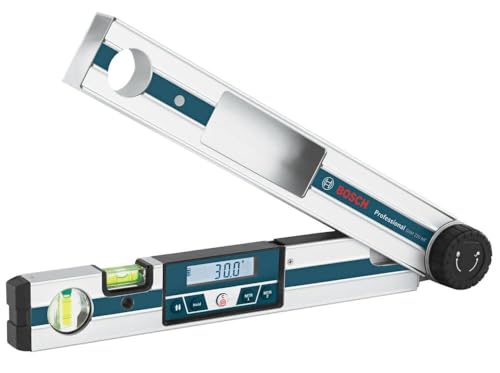
The Bosch GAM 220 MF is the premium option in this group and the only pick that does arithmetic for the user. Bosch describes it as four tools in one: an angle finder, a cut calculator, a protractor and a level. After measuring a corner, its calculator modes work out the single miter angle for crown and trim, and the compound mode handles pieces that sit at a spring angle, removing the most common source of error in crown work.
The trade-off is range. The GAM 220 MF measures from 0 to 220 degrees rather than a full circle, which covers every practical corner and miter situation but not reflex layout work. In return it is the most accurate tool here, rated by Bosch at plus or minus 0.1 degrees, and its 40 cm leg reaches across wide trim and deep returns. The housing is rated IP54 against dust and water, the display flips for overhead readings, and the package includes a leg extension, four AA batteries and a carrying case.
Specs
- Measuring range: 0 to 220 degrees
- Stated accuracy: plus or minus 0.1 degrees
- Leg length: 40 cm (about 16 inches)
- Functions: angle finder, single and compound miter calculator, protractor, level, angle memory, hold, flip display
- Protection rating: IP54 dust and water resistance
- Battery: 4 AA batteries, included per the listing
- Includes: leg extension and carrying case
- Tier: premium
General Tools 828 Digital Sliding T-Bevel

The General Tools 828 starts from the traditional sliding T-bevel rather than a protractor. Its 8-inch stainless steel blade slides and pivots in an impact-resistant ABS handle, so it can be pressed into an existing corner, locked with the steel knob, and carried to the saw exactly like an analog bevel gauge. The difference is the full LCD in the handle, which also reports the copied angle as a number, so the setting can be recorded for later use.
General Tools specifies a 0 to 360 degree range, accuracy of plus or minus 0.3 degrees and a fine 0.05-degree resolution. Four control buttons provide five functions: power, reading hold, reverse angle, flip display and zero. The reverse function is genuinely useful on trim work because it shows the complementary angle without mental subtraction. An automatic shut-off preserves the included CR2032 battery.
Specs
- Measuring range: 0 to 360 degrees
- Stated accuracy: plus or minus 0.3 degrees
- Display resolution: 0.05 degrees
- Blade: 8-inch stainless steel, sliding and locking
- Handle: impact-resistant ABS with full LCD display
- Battery: CR2032 lithium, included per the manufacturer
- Functions: hold, reverse angle, flip display, zero, automatic shut-off
- Tier: mid-range
Kirphealy Digital Angle Finder Protractor LF401

The Kirphealy LF401 is the budget pick, built around an enhanced ABS body instead of metal rules. That construction keeps it light, at roughly 4 ounces per the listing, and easy to carry in an apron pocket for trim checks around a house. The format is the familiar two-arm protractor: 7-inch, 200 mm arms with a large central LCD, a range of 0 to 360 degrees and a display resolution of 0.05 degrees. The listing states an accuracy of plus or minus 0.3 degrees, matching the metal GemRed tools on paper.
An automatic shut-off turns the tool off after about six minutes of inactivity, and the Amazon product information lists a CR2 battery as included. Buyers should note what the lower tier gives up: an ABS body flexes more than metal rules when pressed hard into a corner, and the shorter arms offer less bearing surface on wavy walls. For occasional layout the published specifications cover the task; for daily fitted work, a metal tool is the better long-term choice.
Specs
- Measuring range: 0 to 360 degrees
- Stated accuracy: plus or minus 0.3 degrees, per the listing
- Display resolution: 0.05 degrees
- Rule length: 7 inches (200 mm) per arm
- Body material: enhanced ABS
- Battery: CR2, included per the Amazon product information
- Weight: about 4 ounces
- Functions: large LCD readout, automatic shut-off after about 6 minutes
- Tier: budget
GemRed 82305 Stainless Steel Digital Angle Finder 300 mm
The long version of the GemRed 82305 stretches each rule to 300 mm, giving about 600 mm of combined reach when fully open. That extra length matters on wide boards, large cabinet carcasses and long trim runs, where a short protractor bridges over dips and crowns in the surface and reports an angle that averages the high spots. Longer arms register against more of the workpiece, so the reading better represents the corner as a whole.
The electronics match the smaller 82305: a 0 to 360 degree range, stated accuracy of plus or minus 0.3 degrees, 0.05-degree resolution, a locking knob, and a CR2032 coin cell. The penalty is bulk; folded, the tool is about 12 inches long and noticeably heavier than the 200 mm version. Woodworkers who mostly fit small parts will find the shorter tool handier, while anyone measuring across wide panels will use the extra bearing length on every job.
Specs
- Measuring range: 0 to 360 degrees
- Stated accuracy: plus or minus 0.3 degrees
- Display resolution: 0.05 degrees
- Rule length: 300 mm (about 12 inches) per arm, about 600 mm open
- Body material: stainless steel
- Battery: CR2032 coin cell
- Functions: angle lock, display hold
- Tier: mid-range
How to Choose a Digital Angle Finder
Decide what the number is for. If the goal is to copy an existing corner and carry it to a saw, a sliding T-bevel such as the General Tools 828 or a locking protractor does the job. If the goal is a saw setting, a calculator model such as the Bosch GAM 220 MF removes the step where most mistakes happen, converting a measured corner into single or compound miter angles directly.
Check the range before the resolution. A full 360-degree range handles inside, outside and reflex angles with one tool. A 220-degree tool covers ordinary corners and miters but cannot open flat or fold back for layout work. Resolution is the smaller concern: nearly every tool here displays 0.05 degrees, while stated accuracy sits between plus or minus 0.1 and plus or minus 0.3 degrees. Accuracy, not display fineness, decides how tight a miter can close.
Match arm length to the work. Seven-inch arms are easier to handle on small parts and short trim. Twelve-inch and 40 cm arms average out surface irregularities on wide boards and long runs, and stay registered against both faces of a corner with less rocking.
Consider body material and locking. Metal rules stay straight and hold a setting while the knob is tightened; plastic bodies are lighter but can flex under hand pressure. Whatever the material, a positive lock is essential, because an arm that creeps while the tool is lifted from a corner makes the readout meaningless.
Plan for batteries and storage. Coin-cell tools are slim and light, and an automatic shut-off stretches battery life. Calculator models use AA cells and usually ship with a case, suiting a tool that travels between shop and job site. A hold function and flip display sound minor until a reading must be taken overhead or inside a cabinet.
FAQ
Can a digital angle finder replace a cube-style angle gauge?
No, because the two tools measure different things. A cube gauge sits on a saw table and reads blade or fence tilt relative to that surface. An angle finder opens between two faces and reports the angle between them. Setting blade bevel calls for the cube; copying a corner, laying out a polygon or finding a miter setting calls for the finder. Many shops keep one of each.
How accurate does an angle finder need to be for tight miters?
Stated accuracy of plus or minus 0.3 degrees, the figure published for most tools in this roundup, is enough for painted trim and general furniture work. For stain-grade crown, long miter runs and large frames, errors add up around the joint, so a tool rated at plus or minus 0.1 degrees, such as the Bosch GAM 220 MF, leaves more margin. Technique matters as much: both arms must sit flat against their faces before the lock is set.
What is the difference between an angle finder and a sliding T-bevel?
A protractor-style angle finder has two rules of fixed length hinged at one pivot, and it measures the angle where the rules meet. A sliding T-bevel has one blade that slides and rotates in a handle, so it reaches into shallow spaces where a fixed pivot will not fit. Digital versions of both show the angle as a number; the General Tools 828 is the bevel pattern, and the GemRed and Kirphealy tools are the protractor pattern.
Do digital angle finders work for crown molding?
Yes. Measure the corner with the finder, then either halve the reading for a simple miter or use a calculator model that accounts for the spring angle of the crown. The Bosch GAM 220 MF performs that compound calculation in the tool. With a basic protractor, the measured corner angle is the starting point for a crown chart or a saw with crown stops, and the finder still removes the guesswork of measuring the wall.
Conclusion
Digital angle finders solve the measurement that cube gauges cannot: the angle between two real surfaces. The GemRed 82305 in 200 mm aluminum is the balanced default for general layout, with a full-circle range and published accuracy in line with the class. The Bosch GAM 220 MF earns its premium tier by calculating miter settings and posting the tightest accuracy specification here. The General Tools 828 suits anyone who already works with a sliding bevel and wants a number to go with the copied angle, the Kirphealy LF401 covers occasional layout at a budget tier, and the 300 mm GemRed serves wide work where short arms cannot register properly.
Related guides
More from Amazon
Programs that pair well with the guide above. Offers and eligibility are set by Amazon and may change.
A free business account with business pricing and bulk-buying tools for work, shop or home office.
Create a business accountFree shipping on eligible items, Prime Video and more. Eligible new members can start with a free trial.
Start a Prime free trialAudiobooks and podcasts to listen to on the go. Eligible new members can start with a free trial.
Try Audible freeAd-free music streaming. Eligible new subscribers can start with a free trial.
Try Music Unlimited freeAs an Amazon Associate we earn from qualifying purchases.

Write Your Review
No reviews yet. Be the first to share your experience!