How to Troubleshoot a Drill Press That Vibrates Under Load
What's inside
As an Amazon Associate I earn from qualifying purchases. This post may contain affiliate links at no extra cost to you.
Contents
Start with safety and confirm the symptom
Unplug the drill press before checking the chuck, belt, pulleys, table, or spindle. A press can start unexpectedly if its switch is bumped, and a loose sleeve or wrench can become a projectile. Do not run the machine with guards removed unless a specific check requires it and you can keep clear of rotating parts. Never hold a workpiece by hand to test vibration.
First establish when the vibration occurs. Does it happen with no bit installed, only after the motor starts, or only when a bit cuts wood? Does it change with spindle speed? A press that runs smoothly unloaded but shakes under cutting load points toward a different problem than one that vibrates with nothing in the chuck. Make a note of the speed setting, bit type, material, and how much pressure you applied.
Check the workpiece, bit, and setup
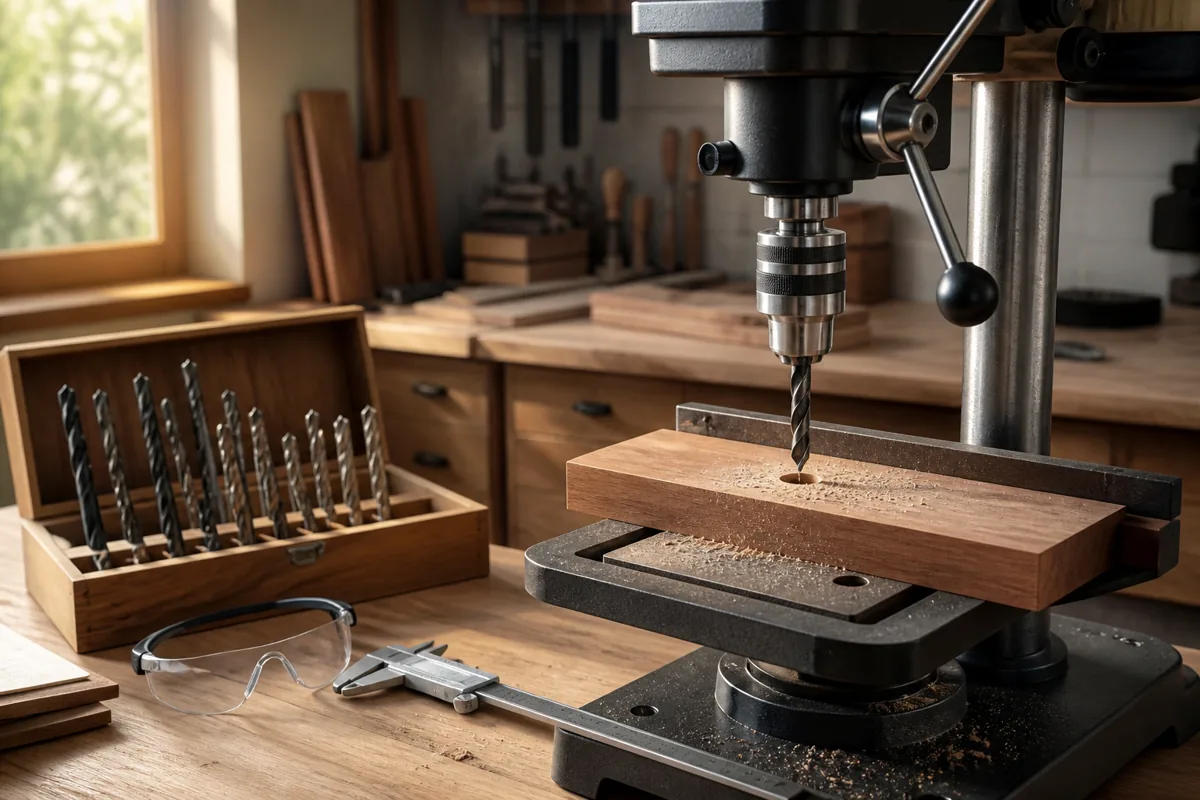
Secure the workpiece to the table with clamps or a drill-press vise. A board that rocks, a rounded edge that is not supported, or a clamp that is not tight can chatter as the bit enters. Check that the table is locked and that the head and base fasteners are tight. A loose table or stand can magnify vibration that starts elsewhere.
Inspect the bit for bent shanks, chipped cutting edges, pitch buildup, or an uneven grind. Roll a straight-shank bit on a flat surface; a visible gap beneath the shank suggests it is bent. Clean resin from Forstner bits and hole saws, and replace damaged bits. A dull bit can need more feed pressure and rub rather than cut, making vibration worse. For a small repair kit, a drill-bit sharpening stone can be enough for simple edge touch-ups, though badly damaged or specialty bits are better replaced.
Use a speed suited to the bit diameter and material. Large bits generally need slower speeds; forcing a large Forstner bit at a high setting can make it grab or chatter. If the vibration appears only during cutting, reduce feed pressure and try a slower speed. If the press then cuts smoothly, the problem may be technique, a dull bit, or an unsuitable speed—not a failing machine.
Isolate the source in stages
With the press unplugged, remove the bit and check that the chuck is seated firmly. If the chuck is visibly loose on the arbor, consult the machine manual for reseating instructions. Do not hammer on the chuck or spindle; impact can damage bearings or the taper. Clean dirt and debris from the chuck jaws, and make sure the bit is gripped straight and fully enough to avoid wobble.
Next, turn the spindle by hand. It should rotate smoothly, without a gritty feel, catching, or obvious side-to-side movement. Some movement can be difficult to judge without a dial indicator, so do not condemn bearings based on a vague impression alone. If you have an indicator, measure runout at the chuck and then at the spindle taper or arbor, if accessible. Chuck-only runout may come from the chuck; runout that remains at the spindle points farther into the machine.
Check the belt with power disconnected. Look for cracks, glazing, frayed edges, or a damaged section. Confirm it is seated in the pulley grooves and that the motor and spindle pulleys are aligned. A belt that is too loose can flutter under load; one overtightened in an attempt to stop slip can strain bearings. Adjust tension to the manual’s guidance rather than tightening it as much as possible.
Match the symptom to likely causes
| When it vibrates | Likely causes | First check |
|---|---|---|
| Unloaded, at most speeds | Loose mounting, pulley imbalance, bent shaft, worn bearings | Fasteners, belt, spindle feel |
| Only with a bit installed | Bent bit, poor chuck grip, dirty or worn chuck | Try a straight, known-good bit |
| Only while cutting | Loose work, dull bit, excessive feed, wrong speed | Clamp the work and reduce feed |
| At one speed range | Resonance, belt or pulley issue, loose component | Check belt seating and pulley fasteners |
This table narrows the search; it does not prove a particular part has failed. A thin benchtop stand can resonate at one speed even when the spindle is sound. Tightening the stand or bolting it to a stable bench may solve that without replacing machine parts.
Inspect belts, pulleys, and mounting points
With the cover open and power disconnected, check pulley set screws and look for cracks or wobble. A pulley that shifts on its shaft can vibrate more as cutting load changes. Do not run the press with a cover open for a casual visual check. If you need to observe a fault under power, follow the manual and keep hands, clothing, and tools well away from moving parts; stop if the machine becomes unstable.
If the belt is worn, replace it with the specified type and length. A generic replacement may be cheaper, but a belt with the wrong profile or length can slip, ride poorly, or require incorrect tension. A drill-press replacement belt is a sensible purchase only after matching the old belt and manual specifications.
Know when to repair or stop using it
Stop using the press if the spindle has obvious looseness, the chuck drops or shifts, the motor smells hot, the pulley wobbles, or vibration is strong enough to move the machine. These can signal bearing, shaft, or mounting damage. Continued operation may turn a repairable problem into a damaged spindle or cracked casting. Check the manual for bearing serviceability; on some presses, replacement is straightforward, while on others labor and parts can approach the cost of a replacement machine.
For a low-cost press used occasionally, a sound bit, a secure workpiece, a correctly adjusted belt, and a stable bench are usually the best-value fixes. Buying a replacement chuck makes sense only if runout follows the chuck rather than the spindle. If the spindle itself is damaged or bearings are noisy and hard to replace, compare the repair quote with a new press before spending. Do not buy a larger machine just to mask vibration: correct setup and a sharp bit matter on any press.