
What's inside
- What is in this guide
- What a wood router does and why beginners buy one
- Router types explained
- Key features that matter on a first router
- Size, power, and workspace considerations
- Budget tiers described honestly
- Who should buy what
- Setting up your first router
- Router safety essentials
- Maintenance that keeps a router accurate
- Common beginner mistakes
- Pre-purchase checklist
- Frequently asked questions
- Conclusion
As an Amazon Associate I earn from qualifying purchases. This post may contain affiliate links at no extra cost to you.
The short answer: the best wood routers for beginners are usually a compact or mid-size router with a variable-speed motor, a collet that accepts both 1/4-inch and 1/2-inch shank bits, smooth depth adjustment, and a soft-start feature. If you can only buy one tool, a combination kit that includes both a fixed base and a plunge base gives you the most flexibility. If your projects are mostly small edge work, a compact trim-style router is easier to control and cheaper to start with.
That is the quick version. The rest of this guide explains why, so you can match a router to the work you actually plan to do instead of buying whatever has the biggest motor on the box. We cover the main router types, the features that genuinely matter, how to think about power and size, a sensible first setup, safety rules, maintenance, and the mistakes most newcomers make in their first few weeks.
Contents
- What is in this guide
- What a wood router does and why beginners buy one
- Router types explained
- Key features that matter on a first router
- Size, power, and workspace considerations
- Budget tiers described honestly
- Who should buy what
- Setting up your first router
- Router safety essentials
- Maintenance that keeps a router accurate
- Common beginner mistakes
- Pre-purchase checklist
- Frequently asked questions
- Conclusion
Our Top Picks


What is in this guide
- What a wood router does and why beginners buy one
- Router types explained
- Key features that matter on a first router
- Size, power, and workspace considerations
- Budget tiers described honestly
- Who should buy what
- Setting up your first router
- Router safety essentials
- Maintenance that keeps a router accurate
- Common beginner mistakes
- Pre-purchase checklist
- Frequently asked questions
- Conclusion
What a wood router does and why beginners buy one
A router is a motor that spins a cutting bit at very high speed, typically somewhere in the tens of thousands of revolutions per minute. You guide the spinning bit along or across a piece of wood, and it removes material in a shape determined by the bit. Swap the bit and the same tool does something entirely different. That versatility is why a router is often called one of the most useful power tools in a small shop.
Common beginner jobs include rounding over sharp edges so a tabletop feels comfortable, cutting decorative profiles on shelf edges, trimming a plywood edge flush with a template, cutting grooves for drawer bottoms or cabinet backs, making dados and rabbets for joinery, and hollowing out recesses for hinges. A router can also flatten a slab when used with a sled, though that is not a first-week project.
What makes the tool intimidating is not complexity but speed. A router removes wood quickly and reacts immediately to how you push it. The good news is that most of the skill is a handful of habits: feed direction, shallow passes, secure clamping, and sharp bits. A well-chosen beginner router makes those habits easier, because it is comfortable to hold, easy to adjust, and does not start with a violent jerk.
Router types explained
Routers are divided mostly by how the motor attaches to its base and by overall size. Understanding the categories matters more than comparing individual products, because the category decides what the tool is good at.
Fixed-base routers
In a fixed-base router, the motor sits in a base and you set the bit depth before you turn the tool on. The depth stays put while you cut. This design is simple, stable, and has a lower center of gravity, which many beginners find easier to control during edge work such as roundovers and chamfers. It is also the type most commonly mounted under a router table. The limitation is that you cannot lower a spinning bit into the middle of a workpiece, so it is not ideal for stopped grooves or mortises.
Plunge routers
A plunge router rides on spring-loaded posts. With the tool running, you push down to lower the bit into the wood, then lock the depth or release the lock and let the spring lift the bit out. This is the right design for mortises, stopped dados, inlay recesses, and any cut that starts in the interior of a board. Many plunge routers also have a rotating depth stop turret so you can take a cut in several preset steps. Plunge routers are generally taller and a little more top-heavy, and they take slightly longer to learn.
Combination kits
A combination kit pairs one motor with two bases, fixed and plunge. You swap the motor between them as needed. Because you buy one motor and two bases, this is typically a better value than buying two separate routers, and it means you are not forced to guess which style you will need. For many beginners who expect their woodworking to grow, this is the safest single purchase.
Compact and trim routers
Compact routers, often called trim routers or laminate trimmers, are small, lightweight, one-handed tools that usually accept smaller bits. They are excellent for roundovers, small chamfers, trimming veneer and laminate, and light hinge work. Their smaller motors cannot handle deep or wide cuts in hardwood, but for the edge-profiling that many beginners do most, they are accurate and far less tiring than a full-size router.
Router table setups
A router table is not a type of router so much as a way to use one. The router is mounted upside down beneath a flat table and you move the wood past the bit. This is often safer and more accurate for small parts, because the workpiece, not the tool, moves against a fence. It is a second purchase for most people, not a day-one requirement.
| Type | Best for | Beginner friendliness | Main drawback |
|---|---|---|---|
| Fixed-base | Edge profiling, router table use | High: stable and simple | Cannot plunge into the middle of a board |
| Plunge | Mortises, stopped grooves, inlays, dados | Moderate: more to learn | Taller, slightly top-heavy |
| Combination kit | General shop use as skills grow | High: covers both styles | Higher upfront cost than a single base |
| Compact / trim | Small roundovers, laminate, light hinge work | Very high: light and one-handed | Limited power and bit size |
If you want a starting point, a quality combination kit is a strong default, and a compact router is a sensible low-cost first step. If you want a closer look at how the two compare in practice, see our combination router kit options.
Key features that matter on a first router
Spec sheets are full of numbers and marketing language. A handful of features account for most of the difference in how a router feels to use, and these are the ones worth checking before you buy.
Variable speed control
Bit diameter and wood type determine the safe spinning speed. Large-diameter bits should run slower, because the outer edge of a big cutter travels much faster than the edge of a small one. Variable speed also lets you reduce burning in dense woods like cherry or maple. A router with a single fixed speed is a poor choice for anyone who wants to use a wider range of bits.
Collet size
The collet is the clamp that grips the bit shank. Common shank sizes are 1/4 inch and 1/2 inch. A 1/2-inch shank is stiffer, vibrates less, and is generally preferred for larger bits. A 1/4-inch shank has a wider selection of inexpensive bits. A router that accepts both sizes, by including or offering two collets, gives you the most choice. Never force a bit into a collet that does not match its shank.
Soft start
A soft-start motor ramps up to speed instead of reaching full rpm instantly. Without it, a powerful router can twist in your hands at the moment you press the switch. For a beginner this is a genuine confidence feature, not a gimmick.
Depth adjustment
This is where cheaper and better routers diverge most. Look for a mechanism that moves in small, repeatable increments, locks firmly without drifting, and has a readable scale. Some routers have a fine-adjustment knob for tiny changes, which makes it much easier to sneak up on an exact depth. Slop or backlash in the adjustment will frustrate you on every project.
Switch position and ergonomics
Can you reach the power switch without letting go of a handle? Is the grip comfortable for your hand size? A router you cannot comfortably control is a router you will not use safely. If possible, handle the tool in a store before you decide.
Base visibility and bit changes
A clear or generously cut base lets you see the bit and layout line while cutting. A spindle lock, which holds the shaft still so you need only one wrench, makes bit changes quicker and less awkward. Both are small details that you will appreciate on the fortieth bit change.
Dust collection
Routing produces a lot of chips and fine dust. Some routers and accessory bases accept a dust port that connects to a shop vacuum. This improves visibility and, importantly, reduces the fine wood dust you breathe. Even with a vacuum attached, wear a respirator rated for fine dust during extended sessions.
| Feature | What to look for | Why it matters for beginners |
|---|---|---|
| Speed control | Variable speed dial across a wide range | Lets you slow down for large bits and avoid burning |
| Collet | 1/4-inch and 1/2-inch shank compatibility | More bit choices and a stiffer grip for bigger cutters |
| Soft start | Gradual ramp-up on power-on | Reduces startup torque and surprise |
| Depth adjustment | Smooth, lockable, fine-adjust option | Accurate, repeatable cuts with fewer test pieces |
| Spindle lock | Single-wrench bit changes | Faster, safer bit swaps |
| Dust port | Vacuum-compatible attachment | Better sight lines and less airborne dust |
| Base design | Flat, clear, accepts guide bushings | Visibility, stability, and template work later on |
Size, power, and workspace considerations
Router power is usually listed in horsepower or amps. Rather than chase the highest number, think about the cuts you plan to make.
Compact routers are generally in the lower power range and are happy with small bits and shallow passes. Mid-size routers, which are the most common choice for a first full-size tool, typically have enough power for most edge profiles, grooves, and dados in common hardwoods and softwoods when you take sensible, shallow passes. Large, high-power routers are intended for heavy cuts, big panel-raising bits, and continuous table use. They are heavy, loud, and harder to control freehand, so they are rarely the right first router.
A common beginner misunderstanding is that more power means you can cut deeper in one pass. It does not. Even a very powerful router should take a bit of wood at a time, because a deep cut increases heat, tear-out, and the chance of the router grabbing. Power is useful mainly so the motor does not bog down, not so that you can skip passes.
Weight and size deserve equal attention. A router you hold in one hand for edge work should feel manageable. If you have smaller hands, limited strength, or plan to work on overhead or vertical surfaces, a lighter tool is a real advantage. On the other hand, a very light tool can feel twitchy on long straight cuts, so think about where you will spend most of your time.
Also consider your space. A router by itself needs very little room, but the work it enables does not: you need a flat bench, clamps, and enough clear space around the workpiece to move the tool through a full cut without hitting anything. Noise is a factor too. Routers are loud, and hearing protection is not optional. If you work in a garage or apartment complex, think about neighbors and cut times.
Budget tiers described honestly
Prices change often and vary by region, so rather than quote figures, here is what you can generally expect at different spending levels.
- Entry level: Usually compact routers or basic single-base models. They often have a fixed speed or limited speed range and simpler depth adjustment. They can do real work on small projects, but expect more vibration, more play in the adjustment, and fewer included accessories.
- Mid range: This is where most beginners get the best balance. You commonly find variable speed, soft start, better depth mechanisms, 1/2-inch collets, and combination kits with two bases. Build quality is usually good enough that the tool will last for years of hobby use.
- Premium: Higher-end routers add more precise fine-adjust systems, better dust management, sturdier bearings, and refined ergonomics. They are a pleasure to use, but a beginner will not see most of the benefit until their skills catch up with the tool.
Do not forget to budget for bits, a straight edge, clamps, safety glasses, hearing protection, and a respirator or dust mask. These supporting items often cost as much as a modest router, and a decent set of starter router bits will make your first projects far more rewarding than a fancier motor with only one cutter.
Who should buy what
Your best choice depends on what you expect to build in the next year or two. Use these scenarios as a guide.
- You mostly want to soften edges and make small boxes or picture frames: a compact trim router is likely enough. It is light, inexpensive, and easy to control with one hand.
- You are building furniture, shelves, and cabinets: a mid-size router, ideally a combination kit, covers grooves, dados, rabbets, roundovers, and mortises. This is the most versatile single choice.
- You plan to build a router table soon: prioritize a fixed-base router with a 1/2-inch collet, easy above-the-table height adjustment, and enough power for table-mounted bits. Check that the motor can be removed from its base and fits common table plates.
- You have limited hand strength or work mostly on small parts: a lighter compact router, possibly paired with a small router table for the tiniest pieces, is both safer and more comfortable.
- You want one tool that will not need replacing: a mid-range combination kit gives room to grow. A compact router often joins it later as a second tool for light work.
If you are still undecided, think about which job you are most likely to do first, then buy for that job rather than for every possible one. A lighter compact option such as a compact trim router is a gentle way to learn the fundamentals before committing to a bigger purchase.
Setting up your first router
Before the first cut, take time to set the tool up properly. A careful setup prevents most of the problems beginners run into.
- Unplug the router. Always unplug it, or remove the battery on a cordless model, before changing bits or adjusting anything near the collet.
- Inspect the bit. Look for chips, bent shanks, or heavy pitch buildup. A damaged bit should be thrown away, not used.
- Insert the shank properly. Push the shank fully into the collet, then pull it back out about 1/8 inch so the shank is not bottomed out. Bottoming out can make the bit loosen or be hard to remove. Tighten the collet firmly with the wrench; the shank should be gripped along most of its length.
- Set the depth. Start shallow. Many routing jobs are best done in multiple passes, each removing only a small amount of wood. For a groove, set the first pass to a fraction of the final depth and deepen incrementally.
- Choose the speed. Use the manufacturer’s guidance for the bit diameter. Larger bits should run slower; small bits can run faster.
- Secure the workpiece. Clamp it to the bench with both hands free to hold the router. Do not rely on holding the board with one hand.
- Make a test cut. Use a scrap piece of the same wood. Check the profile and depth before you touch the project piece.
- Plan your path. Know where the cord is, where you will stand, and how you will finish the cut without being off balance.
Understanding feed direction
For handheld routing, the bit rotates clockwise when viewed from above. To keep control, you generally feed the router so that the bit is cutting into the wood against its rotation. For an outside edge, that means moving the router counterclockwise around the workpiece; for an inside edge, such as the inside of a frame opening, it means moving clockwise. Feeding the wrong way, called a climb cut, makes the bit try to pull the router forward and can make it run away from you. Very light climb passes are sometimes used by experienced woodworkers to reduce tear-out, but a beginner should treat them as something to avoid until they understand the risk.
Let the bit do the work
Move at a steady pace. Pushing too slowly can burn the wood, especially in dense species and cherry. Pushing too hard bogs the motor and leaves a rough finish. Listen to the motor: a steady, consistent sound usually means you are in the right range. Take the router off the wood before turning it off, and wait for the bit to stop spinning completely before setting the tool down.
Router safety essentials
A router is not dangerous when treated with respect, but it will injure you quickly if you get careless. These rules cover the most important points.
- Wear eye protection every time. Chips and fragments leave the bit at speed. Safety glasses or a face shield are essential.
- Wear hearing protection. Routers are loud enough to cause hearing damage over time.
- Protect your lungs. Fine wood dust is a respiratory irritant, and some species can trigger allergic reactions. Use dust collection and a respirator or dust mask suitable for fine particles.
- Use two hands on the router. Keep both hands on the handles whenever the bit is spinning, and keep your fingers well away from the bit.
- Clamp the work. Never hold a small piece in one hand while routing it freehand. Use clamps, a non-slip mat, or a jig. For tiny parts, route a longer board and cut the pieces afterward, or use a router table with appropriate guards and push blocks.
- Mind the cord. Keep the cord behind you and away from the cutting path.
- Avoid loose clothing, jewelry, and long hair. Anything that can catch the spinning parts is a hazard.
- Take shallow passes. Deep cuts increase kickback and loss of control. Several light passes are safer and produce a cleaner result.
- Always disconnect power before changes. Unplug the router for bit changes and adjustments.
- Let the bit stop completely. Do not set the router down while the bit is still spinning, and do not lift a spinning router off the bench and wave it around.
- Read the manual. Your tool’s manual includes specific guidance on speeds, bit sizes, and accessories. Follow it.
Router table work has its own rules. Use a fence, feather boards, push blocks, and a guard where possible, feed against the bit rotation, and never rout very small pieces by hand against an exposed bit. If you are not sure a setup is safe, stop and rethink it.
Maintenance that keeps a router accurate
Routers are simple machines, and a few habits keep them running well for years.
- Clean after use. Blow or brush chips and dust from the base, the motor vents, and the collet area. Dust built up around the vents can contribute to overheating.
- Clean the collet and shaft. Resin and fine dust inside the collet can cause bits to slip or run out of true. Wipe the collet and the bit shank clean, and replace a worn or damaged collet rather than trying to make it work.
- Clean bits. Pitch and resin buildup dulls bits and causes burning. Use a cleaner designed for resin removal, and avoid scraping the carbide edges with hard tools.
- Keep bits sharp. A dull bit tears the wood, burns, and forces you to push harder. Replace or have bits professionally sharpened when they stop cutting cleanly.
- Check the cord and switch. Look for cuts, cracks, or loose plugs. Do not use a router with a damaged cord.
- Lubricate the posts on plunge models. Follow the manual’s recommendation for cleaning and lubricating the guide posts so the plunge action stays smooth.
- Store it properly. Keep the router and bits in a dry place. Rust on bits and collets is a common problem in damp garages, and a light wipe with a protectant can help.
- Watch for wear. On brushed motors, the carbon brushes wear over time. Many tools have replaceable brushes; check your manual for how and when to inspect them. Unusual noise, smell, or vibration are signs to stop and investigate.
Common beginner mistakes
Taking one deep pass
It is tempting to set the final depth and cut in one go. This overloads the motor, burns the wood, and increases the chance of the router grabbing. Make multiple shallow passes instead.
Using the wrong speed
Running a large bit at maximum speed is both unsafe and hard on the bit. Check the manufacturer’s guidance and reduce speed for larger diameters.
Feeding in the wrong direction
Feeding with the rotation instead of against it makes the router tend to run away. Learn the rule for outside and inside edges and practice on scrap first.
Skipping the test cut
A scrap piece costs almost nothing, while a ruined project piece may cost hours. Always test the profile and depth first.
Poor clamping
Workpieces that shift mid-cut ruin the cut and create hazards. Use real clamps and give yourself room to move.
Routing across the end grain at the end of a pass
When a bit exits the far edge of a board, the fibers there can break out, leaving a chipped corner. Rout the end grain first, then the long grain, or clamp a sacrificial backer board at the exit point.
Buying too many bits too early
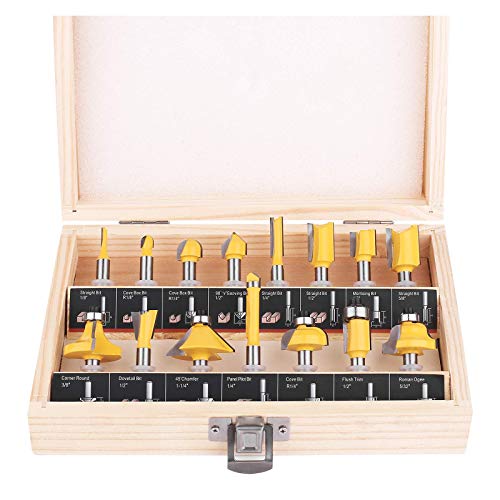
A giant bit set looks like a bargain, but you will use only a handful. Begin with a straight bit, a roundover bit, a chamfer bit, and perhaps a flush-trim bit with a bearing, and add others as projects demand them.
Ignoring dust
Fine dust builds up quickly. Use dust collection, wear a respirator, and clean the work area regularly.
Neglecting the bearing
Many edge bits use a bearing to guide the cut. A bearing that is gummed up with resin or worn out will leave marks or stop spinning. Keep bearings clean and replace them when they feel rough.
Pre-purchase checklist
Print this out or keep it on your phone when you shop.
- I know whether my first projects are mostly edge work, grooves and joinery, or both.
- The router has variable speed control.
- The router has soft start, or I am comfortable managing startup torque.
- The collet accepts 1/2-inch shanks, or includes a reducer or second collet for 1/4-inch bits.
- The depth adjustment feels smooth, locks firmly, and has a readable scale.
- The switch is reachable while holding the handles.
- The tool is a weight and size I can control comfortably.
- The base is flat and offers good visibility of the bit.
- A dust port is available or included.
- Replacement parts such as collets and bases are available.
- I have budget for safety glasses, hearing protection, a dust mask or respirator, clamps, and a few quality bits.
- I have read the warranty and return policy.
- I have a flat bench and a plan for where I will use the tool.
Frequently asked questions
What is the best type of router for a complete beginner?
A mid-size router with variable speed and soft start is usually the most forgiving all-rounder, and a combination kit with fixed and plunge bases adds flexibility. If your projects are small and mostly involve edges, a compact trim router is easier to hold and control.
Should I buy a fixed-base or plunge router first?
If you will mainly profile edges or plan to use a router table, start with a fixed base. If you need mortises, stopped grooves, or interior cuts, a plunge router is better. A combination kit avoids having to choose.
How much horsepower do I need?
For most hobby work, a mid-range motor is enough when combined with shallow passes. Very high power is mainly for large bits and sustained table use. A heavier, more powerful router is harder for a beginner to control by hand.
Is a cordless router a good first purchase?
Cordless models are convenient and remove the cord from the cutting path, which is nice for small tasks. However, runtime and power depend on the battery, so they suit lighter work best. If you already own batteries for a tool system, it may be worth considering, but check that the model handles the bits you want to use.
Do I need a router table right away?
No. Many people spend months or years routing freehand with clamps and jigs. A table is helpful for small parts, repeated profiles, and edge work on narrow stock, and you can add one later using a fixed-base router.
Which router bits should I buy first?
A straight bit for grooves and dados, a roundover bit for softening edges, a chamfer bit, and a flush-trim bit with a bearing cover a large share of beginner projects. Buy quality bits individually rather than a very large low-quality set.
Why does my router burn the wood?
Burning usually comes from a dull or dirty bit, a feed rate that is too slow, a speed that is too high for the bit size, or stopping in one place while the bit is spinning. Clean or replace the bit, adjust speed, and keep the router moving at a steady pace.
Is routing dangerous for beginners?
Any power tool carries risk, but routing is manageable with good habits: secure clamping, shallow passes, correct feed direction, eye, ear, and lung protection, and unplugging before bit changes. Practice on scrap, start with simple cuts, and stop whenever something feels unsafe.
Conclusion
The best wood routers for beginners are the ones that make good habits easy: a comfortable size, variable speed, soft start, smooth depth adjustment, and a collet that accepts common bit shanks. A combination kit gives you the widest range of work at a reasonable value, while a compact router is a gentle, affordable way to start. Whichever you choose, spend part of the budget on safety gear, clamps, and a small set of quality bits. Practice on scrap, take shallow passes, and feed in the correct direction. With those basics in place, a router quickly becomes one of the most rewarding tools in your shop.
Disclosure: As an Amazon Associate, fdwoodworking.com earns from qualifying purchases made through links on this page, at no extra cost to you.
Related guides
More from Amazon
Programs that pair well with the guide above. Offers and eligibility are set by Amazon and may change.
A free business account with business pricing and bulk-buying tools for work, shop or home office.
Create a business accountFree shipping on eligible items, Prime Video and more. Eligible new members can start with a free trial.
Start a Prime free trialAudiobooks and podcasts to listen to on the go. Eligible new members can start with a free trial.
Try Audible freeAd-free music streaming. Eligible new subscribers can start with a free trial.
Try Music Unlimited freeAs an Amazon Associate we earn from qualifying purchases.




Write Your Review
No reviews yet. Be the first to share your experience!