How to Change Straight Knives in a Stationary Jointer
What's inside
As an Amazon Associate I earn from qualifying purchases. This post may contain affiliate links at no extra cost to you.
Contents
Before you start
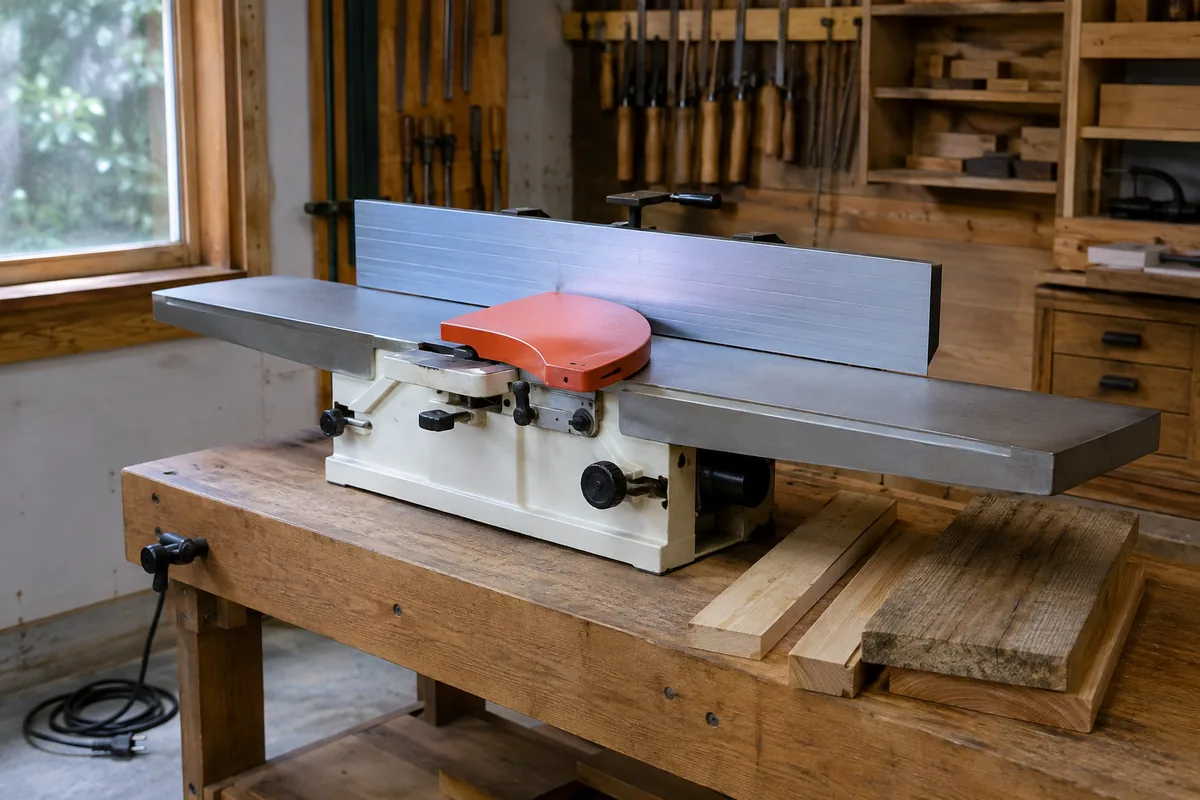
Changing straight knives in a stationary jointer is a precision job, not just a blade swap. Knives set too high can catch the workpiece; knives set too low leave ridges and make it hard to get a flat face. A small mismatch between knives can also leave steps across the board.
First, identify the cutterhead type. This procedure is for a conventional straight-knife head with individual knives held by gib bars and screws. A spiral or helical head uses replaceable inserts and a different procedure. Check the jointer manual for the correct knife dimensions, sharpening limits, torque, and setup method. Knives that look similar may differ in length, thickness, or hole pattern.
Unplug the machine and verify it cannot start. Remove the fence or move it clear, then open the cutterhead guard as directed by the manual. Wear cut-resistant gloves while handling loose knives, but take them off before turning the cutterhead or tightening fasteners if they could snag. Keep fingers out of the cutterhead openings.
Tools and replacement parts
Use the correct replacement knives for your jointer, plus the specified driver or wrench. A knife-setting jig is useful if your machine supports one; a dial indicator gives finer control but takes longer to use. A straightedge helps check the cutterhead and tables, but it is not a substitute for measuring knife projection. For comparison, the common approaches have different costs and limits:
| Method | What it does well | Trade-off |
|---|---|---|
| Machine-specific setting jig | Sets knives to a repeatable height quickly | Must match the cutterhead or knife system |
| Dial indicator | Measures projection precisely across the knife | Slower; needs a stable base and careful technique |
| Straightedge and hand adjustment | Inexpensive and adequate for some machines | More sensitive to feel and operator consistency |
If you need a jig, look for a jointer knife-setting jig made for your cutterhead style. A basic jig is often a sensible buy for a jointer that gets occasional home-shop use. For frequent knife changes or a machine with no compatible jig, a dial indicator with a stable base offers more control, but only if you know how to reference it consistently.
Remove the old knives
Rotate the cutterhead by hand only when the machine is unplugged. Bring one knife to a position where you can reach its fasteners safely, following the manual’s access instructions. Loosen the gib screws gradually and evenly. Keep a hand on the knife so it cannot slide or drop as the gib releases. Remove the knife and gib, then set them aside in order.
Repeat for the remaining knives, turning the cutterhead carefully between positions. Do not pry against the cutterhead or use a screwdriver as a wedge; damaged seating surfaces can prevent a knife from sitting flat. If a screw is seized, stripped, or packed with resin, stop and clean or replace it rather than forcing it. Worn or damaged screws may not clamp the gib securely.
Clean the knife seats, gib bars, and screw threads with a suitable brush and solvent approved by the manual. Resin or fine chips trapped under a knife can raise one end enough to cause a visible ridge. Avoid abrasive grinding on the cutterhead or gib faces. Inspect the knives for cracks, chips, and uneven wear before deciding whether they are reusable.
Install and set the new knives
Fit one knife and its gib in the correct orientation. Make sure the knife rests flat and is aligned with the cutterhead, then snug the screws without fully tightening them. Adjust the knife using the machine’s recommended jig or measurement method. Repeat along the knife’s length: the ends and center should not show a meaningful height difference. A knife that is even at one end but high at the other can produce tapered cuts or chatter.
Set each knife to the height specified by the manufacturer. Do not assume that matching the old knife position is accurate; the old set may have been wrong or uneven. With an indicator, take readings at several points along each knife and compare them. With a setting jig, seat it consistently and follow its instructions. A straightedge-and-hand method can work on machines designed for it, but do not rely on a casual visual estimate.
Once the knife is set, tighten the screws in the specified order and to the specified torque if the manual gives one. Tightening can shift the knife, so recheck its height afterward. Then repeat for the other knives. The goal is for all knives to share the same projection, not merely to appear level by eye. Avoid over-tightening: it can damage threads or the gib and still fail to correct a knife that is not seated properly.
Checks before using the jointer
Turn the cutterhead by hand through a full rotation. Confirm that no knife, gib, or screw contacts the tables, guard, or housing. Reinstall the guard and fence, clear tools from the machine, and reconnect power only when the setup is complete. Stand clear of the cutterhead and run the jointer briefly without stock. Stop immediately if you hear knocking, scraping, or unusual vibration.
Make a light test cut on a straight, defect-free scrap board. Check the face for ridges, scallops, or a repeating line that could indicate one knife is set differently. A step across the width often points to a knife-height mismatch; persistent chatter can also come from loose fasteners, dull knives, poor stock support, or a cutterhead problem. Disconnect power before inspecting or adjusting anything.
If the knives will not stay set, a screw will not tighten, the cutterhead is damaged, or vibration remains after correct installation, do not keep running the machine. Consult the manual or a qualified repair shop. For occasional use, paying for one careful setup may be cheaper than buying measuring tools; if you change knives regularly, a compatible jig or indicator can save time and make repeatable settings easier.