Best Whole House Water Filtration and Softener Combos
What's inside
- Top 3 Picks
- Quick Comparison
- How We Chose
- 1. Kind Water Systems E-3000 – Best for City Water Households That Want Softening Without Salt
- 2. PRO+AQUA PRO-E-S80E Elite Whole House Water Filtration System & 80,000 Grain Water Softener Combo – Best Overall for Larger Households on City Water
- 3. Kind Water Systems E-3000UV Whole House Salt-Free Softener & Filter Combo with UV – Best for City Water Households That Also Want Disinfection
- 4. Aquasure Whole House Water Filtration Bundle with Water Softener, 75 GPD RO System & Dual Purpose Sediment/GAC Pre-Filter – Best for Drinking Water Quality at Every Tap
- 5. PRO+AQUA Elite 5-Stage Whole House Water Softener and Filter Bundle System for Well Water – Best for Private Wells with Iron and Heavy Metals
- 6. NU Aqua 4-Stage Salt Free Water Softener Whole House Water Filter System – Best Mid-Range Salt-Free Option for Renters and Smaller Homes
- 7. Express Water Whole House Water Filter System, Ultimate Protection, 3-Stage – Best Budget Filtration Base
- 8. Kenmore Elite 520 Hybrid Water Softener & Whole House Filtration System – Best Budget 2-in-1 for Small Homes
- 9. Aquasana Whole House Water Filter System | 1M Gal | UV | WH-1000-CS-UVS-B – Best Premium for Long Service Intervals on City Water
As an Amazon Associate I earn from qualifying purchases. This post may contain affiliate links at no extra cost to you.
Best overall: the PRO+AQUA PRO-E-S80E Elite Whole House Water Filtration System & 80,000 Grain Water Softener Combo. It is the cleanest match for the most common buying situation — four to six people on treated city water with moderately hard water who want real ion-exchange softening plus multi-stage filtration in one purchase, at a mid-range price. If your water comes from a private well, the PRO+AQUA Elite 5-Stage well water bundle is the better fit. If you cannot or will not deal with salt, the Kind Water Systems E-3000UV is the premium salt-free route. If the budget is tight, the Kenmore Elite 520 Hybrid delivers both functions for the least money. The rest of this guide matches filtration media, grain capacity, flow rate, installation requirements and measured water hardness to household size — and explains plainly what each system will and will not do.
Contents
- Top 3 Picks
- Quick Comparison
- How We Chose
- 1. Kind Water Systems E-3000 – Best for City Water Households That Want Softening Without Salt
- 2. PRO+AQUA PRO-E-S80E Elite Whole House Water Filtration System & 80,000 Grain Water Softener Combo – Best Overall for Larger Households on City Water
- 3. Kind Water Systems E-3000UV Whole House Salt-Free Softener & Filter Combo with UV – Best for City Water Households That Also Want Disinfection
- 4. Aquasure Whole House Water Filtration Bundle with Water Softener, 75 GPD RO System & Dual Purpose Sediment/GAC Pre-Filter – Best for Drinking Water Quality at Every Tap
- 5. PRO+AQUA Elite 5-Stage Whole House Water Softener and Filter Bundle System for Well Water – Best for Private Wells with Iron and Heavy Metals
- 6. NU Aqua 4-Stage Salt Free Water Softener Whole House Water Filter System – Best Mid-Range Salt-Free Option for Renters and Smaller Homes
- 7. Express Water Whole House Water Filter System, Ultimate Protection, 3-Stage – Best Budget Filtration Base
- 8. Kenmore Elite 520 Hybrid Water Softener & Whole House Filtration System – Best Budget 2-in-1 for Small Homes
- 9. Aquasana Whole House Water Filter System | 1M Gal | UV | WH-1000-CS-UVS-B – Best Premium for Long Service Intervals on City Water
Our Top Picks
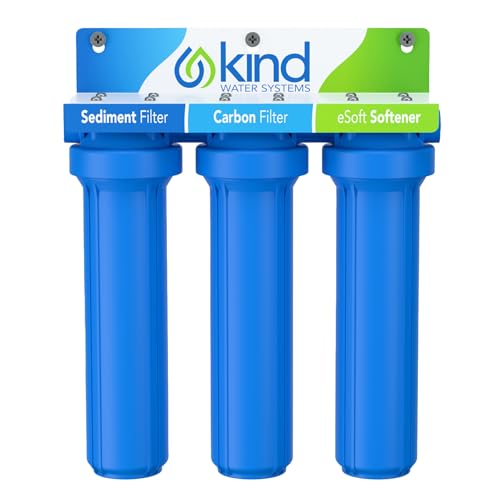 Kind Water Systems E-3000 Whole House Salt-Free WaterFilter + Softener25 x 9 x 29 inches45.2 PoundsCheck on Amazon
 PRO+AQUA PRO-E-S80E Elite Whole House Water Filtration System80k Grain17 x 17 x 36 inches222 poundsCheck on Amazon
 Kind Water Systems E-3000UV Whole House Salt-Free WaterFilter + Softener22.86 x 63.5 x 73.66 inches55.9 PoundsCheck on Amazon
 Aquasure Whole House Water Filtration Bundle w/Water Softener72,000 Grains56 x 10 x 10 inchesCheck on Amazon
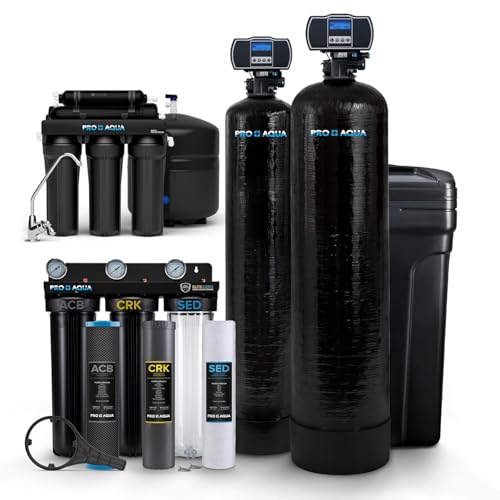 PRO+AQUA Elite 5-Stage Whole House Water Softener andHome Bundle + RO13 x 12.99 x 57 inches325 PoundsCheck on Amazon
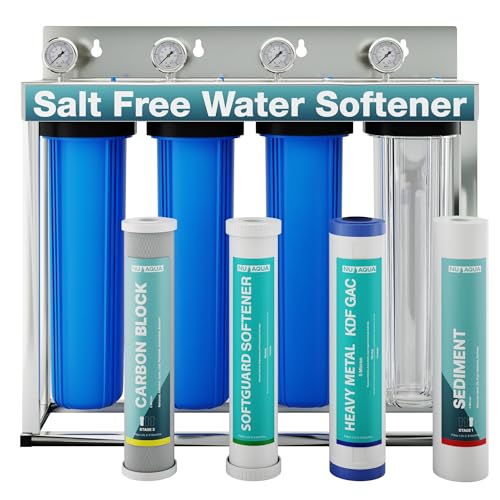 NU Aqua 4-Stage Salt Free Water Softener WholeWater Softener System31 x 31 x 7 inches53 poundsCheck on Amazon
Top 3 Picks
Best Overall: PRO+AQUA PRO-E-S80E Elite Whole House Water Filtration System & 80,000 Grain Water Softener Combo
An 80,000-grain metered softener paired with multi-stage carbon filtration is the right amount of capacity for a busy four-to-six-person household on city water, and this is the most complete package at the mid-range tier. It suits anyone who wants softened water at every tap without buying a separate filter and softener. If your household is smaller than four people, you are paying for capacity you will not use — the 64,000-grain Aquasure bundle covers that case for less.
Best Budget: Kenmore Elite 520 Hybrid Water Softener & Whole House Filtration System
A single-unit 2-in-1 design that combines softening and filtration, which cuts both the purchase price and the plumbing work compared with buying two separate tanks. It suits smaller homes, condos and anyone installing in a tight utility space where two tanks will not fit. The trade-off is capacity: a hybrid unit this size is a two-to-four-person system, not a whole-house workhorse.
Best Premium: Kind Water Systems E-3000UV Whole House Salt-Free Softener & Filter Combo with UV
The premium pick for city-water households that want scale control, filtration and UV disinfection without salt, brine discharge or a drain line. It suits people who object to the sodium and the monthly bag-hauling that come with ion-exchange softening, and who have the budget to pay for convenience. It is a conditioner, not a softener — it does not remove hardness minerals, and if you want genuinely soft water this is the wrong product.
Quick Comparison
All twelve systems below, sorted by what they are actually for. Price tier reflects where each unit sits in the market; specific prices move constantly, so check current listings for figures.
| Product | Best For | Key Specs | Price Tier |
|---|---|---|---|
| Kind Water Systems E-3000 | City water, no-salt households | Salt-free conditioner + city-water filtration; no brine, no drain line, no power | Premium |
| PRO+AQUA PRO-E-S80E Elite Combo | Best overall for 4–6 people on city water | 80,000-grain metered softener + multi-stage carbon filtration; high-capacity class | Mid-range |
| Kind Water Systems E-3000UV | City water with UV disinfection | Salt-free conditioning + filtration + UV stage; no salt, no brine discharge | Premium |
| Aquasure Whole House Bundle w/ 75 GPD RO | Drinking water at every tap plus RO | Softener + whole-house filtration + 75 GPD under-sink reverse osmosis | Mid-range |
| PRO+AQUA Elite 5-Stage Well Water Bundle | Private well with iron and metals | 5-stage filtration + softener; targets heavy metals and well-water contaminants | Premium |
| NU Aqua 4-Stage Salt-Free | Renters and no-salt mid-range buyers | 4-stage carbon filtration + salt-free conditioning; no brine tank | Mid-range |
| Express Water Ultimate Protection 3-Stage | Lowest-cost filtration base | 3-stage sediment + carbon filtration; filtration only, no softening | Budget |
| Kenmore Elite 520 Hybrid | Smallest budget 2-in-1 footprint | Hybrid softener + filtration in one cabinet-style unit; NSF-certified 2-in-1 | Budget |
| Aquasana WH-1000-CS-UVS-B | Long-life premium city-water filtration | 1,000,000-gallon rated filter platform with UV; salt-free conditioning class | Premium |
| EcoPure EPH130 | Budget 2-in-1 for small homes | Combined softener + filtration, compact 2-in-1 design | Budget |
| Aquasure 64,000 Grain Bundle | Budget salt-based softening plus RO | 64,000-grain digital metered softener + filtration + 75 GPD RO | Budget |
| iSpring WF150K | Set-and-forget filtration, up to 10 years | Central multi-stage filtration with smart valve; long service interval, no softening | Mid-range |
How We Chose
Every system here was selected by comparing published manufacturer specifications, listing details and well-established facts about how each treatment category works — not by installing or testing units. We started by asking whether each product genuinely combines filtration with softening or conditioning, because several whole-house filters on the market are filtration only and get sold as if they soften water. From there we screened on four things: media match to water source (chlorine versus chloramine, city versus well), grain capacity and flow rating against realistic household demand, the installation envelope (drain access, power, floor space, connection size), and the upgrade path — whether you can add UV, reverse osmosis or a larger tank later without replacing the whole system. Finally we kept a spread across budget, mid-range and premium tiers so there is a defensible choice whether you are outfitting a starter home or a six-person house with a private well.
1. Kind Water Systems E-3000 – Best for City Water Households That Want Softening Without Salt
As an Amazon Associate we earn from qualifying purchases at no extra cost to you.
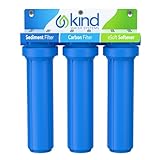
The Kind Water Systems E-3000 is built for a specific reader: someone on municipal water who dislikes hauling 40-pound salt bags, has no floor drain or convenient place to discharge brine, and still wants the white crust off the shower glass. It pairs salt-free conditioning with filtration media for city water, which means it addresses scale formation and chlorine-type taste and odor problems rather than removing hardness minerals outright.
That distinction is the single most important fact in this category. Salt-free conditioners — usually built around template-assisted crystallization media — change the form of dissolved calcium and magnesium so the minerals pass through without sticking to pipes, heating elements and fixtures. Ion-exchange softeners physically remove those minerals and replace them with sodium or potassium. The practical result: the E-3000 can reduce new scale buildup and keep existing scale from accumulating, but it will not turn hard water into slippery soft water, and it will not help if you simply prefer the feel of softened water on your skin.
- Configuration: salt-free conditioning plus city-water filtration, sold as one system
- Water source: treated municipal water
- Method: salt-free scale conditioning — no ion exchange, no brine tank, no salt
- Discharge: no backwash brine line required
- Power: none required for salt-free conditioning
- Maintenance: periodic media replacement instead of monthly salt top-ups
- Price tier: premium
Where it earns its premium price is in ownership simplicity. There is no salt to buy, carry or spill, no brine tank to keep clean, no regeneration cycle running at 2 a.m., and no sodium added to your drinking water. For a household that would otherwise leave a softener out of the budget entirely because of the maintenance burden, that is a real upgrade rather than a compromise. It also sidesteps the discharge restrictions some municipalities place on brine, which is a practical issue that rarely comes up until an inspector does.
Pros
- No salt, no brine tank and no drain line — the easiest of the softening-class systems to live with
- No electricity draw and no moving parts to fail
- Adds sodium-free operation, useful for anyone limiting sodium intake
- Removes the chlorine taste and odor that city-water households notice most
Cons
- Does not actually remove hardness minerals, so water never feels “soft”
- Premium price for a system that stops short of true softening
- Media replacement is infrequent but not free, and it is a whole-tank service rather than a cartridge swap
- No UV or reverse osmosis stage in this configuration
Compared with the Kind Water E-3000UV directly above it in this list, the E-3000 is the same conditioning and filtration approach minus the ultraviolet disinfection stage. If your water is municipal and already disinfected at the plant, the UV stage is insurance rather than a necessity, and the E-3000 saves you the difference. Compared with the NU Aqua 4-Stage salt-free system, the Kind Water unit is the premium, longer-service-interval option, while NU Aqua is the mid-range way to get the same category of treatment.
2. PRO+AQUA PRO-E-S80E Elite Whole House Water Filtration System & 80,000 Grain Water Softener Combo – Best Overall for Larger Households on City Water

This is the pick for the household that has decided it wants genuinely soft water and a filtration stage ahead of it. The listing combines a high-capacity 80,000-grain softener with multi-stage whole-house filtration, which is the combination that solves the two most common city-water complaints at once: hard water that ruins fixtures and leaves spotting, and chlorine that makes tap water taste like a swimming pool. It suits four to six people in a house with two or more bathrooms and normal-to-high water use.
The 80,000-grain figure is the number that matters. Grain capacity describes how much hardness the resin can remove before it must regenerate, and it is the spec that determines how often the system cycles. A metered control valve — the class of valve used in the Elite series — measures actual gallons used and regenerates on demand rather than on a fixed timer, which is both more efficient and less wasteful of salt and water. That is the difference between a system that costs you a few bags of salt a year and one that quietly runs a regeneration cycle every night whether you used water or not.
- Softener capacity: 80,000 grains — high-capacity class
- Filtration: multi-stage carbon filtration ahead of or alongside the softener
- Control: metered, on-demand regeneration rather than fixed-timer
- Water source: treated municipal water
- Installation class: two-tank footprint, drain or standpipe for backwash, standard household power outlet
- Consumables: softener salt plus periodic filter cartridge changes
- Price tier: mid-range
The value story here is that you get the capacity of a premium system without the premium markup. An 80,000-grain unit is genuinely oversized for a two-person household, and that is fine — oversized capacity means fewer regenerations, less salt per gallon treated and more headroom if your family grows or you add a bathroom. Where it stops short of the premium tier is in refinement: no UV stage, no reverse osmosis package, and the filtration media is aimed at city water rather than the iron, manganese and sulfur problems that come with a private well.
Pros
- 80,000-grain capacity suits four-to-six-person households without constant regeneration
- Metered on-demand regeneration saves salt and water versus timer-based valves
- Combines true ion-exchange softening with filtration in one purchase
- Mid-range price for high-capacity-class performance
Cons
- Two-tank installation needs floor space plus a drain for backwash
- You will be buying and carrying salt for the life of the unit
- Not designed for well water with iron or sulfur
- No UV disinfection or drinking-water reverse osmosis stage included
The nearest alternative is the Aquasure 64,000 Grain Bundle, which costs less and adds a 75 GPD reverse osmosis system for drinking water. Choose the PRO+AQUA if you want maximum softening capacity for a big household and can add RO later; choose the Aquasure bundle if your household is smaller and you would rather have the under-sink RO in the box from day one. The Kenmore Elite 520 is the third option — cheaper still, but a hybrid unit that will not keep up with this level of demand.
3. Kind Water Systems E-3000UV Whole House Salt-Free Softener & Filter Combo with UV – Best for City Water Households That Also Want Disinfection

This is the E-3000 with an ultraviolet disinfection stage added, and it is aimed at the buyer who wants one system to handle scale, taste, odor and microbiological concerns without salt or chemicals. It suits municipal-water households — particularly those on a private community well system or a small utility where water quality varies — who want the extra layer of assurance UV provides. It is also the sensible pick for anyone with a cistern, a rainwater top-up or a long service line where biological growth is a realistic worry.
UV works differently from every other stage in these systems. It does not filter anything out; it does not change chemistry or remove minerals. It exposes water to ultraviolet light at a dose that inactivates bacteria, viruses and other microorganisms, and it does so without adding anything to the water. The catch is that UV only works on water that is already clear — sediment, iron and turbidity shield microorganisms from the light, which is why UV is always placed after filtration, and why a system that combines conditioning, carbon filtration and UV in a single package is more useful than a standalone UV unit bolted onto unfiltered water.
- Configuration: salt-free conditioning + city-water filtration + UV disinfection
- Method: no ion exchange, no brine, no salt added to the water
- Disinfection: ultraviolet stage placed after filtration
- Discharge: no brine line required
- Power: required for the UV lamp
- Maintenance: periodic media replacement plus UV lamp replacement on its rated interval
- Price tier: premium
The case for buying the UV version rather than the base model comes down to one question: is your water supply consistently and reliably disinfected before it reaches your tap? If it is, you are paying a premium for reassurance. If it is not — or if you simply do not know, which is common with small private systems and shared wells — the UV stage converts an unknown into a managed risk, and it does so without the taste and byproduct concerns people associate with chlorination.
Pros
- Adds microbiological protection without chemicals or salt
- Conditioning and filtration stages protect the UV lamp from the turbidity that would defeat it
- No brine discharge, so it works where salt-based systems are restricted
- One integrated system instead of three separate devices competing for space
Cons
- Highest price tier in this roundup
- UV lamps are a consumable with a defined replacement interval, and the system needs power
- Still does not remove hardness minerals — water will not feel soft
- UV is a barrier, not a fix, for water with serious bacterial contamination; that is a job for testing and professional treatment
Against the base Kind Water E-3000, this model is the same system plus the UV stage and its ongoing lamp cost. If your water is municipally treated and you have no reason to doubt it, the base model saves money and one consumable. Against the Aquasana WH-1000-CS-UVS-B, this is the conditioning-first approach with a much shorter service interval, while Aquasana is the million-gallon, replace-the-media-rarely approach — the choice comes down to whether you want scale control or sheer longevity.
4. Aquasure Whole House Water Filtration Bundle with Water Softener, 75 GPD RO System & Dual Purpose Sediment/GAC Pre-Filter – Best for Drinking Water Quality at Every Tap

This bundle is for the household that cares as much about what comes out of the kitchen tap as about what happens in the shower. It stacks three things that are usually bought separately: a whole-house softener, whole-house filtration with a dual-purpose sediment and granular activated carbon pre-filter, and a 75 GPD reverse osmosis system for drinking water. It suits families who currently buy bottled water, or who have a refrigerator filter that needs changing every few months and still leaves an aftertaste.
The architecture is worth understanding because it explains why the bundle makes sense. Whole-house filtration handles the water going to showers, laundry and appliances — it removes sediment and reduces chlorine at high flow rates, but it is not designed to produce polished drinking water. Reverse osmosis handles one tap and does the opposite: it runs water slowly through a membrane that rejects dissolved solids, which is why RO systems are rated in gallons per day rather than gallons per minute. A 75 GPD rating is the standard residential class and is comfortably enough for drinking and cooking for a family, provided there is a storage tank, which these systems include.
- Softener: ion-exchange, salt-based, whole-house
- Whole-house filtration: dual-purpose sediment and granular activated carbon pre-filter stage
- Drinking water: 75 GPD reverse osmosis system with storage
- Water source: treated municipal water
- Installation class: multiple components — softener and filter at the main line, RO under the kitchen sink
- Consumables: salt, whole-house cartridges, RO pre- and post-filters, RO membrane every few years
- Price tier: mid-range
Buying the three components as a bundle is cheaper than assembling them individually and, more importantly, guarantees the parts are compatible. The dual-purpose sediment and GAC pre-filter is a sensible design choice because it protects the softener resin from particulate and reduces chlorine, which extends resin life — chlorine is one of the main things that degrades ion-exchange resin over time.
Pros
- Covers whole-house softening, whole-house filtration and drinking water in one purchase
- 75 GPD RO is the right class for household drinking and cooking
- Pre-filter reduces chlorine, which helps the softener resin last longer
- Mid-range tier despite covering three separate jobs
Cons
- Most components to install of anything in this roundup — expect a plumber unless you are experienced
- RO wastes some water as concentrate and needs a drain connection under the sink
- Four different consumable types to track
- Not configured for well water contaminants
Against the Aquasure 64,000 Grain Bundle, this version carries a larger softener and a fuller filtration package, which matters if your household is bigger than three or four people. Against the PRO+AQUA PRO-E-S80E, the trade is capacity versus coverage: PRO+AQUA gives you more softening headroom, Aquasure gives you the RO tap. If you drink a lot of tap water, take the RO.
5. PRO+AQUA Elite 5-Stage Whole House Water Softener and Filter Bundle System for Well Water – Best for Private Wells with Iron and Heavy Metals
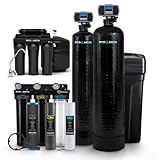
Well owners are a different buying category, and this is the system built for them. The listing describes a five-stage whole-house filtration and softening bundle specifically aimed at well water and heavy metals. It suits rural households on a private well where the water carries iron, manganese and other dissolved metals alongside ordinary hardness — the combination that destroys salt-based softeners not designed for it.
Why five stages matter on a well: iron fouls ion-exchange resin. If iron reaches the resin bed, it coats the beads and the softener loses capacity permanently, which is why well-water systems put dedicated iron and metals removal ahead of the softener rather than relying on the softener to handle everything. A staged approach — sediment removal first, then oxidation or metals-targeted media, then carbon, then softening — protects the most expensive component in the system. This is also why you cannot simply take a city-water combo and point it at a well, even if the grain capacity looks adequate.
- Stages: five, sequenced ahead of and including softening
- Target contaminants: heavy metals and typical well-water problems per the listing
- Softener: ion-exchange, salt-based, whole-house
- Water source: private well
- Installation class: multi-tank; needs drain access, power and enough floor space for a treatment train
- Consumables: salt, media and cartridges at different intervals
- Price tier: premium
The premium price buys specificity. You are not paying for a bigger tank; you are paying for media chosen to handle the contaminants that actually appear in well water, and for a configuration that will not be ruined by the first slug of iron. That is a meaningful difference over the life of the system — a fouled resin bed means a softener that stops softening, and replacing resin is not a cheap service call.
Pros
- Purpose-built for well water rather than adapted from a city-water design
- Multi-stage protection keeps iron and metals away from the softener resin
- Covers hardness and metals in one integrated system
- Established brand with widely available replacement media
Cons
- Premium tier, and the most installation-intensive option here
- Requires water testing to set up correctly — media selection depends on what is actually in your water
- More consumables and more service points than a two-tank city system
- Overkill for treated municipal water
Against the iSpring WF150K, the difference is scope. iSpring’s system is filtration with an unusually long service interval and no softening — excellent for a city-water household that wants set-and-forget filtration, wrong for a well with hard water and iron. Against the Aquasure 64,000 Grain Bundle, PRO+AQUA is the well-specific premium choice while Aquasure is the value city-water option. Get a laboratory water test before choosing between them; it is the single most useful thing a well owner can do.
6. NU Aqua 4-Stage Salt Free Water Softener Whole House Water Filter System – Best Mid-Range Salt-Free Option for Renters and Smaller Homes
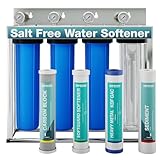
NU Aqua’s four-stage salt-free system is the sensible middle path for people who want the benefits of whole-house treatment without the salt habit and without the premium price of the Kind Water units. It suits renters, condo owners, smaller households and anyone whose landlord or HOA would object to a brine discharge line. It also suits households that want filtration more than they want softening — if your main complaint is taste, odor and sediment rather than hard-water scale, this covers the ground.
Four stages in a salt-free whole-house system typically means sediment filtration followed by carbon stages, with salt-free conditioning media as the scale-control element. The stage count is a reasonable shorthand for how much contact time and how many distinct problems the system can address, but it is not a quality ranking on its own — media quality and the volume of media in each stage matter more than the number printed on the box. A four-stage system with generous carbon beds will outperform a six-stage system with thin cartridges.
- Stages: four — sediment, carbon and salt-free conditioning class
- Method: no ion exchange, no brine tank, no salt
- Water source: treated municipal water
- Discharge: no brine line required
- Installation class: single-tank or compact multi-stage footprint, no drain needed
- Maintenance: periodic cartridge or media replacement
- Price tier: mid-range
For renters, the absence of a drain requirement is the decisive feature. A salt-based softener needs somewhere for brine to go, and in an apartment or a rented townhouse that often means a utility sink, a standpipe or a laundry drain — arrangements a landlord may not permit and that you cannot take with you when you move. A salt-free conditioner with cartridge filtration installs on the main line with a couple of shut-off valves and comes out again just as easily.
Pros
- No salt, no brine, no drain line — the most rental-friendly configuration here
- Mid-range price for whole-house filtration plus scale conditioning
- Compact footprint compared with a two-tank softener and filter setup
- Simple cartridge-based maintenance you can do yourself
Cons
- Does not remove hardness minerals; water will not feel soft
- Cartridge changes are more frequent than the multi-year media cycles of premium salt-free systems
- No UV or reverse osmosis stage
- Not appropriate for well water with iron
Compared with the Kind Water E-3000, this is the value version of the same idea: both condition rather than soften, both avoid salt and brine, but Kind Water’s premium tier buys longer service intervals and a more integrated package. Compared with the Express Water 3-Stage, NU Aqua adds the conditioning element that Express Water lacks, which is the difference between a filter and a filter-plus-scale-control system.
7. Express Water Whole House Water Filter System, Ultimate Protection, 3-Stage – Best Budget Filtration Base

Be clear about what this is: a three-stage whole-house filtration system, not a water softener. It suits budget-conscious households on city water whose primary problems are sediment, chlorine, taste and odor, and who either do not have hard water or plan to add a softener separately later. It is also the right first purchase for someone who wants to see what whole-house filtration alone does for their water before committing to the cost and maintenance of softening.
Three stages in this class typically means a sediment pre-filter to catch particulate and protect downstream media, followed by carbon stages — often a carbon block or granular activated carbon — to reduce chlorine and the taste and odor compounds that come with it. Running a sediment stage first is not padding; it is what keeps the carbon stages from clogging early and losing efficiency, which is why cheap single-stage filters tend to disappoint.
- Stages: three — sediment plus carbon filtration class
- Function: filtration only; no softening or conditioning
- Water source: treated municipal water
- Installation class: single-unit, main-line installation, no drain line needed
- Maintenance: cartridge replacement at manufacturer intervals
- Price tier: budget
The case for it is straightforward: this is the least expensive way to get genuine multi-stage whole-house filtration, and the money saved can go toward a softener or an under-sink RO later. Because there is no brine tank and no regeneration cycle, installation is simple and the system can be mounted in a garage, a crawlspace or a utility closet where a softener would not fit or would not be permitted.
Pros
- Lowest entry price of any whole-house system in this roundup
- No salt, no drain, no power — the simplest possible install
- Improves taste and odor across every tap, not just the kitchen
- Easy to combine with a softener purchased later
Cons
- Does not soften water at all — hard-water scale will continue
- Cartridge changes come around more often than media-based systems
- No UV, no RO, no conditioning stage
- Will not fix iron, sulfur or manganese in well water
Against the Kenmore Elite 520 Hybrid, the trade is softening versus simplicity. Kenmore adds a softening function and a single-unit cabinet design, but costs more and needs drain access. Against the NU Aqua 4-Stage, Express Water is the budget filtration base without the salt-free conditioning stage. If your water is hard, budget for the softener now rather than later — retrofitting costs more than buying it up front.
8. Kenmore Elite 520 Hybrid Water Softener & Whole House Filtration System – Best Budget 2-in-1 for Small Homes

The Kenmore Elite 520 is the budget answer to the question “can I soften and filter with one box?” It is an NSF-certified 2-in-1 hybrid that combines softening and filtration in a single cabinet-style unit, which suits small homes, condos, townhouses and anyone whose utility space will not accommodate two tanks plus a brine tank. It is also the most approachable system here for a first-time buyer who wants one installation instead of three.
Hybrid design has a real engineering rationale beyond convenience. Combining softening resin and filtration media in a single vessel means one plumbing connection, one bypass valve and one footprint — and fewer joints is fewer places to leak. The trade-off is capacity: a single-cabinet hybrid holds less resin than a dedicated two-tank softener, so it regenerates more often and suits smaller households. If you have four or more people in the house, a hybrid will cycle frequently enough that the salt and water use becomes noticeable.
- Type: 2-in-1 hybrid softener and filtration in one unit
- Certification: NSF-certified per the listing
- Water source: treated municipal water
- Installation class: single cabinet footprint; needs drain access for regeneration and a power outlet
- Consumables: softener salt plus filter replacement
- Price tier: budget
NSF certification is worth more attention than it usually gets. It means an independent body has verified the product against a published standard, which is not true of every system sold online. For a budget purchase, that is a meaningful assurance — particularly for a device that treats all the water your family drinks, cooks with and bathes in.
Pros
- Genuine softening and filtration in one compact unit at a budget price
- NSF-certified, which is uncommon at this tier
- One installation, one bypass, one footprint
- Good fit for condos, small homes and tight utility closets
Cons
- Lower grain capacity than dedicated two-tank systems — not a large-family solution
- Regenerates more often, so salt use per person is higher
- Still requires a drain and a power outlet
- Limited upgrade path compared with modular systems
Against the EcoPure EPH130, this is the same 2-in-1 category at the same budget tier — the deciding factors are cabinet size versus your available space and which brand’s replacement parts are easier for you to source locally. Against the Express Water 3-Stage, Kenmore adds softening for a modest premium, which is the right call if your water is actually hard. If your household is larger than four, skip both and look at the Aquasure 64,000 Grain Bundle instead.
9. Aquasana Whole House Water Filter System | 1M Gal | UV | WH-1000-CS-UVS-B – Best Premium for Long Service Intervals on City Water

Aquasana’s million-gallon platform is the pick for the buyer who hates maintenance more than they hate spending money. The listing describes a whole-house filter rated to 1,000,000 gallons with a UV stage. It suits large households on treated municipal water who want to install something once and forget it for years at a time, and who value a long-established brand with a documented replacement-media program.
One million gallons is a genuinely useful number to reason about. A family of four using roughly 300 gallons a day will pass about 110,000 gallons a year, which puts a million-gallon rating in the region of several years of service before the main media needs attention — far longer than the six- or twelve-month cartridge cycles typical of budget systems. Fewer service events means lower long-run maintenance cost and far less chance of the classic failure mode where a homeowner stops changing filters and the system quietly stops doing anything.
- Capacity rating: 1,000,000 gallons on the main filter platform
- Disinfection: UV stage
- Water source: treated municipal water
- Softening: salt-free conditioning class, not ion-exchange softening
- Installation class: main-line filter plus UV; power required, no brine line
- Maintenance: long-interval media replacement plus UV lamp changes
- Price tier: premium
The important caveat is the same one that applies to every salt-free system: this is filtration and conditioning, not softening. If you have genuinely hard water and want it soft, Aquasana is not a substitute for a softener — it is a complement to one. Where it wins is on water quality and longevity for people whose primary