Best Spin-Down Sediment Water Filters
What's inside
- Top 3 Picks
- Quick Comparison
- How We Chose
- 1. iSpring WSP-50 – Best for Whole-House City Water
- 2. Waterdrop RPFK – Best Budget Spin-Down Sediment Filter
- 3. iSpring WSP50ARB Big – Best Premium for Large Homes and Heavy Sediment
- 4. iSpring WSP-50SL – Best for Compact Whole-House Retrofits
- 5. iSpring WSP-100 – Best for Coarse Sediment and Low Pressure Drop
- 6. Rusco 1-1/2-60-F – Best Premium for 1½-Inch Mains and Well Water
- 7. Purevua PSF1 – Best Budget Pick for Mixed Thread Sizes
- 8. Waterdrop BG103 Mega – Best for Heavy Sand and Grit
- 9. YOTOSIRE Spin Down Sediment Filter with Pressure Gauge – Best Budget Pick With Pressure Monitoring
As an Amazon Associate I earn from qualifying purchases. This post may contain affiliate links at no extra cost to you.
The best spin-down sediment water filter for most homes is the iSpring WSP-50: a 50-micron stainless steel screen in a transparent housing with a bottom flush valve, sized for whole-house flow on a 1-inch class main. It suits the largest group of buyers — city water with occasional rust flakes and grit, a two- or three-bathroom house, and a homeowner who wants to see the trapped sediment and dump it in thirty seconds without buying cartridges. If the budget is tight, the Waterdrop RPFK does the same job in the 40–50 micron class for less money. If you have heavy sand, a large family, or a 1½-inch main, step up to the iSpring WSP50ARB Big or the Rusco 1-1/2-60-F. This guide compares micron ratings, housing and screen materials, connection sizes, flow capacity, and flush access, so you can match a unit to your plumbing and your actual sediment load rather than to a marketing bullet.
Contents
- Top 3 Picks
- Quick Comparison
- How We Chose
- 1. iSpring WSP-50 – Best for Whole-House City Water
- 2. Waterdrop RPFK – Best Budget Spin-Down Sediment Filter
- 3. iSpring WSP50ARB Big – Best Premium for Large Homes and Heavy Sediment
- 4. iSpring WSP-50SL – Best for Compact Whole-House Retrofits
- 5. iSpring WSP-100 – Best for Coarse Sediment and Low Pressure Drop
- 6. Rusco 1-1/2-60-F – Best Premium for 1½-Inch Mains and Well Water
- 7. Purevua PSF1 – Best Budget Pick for Mixed Thread Sizes
- 8. Waterdrop BG103 Mega – Best for Heavy Sand and Grit
- 9. YOTOSIRE Spin Down Sediment Filter with Pressure Gauge – Best Budget Pick With Pressure Monitoring
Our Top Picks
 iSpring WSP50ARB Big Spin Down Sediment Filter50-Micron13.8 x 5 x 4 Inches4.25 poundsCheck on Amazon
 iSpring WSP-100 Whole House Spin Down Sediment Filter100 Microns3.5 x 3.5 x 9 inches1 PoundsCheck on Amazon
 Rusco 1-1/2-60-F Polyester Screened Spin-Down Filter System1 Count (Pack of 1)15 x 5 x 3 inches1.72 poundsCheck on Amazon


Top 3 Picks
Best overall: iSpring WSP-50
The WSP-50 hits the sweet spot of micron rating, flow capacity, and price tier for a typical whole-house install. A 50-micron stainless steel screen catches the sand, rust, and pipe scale that ruins faucet aerators and appliance valves, while the transparent housing lets you judge your sediment load by eye instead of by guesswork. The bottom flush valve means maintenance is a thirty-second job with a bucket.
Best budget: Waterdrop RPFK
The RPFK delivers the core spin-down feature set — fine stainless steel mesh, a see-through body, a manual flush port — at the lowest price tier in this roundup. It is the right first filter for a rental, a cabin, a garage or shop sink line, or anyone who wants to prove the concept before committing to a bigger housing.
Best premium: iSpring WSP50ARB Big
The “Big” body holds far more screen surface area than a standard WSP-50, so it passes higher flow with less pressure drop and goes longer between flushes. For a four-bathroom house, a well with real sand, or a line feeding irrigation, the extra capacity is what keeps the filter from becoming the bottleneck. The Rusco 1-1/2-60-F is the equivalent premium move if your main is 1½ inches.
Quick Comparison
Every unit below is a screen-based sediment filter — none of them is a water treatment device, and none removes dissolved contaminants. The differences that matter are the micron rating, the screen material, the connection size, the flow class, and how easy the flush is to reach.
| Product | Best for | Key specs (as listed / spec class) | Price tier |
|---|---|---|---|
| iSpring WSP-50 | Most whole-house installs on city water | 50 micron; stainless steel mesh; transparent housing; 1-inch class connection; whole-house flow class; manual bottom flush | Mid-range |
| Waterdrop RPFK | Lowest-cost entry into spin-down filtration | 40–50 micron; stainless steel mesh; BPA-free housing; standard residential connection class; manual bottom flush | Budget |
| iSpring WSP50ARB Big | Large homes, heavy sediment, high flow | 50 micron; stainless steel mesh; oversized “Big” body; high flow class; manual bottom flush | Premium |
| iSpring WSP-50SL | Straightforward compact retrofits | 50 micron; stainless steel mesh; compact SL body; 1-inch class connection; manual bottom flush | Mid-range |
| iSpring WSP-100 | Coarse sediment and low-maintenance lines | 100 micron; stainless steel mesh; transparent housing; 1-inch class connection; high flow / low pressure drop | Mid-range |
| Rusco 1-1/2-60-F | 1½-inch mains, wells, light commercial | 60 mesh polyester screen (coarse-to-medium); 1½-inch connections; very high flow class; cleanable/reusable screen; manual flush | Premium |
| Purevua PSF1 | Mixed thread sizes and DIY plumbing | Dual thread: 1-inch MNPT and 3/4-inch FNPT; stainless steel mesh screen; transparent housing; manual bottom flush | Budget |
| Waterdrop BG103 Mega | Heavy sand and grit ahead of finer filters | Two-stage screens at 500 micron and 200 micron; oversized Mega body; high flow class; manual flush | Premium |
| YOTOSIRE Spin Down with Pressure Gauge | Budget buyers who want pressure monitoring | 50 and 100 micron stainless steel mesh screens; integral pressure gauge; standard residential connection class; manual bottom flush | Budget |
How We Chose
We selected these nine units by comparing published specifications and the practical realities of the category rather than by any hands-on evaluation — this is a research-based roundup, not a test report. The criteria, in order of weight:
- Specification completeness. A spin-down filter is only useful if the buyer can match its micron rating and connection size to their plumbing. Products that publish a clear screen rating and thread specification rank above those that describe themselves only in vague terms.
- Category fit. Every pick has to do the actual job of a spin-down: trap visible sediment in a cleanable screen, pass whole-house flow, and flush without disassembly. Units that blur into cartridge filtration or into treatment claims were set aside.
- Use-case spread. The list deliberately covers city water, well water, high-flow mains, and tight retrofit spaces, so a reader with any of those situations finds a direct answer instead of a compromise.
- Upgrade path. A filter that can be re-screened, re-plumbed, or moved to a different mesh size earns a place over a sealed disposable body.
- Ownership cost. Screen-based filters have essentially no consumable cost beyond an occasional O-ring, and that durability advantage is central to why the category exists.
1. iSpring WSP-50 – Best for Whole-House City Water
As an Amazon Associate we earn from qualifying purchases at no extra cost to you.

The WSP-50 is the reference point for the whole category: a 50-micron stainless steel mesh screen inside a transparent housing, plumbed into the main line ahead of everything else, with a small flush valve at the bottom. If you live on municipal water and your complaint is rust flakes from old galvanized pipe, grit that arrives after main repairs, or the fine sand that shows up in toilet tanks, this is the unit that solves it with the least fuss. It also suits a shop or garage line where you want a single point of protection for a utility sink, a hose bib, or the water you use for mixing water-based finishes — sediment in that water shows up as speckles in a finish, and it is far cheaper to stop it at the main than to filter it at the tap.
Key specs
- Filtration rating: 50 micron, the standard fine-sediment rating for whole-house prefiltration.
- Screen: stainless steel mesh — washable and reusable, effectively a lifetime part.
- Housing: transparent, so trapped sediment is visible without opening anything.
- Connection: 1-inch class threaded ports, with adapters commonly supplied for 3/4-inch lines; confirm the exact thread configuration on the specific variant you order.
- Flow class: whole-house, appropriate for a typical two- to three-bathroom home when clean.
- Flush: manual ball-valve drain at the bottom; a bucket or a short hose to a floor drain handles the discharge.
- Mounting: bracket included; the body hangs vertically with horizontal inlet and outlet.
Strengths
The reason this unit wins the overall slot is that it makes the invisible visible. A transparent body turns “I think my water has sediment” into a two-second visual check. That matters more than most spec sheets admit, because it tells you when to flush, whether your sediment load is seasonal, and whether you actually need a finer downstream filter. Homeowners routinely discover that their load is a spring runoff problem rather than a year-round one, which changes how often they need to service the unit.
The 50-micron rating is the other reason it sits at the top. It is fine enough to catch the particles that clog aerators, showerheads, and appliance inlet screens, but coarse enough that it does not choke on the first rush of debris and stall the house’s water pressure. In practice, 50 micron is the balance point where a screen filter still passes normal household flow while doing meaningful work. The stainless screen does not degrade with cleaning, so the only wear items over a decade of use are the O-ring and the housing itself.
Flushing is genuinely simple: close the upstream valve, open the downstream valve to relieve pressure, open the drain, and let a few gallons run. Because the screen sits vertically, sediment slides down and out rather than packing into the mesh. A short length of hose to a floor drain or a five-gallon bucket is all the “plumbing” the maintenance requires.
Pros
- 50-micron stainless mesh is the practical sweet spot for city water.
- Transparent housing makes sediment load and flush timing obvious.
- Reusable screen means no cartridges to buy, ever.
- 1-inch class ports suit most whole-house mains and accept common adapters.
- Bottom drain valve makes flushing a one-person, thirty-second job.
- Mounting bracket and fittings are typically included.
Cons
- A single 50-micron screen can blind over quickly on very heavy sand or well water, requiring frequent flushes.
- No pressure gauge, so you cannot quantify pressure drop without adding one.
- Standard body has less screen area than the “Big” version, so it becomes the flow bottleneck in larger homes.
- Transparent housings should be protected from sunlight and hard freezing; an unheated crawlspace in a cold climate is a real risk.
How it compares
Against the Waterdrop RPFK, the WSP-50 costs more but comes from a brand with a deep, well-documented whole-house filtration line, which matters if you plan to add a carbon block or softener downstream and want components that speak the same plumbing language. Against the iSpring WSP50ARB Big, it gives up screen area and flow headroom but saves money and takes up less wall space — the trade is capacity, not filtration quality, since both are 50 micron.
2. Waterdrop RPFK – Best Budget Spin-Down Sediment Filter

The RPFK is the pick for anyone who wants the spin-down concept at the lowest possible entry cost. It uses the same architecture as the premium units — a fine stainless steel mesh screen, a see-through housing, and a manual flush at the bottom — in a compact body aimed at a single line rather than a whole estate. Waterdrop lists it in the 40–50 micron range with a BPA-free housing, which puts its filtration performance in the same class as units costing considerably more. For a rental property, a seasonal cabin, a garage utility sink, or a first-time installation where you are not yet sure how much sediment your water actually carries, that is the right amount of filter to buy.
Key specs
- Filtration rating: 40–50 micron class, fine enough for grit, sand, and rust particles.
- Screen: stainless steel mesh, washable and reusable.
- Housing: BPA-free construction, transparent enough to inspect the screen.
- Connection: standard residential threaded connection class with adapters available; verify the thread size against your pipe before ordering.
- Flow class: suited to a single fixture line or a small home; not intended to feed a large house plus irrigation.
- Flush: manual bottom drain valve.
Strengths
The strongest argument for the RPFK is economic honesty. A spin-down filter is a mechanical device with no consumable cartridge, so a budget unit and a premium unit do the same fundamental thing: they pass water through a woven screen and let gravity carry the trapped debris out the bottom. What you pay extra for in the premium tier is screen surface area, flow capacity, fitting quality, and brand support — not a better micron rating. If your demand is modest and your sediment load is light, none of those premiums buy you anything you will notice.
The BPA-free housing claim is worth noting for anyone running a line to a kitchen or a drinking-water fixture downstream, even though a sediment filter is a pretreatment device rather than a final water treatment step. It also suggests a housing formulation aimed at durability rather than the cheapest possible molding, which is a reasonable proxy for how the rest of the body is built.
Installation is straightforward and forgiving. The compact body fits in tighter spots than the oversized units, and the transparent section gives you the same visual feedback loop as the expensive models. Because the screen is stainless, cleaning is a rinse rather than a replacement. If you are the kind of buyer who wants to spend the least amount of money that still solves the problem, this is where the value sits.
Pros
- Lowest price tier of any unit in this roundup.
- 40–50 micron stainless screen matches the filtration class of pricier models.
- BPA-free housing materials.
- Compact footprint suits tight installs and single-line use.
- Reusable screen, no cartridges, minimal ongoing cost.
Cons
- Smaller screen area means more frequent flushing under heavy sediment.
- Less flow headroom than 1-inch full-size bodies; not the pick for a big house or irrigation.
- Fewer published connection details than the iSpring and Rusco lines, so measuring your pipe first is essential.
- Shorter track record in the whole-house category than the established filtration brands.
How it compares
Next to the iSpring WSP-50, the RPFK trades brand depth, published connection clarity, and a slightly larger body for a lower price. Next to the Purevua PSF1, it gives up the dual-thread design that lets you plumb either 1-inch male or 3/4-inch female connections without extra fittings — a real advantage if your existing pipe stub is an odd size. If your plumbing is standard and your budget is the binding constraint, the RPFK is the cleaner answer.
3. iSpring WSP50ARB Big – Best Premium for Large Homes and Heavy Sediment

The WSP50ARB takes the WSP-50 formula and scales the body up. The “Big” designation refers to a substantially larger housing with far more screen surface area, which does two things at once: it passes higher flow rates with less pressure drop, and it holds more sediment before it needs flushing. That combination is exactly what a large household, a long plumbing run, or a well with genuine sand needs. It keeps the 50-micron rating of the standard model, so you are not giving up filtration fineness for the extra capacity — you are buying headroom.
Key specs
- Filtration rating: 50 micron, same fine-sediment class as the standard WSP-50.
- Screen: stainless steel mesh with substantially greater surface area than a standard spin-down.
- Housing: oversized “Big” body marketed as a Sediment Buster; clear inspection section.
- Connection: full-size whole-house threaded ports in the 1-inch class; verify the exact variant.
- Flow class: high — intended for large homes, long service runs, and systems where a standard body would throttle pressure.
- Flush: manual bottom drain, with longer intervals between flushes because of the larger debris reservoir.
Strengths
Screen surface area is the most underrated specification in this category. Two filters can both be rated at 50 micron and behave completely differently, because the pressure drop across a screen depends on how much open area is available for the water to pass through. A larger screen spreads the same flow over more openings, which lowers the velocity through each one, which lowers the pressure loss and slows the rate at which the mesh blinds over. In a house with marginal incoming pressure, that difference is the gap between a strong shower and a disappointing one.
The second benefit is service interval. A big body simply holds more sand before flow starts to fall off, so a homeowner on a sandy well who would be flushing a compact unit weekly might stretch that to every two or three weeks. That is not a trivial convenience — it is the difference between a filter that stays in service and one that gets bypassed because nobody wants to deal with it.
The third benefit is future-proofing. Oversizing the sediment stage leaves room for growth: adding a bathroom, adding irrigation, or adding downstream treatment that introduces its own pressure penalty. A filter that is already generous will not need to be replaced when the rest of the system gets bigger. For woodworkers running a shop with a utility sink, a hose bib, and occasional high-demand use, that margin is genuinely useful.
Pros
- Large screen area means lower pressure drop at the same 50-micron rating.
- Longer intervals between flushes under heavy sediment loads.
- Handles large-home and multi-fixture demand without throttling.
- Reusable stainless screen with no consumable cost.
- Leaves capacity headroom for future plumbing or treatment additions.
Cons
- Premium price tier for what is still a 50-micron mechanical filter.
- Physically bulky — needs more wall space and more clearance below for the flush.
- Overkill for a small home on clean municipal water.
- Still no integral pressure gauge on the base configuration.
How it compares
Against the iSpring WSP-50, this is a straight capacity upgrade: identical filtration, more flow, fewer flushes, higher cost and a bigger footprint. Against the Rusco 1-1/2-60-F, the choice comes down to pipe size and screen philosophy. The Rusco is built around 1½-inch connections and a coarse-to-medium polyester screen for maximum flow on a large main, while the iSpring stays in the 1-inch, 50-micron world. If your main is 1½ inches or you are feeding a large property, the Rusco wins; if you want fine 50-micron filtration on a normal residential main, the WSP50ARB is the better fit.
4. iSpring WSP-50SL – Best for Compact Whole-House Retrofits
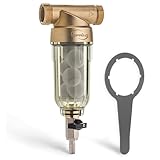
The WSP-50SL is the same 50-micron stainless screen platform as the standard WSP-50, packaged in iSpring’s SL body. In practice that means a slightly different housing and fitting configuration in the same performance class, which makes it the pick when your installation is constrained by the space you have or by the fittings you already own. It is still a Sediment Buster-family unit with a bottom flush and a reusable screen, so the maintenance story is identical to the rest of the line. If you have measured your available wall space and found it tight, or you are replacing a failed unit and want to match an existing bracket and pipe stub, this variant is often the one that drops in without re-plumbing.
Key specs
- Filtration rating: 50 micron.
- Screen: stainless steel mesh, washable and reusable.
- Housing: SL body variant with a clear inspection section.
- Connection: 1-inch class whole-house ports; confirm the exact thread configuration on the listing.
- Flow class: standard whole-house, comparable to the WSP-50.
- Flush: manual bottom drain valve.
Strengths
The strongest case for the SL is that it keeps you inside one ecosystem. If you already run iSpring filtration downstream — a carbon block, a softener, or a whole-house treatment stage — staying with the same brand means fittings, adapters, and O-rings you already understand, and a maintenance routine that does not change from one housing to the next. That is a real advantage over mixing brands, where a 1-inch nominal thread on one unit may not match the adapter set you bought for another.
Performance-wise, this is a 50-micron screen filter and it behaves like one. It catches the visible grit that damages fixtures, it flushes from the bottom in seconds, and it has no consumable cartridge. Where it differs from the standard WSP-50 is packaging rather than filtration: the body shape and included hardware are oriented toward a clean, compact install. For a retrofit into a basement main line where the previous filter occupied a specific footprint, that compactness is the deciding factor.
It also handles the common failure scenario well. When an old cartridge housing cracks or a plastic sump strips its threads, the replacement decision is often “do I buy the same disposable design again, or do I move to a screen filter that never needs a cartridge?” The SL body is a sensible landing spot for that upgrade because it installs in roughly the same wall footprint while permanently eliminating the cartridge purchase.
Pros
- 50-micron stainless screen with no consumable cartridges.
- Compact SL body suits tight retrofit spaces.
- Keeps you within one brand’s fitting and accessory ecosystem.
- Bottom flush valve for quick, tool-free cleaning.
- Transparent section for visual sediment checks.
Cons
- No filtration advantage over the standard WSP-50 — you are choosing packaging, not performance.
- Less screen area than the Big version, so heavier loads mean more frequent flushing.
- Connection configuration varies by variant, so the listing must be read carefully.
- No pressure gauge.
How it compares
Against the iSpring WSP-50, the SL is essentially the same filter in a different body — pick whichever variant matches your available space and existing fittings, because the micron rating and maintenance routine are identical. Against the iSpring WSP50ARB Big, it gives up flow capacity and flush interval in exchange for a smaller footprint and a lower price tier. If your home is a normal size and your sediment is light to moderate, the SL is the more efficient purchase; if you are fighting sand, the Big body earns its premium.
5. iSpring WSP-100 – Best for Coarse Sediment and Low Pressure Drop

The WSP-100 is the same architecture as the rest of the iSpring spin-down line with one key change: the screen is rated at 100 micron instead of 50. That is a deliberate trade. A coarser screen passes more water with less pressure loss and blinds over far more slowly, which makes it the right choice when your water carries heavy, chunky debris — coarse sand, rust chunks, bits of scale from an aging main — and your priority is keeping full flow to the house rather than catching the finest particles. It is also a sensible first stage ahead of a finer filter or a cartridge housing downstream.
Key specs
- Filtration rating: 100 micron — coarse-to-medium sediment class.
- Screen: stainless steel mesh, washable and reusable.
- Housing: transparent, matching the standard iSpring spin-down body.
- Connection: 1-inch class whole-house ports with adapters commonly available.
- Flow class: high, with lower pressure drop than a 50-micron screen of the same size.
- Flush: manual bottom drain valve.
Strengths
The case for 100 micron is hydraulic. Pressure drop across a screen rises as the openings get smaller and as the mesh captures more debris, and in a house with already-marginal supply pressure, a fine screen can be the straw that breaks the shower. A 100-micron screen removes the bulk of the problem — the visible grit that scores valve seats and clogs aerators — while leaving noticeably more pressure in the system. In practical terms, this is the filter you choose when you would rather flush less often and keep the pressure up than chase the last few microns.
It is also the more forgiving choice for a first-time installer. Coarse screens tolerate being left in service longer without a dramatic flow penalty, so the consequences of forgetting to flush are milder. For a rental property, a vacation home, or any installation where maintenance attention is irregular, that tolerance is worth more than a finer rating that nobody is around to service.
Finally, the WSP-100 works well as a sacrificial first stage. If you plan to run a finer filter, a carbon block, or a softener downstream, putting a 100-micron spin-down in front of it dramatically extends the life of whatever comes next, because the coarse stage takes the heavy load that would otherwise blind a fine cartridge in weeks.
Pros
- Lower pressure drop than 50-micron screens of the same body size.
- Longer service intervals under heavy, chunky debris loads.
- Excellent sacrificial first stage ahead of finer filtration.
- Reusable stainless screen, no cartridges.
- Tolerant of irregular maintenance.
Cons
- Will pass fine silt and small particles that a 50-micron screen would catch.
- Not the right single filter if your complaint is fine sediment reaching fixtures.
- Same body-size limitations as the standard WSP-50 for very high flow.
- No pressure gauge.
How it compares
Against the iSpring WSP-50, this is a direct micron-versus-flow trade: the WSP-50 catches finer particles, the WSP-100 protects pressure better and needs less attention. Against the Waterdrop BG103 Mega, the BG103 goes even coarser with a 500-micron first stage plus a 200-micron second stage, which makes it a heavy-solids tool rather than a general-purpose filter. If your water is merely gritty, the WSP-100 is the more balanced pick; if it is genuinely sandy, the BG103’s staged screens handle more volume before blinding.
6. Rusco 1-1/2-60-F – Best Premium for 1½-Inch Mains and Well Water

Rusco has been building spin-down screen filters for decades, and the 1-1/2-60-F is the model aimed at the top end of residential and the bottom end of light commercial. The designation tells you most of the story: 1½-inch connections, a 60 mesh polyester screen, and a large body designed to move serious volume with minimal pressure loss. This is the filter for a house on a 1½-inch main, a property with a well and a pressure tank, an outbuilding with irrigation, or anyone who has already learned that a compact 1-inch unit becomes the weak link in a high-demand system.
Key specs
- Screen rating: 60 mesh polyester — a mesh designation rather than a micron figure; in the coarse-to-medium range.
- Screen material: polyester, cleanable and reusable, with replacement and alternate-mesh screens available as an upgrade path.
- Connection: 1½-inch threaded ports, matching large residential mains.
- Body: large-capacity housing with a substantial debris reservoir.
- Flow class: very high — well beyond typical 1-inch residential filters.
- Flush: manual flush valve at the bottom of the housing.
Strengths
The 1½-inch connection is the headline. Most residential spin-down filters top out at 1-inch ports, which is fine until your service line is 1½ inches and you insert a 1-inch restriction into it. The Rusco matches the pipe rather than choking it, which preserves flow for large homes, multi-zone irrigation, and any system where several fixtures run simultaneously. If you have ever watched pressure collapse when the irrigation kicks on, the connection size is usually the reason.
The second strength is the replaceable screen system. Rusco’s design lets you swap the screen element, which means the mesh rating is not a permanent decision — you can start coarse for a heavy spring runoff and move finer once the load settles, or keep a spare screen on the shelf so that a cleaning and a reinstall happen back to back instead of leaving the house on unfiltered water while you scrub. That kind of modularity is what separates a premium filter from a sealed budget body.
The third strength is durability and parts availability. A large body with a thick housing, standard threaded connections, and a well-supported screen line is a component you can plan to own for a decade or more. Polyester screens handle repeated cleaning well, and because the housing is oversized, the sediment has somewhere to go between services.
Pros
- 1½-inch connections match large residential mains without restriction.
- Very high flow capacity for large homes and irrigation.
- Replaceable screens in alternate mesh ratings extend the filter’s usefulness.
- Oversized debris reservoir stretches service intervals.
- Long-established brand with widely available replacement parts.
Cons
- Premium price tier, and the largest footprint in this roundup.
- 60 mesh is coarser than a 50-micron screen — fine silt passes through.
- Overkill, and awkward to plumb, on a standard 3/4-inch or 1-inch residential main.
- Requires enough clearance below the housing for a proper flush and drain path.
How it compares
Against the iSpring WSP50ARB Big, the Rusco wins on raw flow and connection size and loses on filtration fineness: the iSpring holds a 50-micron rating while the Rusco’s 60 mesh polyester screen sits coarser. For a 1½-inch main or a heavy-demand property, flow matters more and the Rusco is the correct choice. Against the Waterdrop BG103 Mega, the Rusco is the more permanent, serviceable installation, while the BG103 is a staged heavy-solids catcher. If you are plumbing a whole property and want one filter to last, the Rusco is the long-term answer.
7. Purevua PSF1 – Best Budget Pick for Mixed Thread Sizes

The PSF1’s distinguishing feature is written right into its name: a dual-thread body offering 1-inch MNPT and 3/4-inch FNPT connections on the same housing. That sounds like a small detail and it is not. Thread mismatches are the single most common reason a DIY filter install stalls halfway through — you buy a unit, cut the pipe, and discover that the adapter you need is a special order. A body that accepts either a 1-inch male threaded fitting or a 3/4-inch female connection gives you two ways to make the joint with parts that are on the shelf at any hardware store.
Key specs
- Connection: dual thread — 1-inch MNPT and 3/4-inch FNPT on the same head.
- Screen: stainless steel mesh; confirm the exact micron rating on the listing, as this body is sold in more than one configuration.
- Housing: transparent body for visual inspection.
- Flush: manual bottom drain valve.
- Flow class: residential; sized for a typical home main rather than large-property demand.
- Price tier: budget.
Strengths
The dual thread is the whole argument. On a standard install you can plumb 1-inch male fittings directly into the head, and on a smaller line you can thread 3/4-inch male pipe into the female ports without an adapter at all. That flexibility matters most in exactly the situations where budget filters get bought: retrofits into older homes with mixed pipe sizes, outbuilding lines, garage and shop plumbing, and any installation where the person doing the work wants to finish in one trip to the hardware store.
Beyond the threads, the PSF1 delivers the standard spin-down feature set at a low price: a reusable stainless screen, a clear housing so you can see when to flush, and a bottom drain that empties the trapped sediment by gravity. There is no cartridge to buy, which means the ongoing cost of ownership is essentially zero beyond an occasional O-ring. Over a few years, that difference adds up against cartridge housings that consume a filter element every one to three months.
It is also a low-risk way to find out how much sediment your water actually carries. If you install a budget spin-down and discover that the screen stays clean for months, you have learned that you do not need a bigger filter. If it blinds in a week, you have learned that you do — and you have spent the minimum to find out.
Pros
- Dual-thread design accepts 1-inch MNPT or 3/4-inch FNPT connections.
- Eliminates the most common adapter-hunting delay in DIY installs.
- Budget price tier with the standard reusable-screen feature set.
- Transparent housing for easy sediment checks.
- No consumable cartridges.
Cons
- Micron rating varies by configuration — read the listing carefully.
- Less published specification detail than the established filtration brands.
- Smaller body means more frequent flushing under heavy loads.
- Not intended for high-flow whole-property demand.
How it compares
Against the Waterdrop RPFK, the PSF1’s advantage is purely the dual-thread head — if your plumbing is standard, the RPFK’s brand backing may be worth more than the fitting flexibility. Against the iSpring WSP-50, the PSF1 gives up specification clarity and body size but costs less and installs more easily on odd pipe. For a shop sink line or a garage where the plumbing has been modified over the years, the dual thread is genuinely the deciding feature.
8. Waterdrop BG103 Mega – Best for Heavy Sand and Grit

The BG103 Mega is not a fine filter and does not pretend to be. It is a staged coarse-sediment catcher with a 500-micron first screen and a 200-micron second screen inside an oversized body, and it exists for one situation: water that carries enough sand, grit, and particulate to blind a normal 50-micron screen in days. If you are on a well with a sand problem, if your water arrives cloudy after heavy rain, or if you are protecting downstream equipment from abrasion, this is the tool for the job. It sits ahead of finer filtration rather than replacing it.
Key specs
- Staged screens: 500 micron coarse stage plus 200 micron second stage.
- Screen material: stainless steel mesh, cleanable and reusable.
- Body: oversized “Mega” housing with a large debris reservoir.
- Flow class: high, thanks to the coarse ratings and big body.
- Flush: manual bottom drain valve.
- Price tier: premium.
Strengths
The two-stage arrangement is the clever part. A single coarse screen passes everything below its rating; a staged design lets the 500-micron stage intercept the heavy load and the 200-micron stage polish what gets through, so the finer screen is not asked to handle the full volume of grit at once. The result is a filter that keeps flowing far longer than a single fine screen would under the same conditions, and a flush interval measured in weeks rather than days.
The oversized body compounds that advantage. More internal volume means more room for debris to accumulate before it interferes with flow, and more surface area on each screen means lower velocity and lower pressure drop. On a well system where the pump already has to work, keeping the pressure penalty small is not a luxury — it is the difference between a system that runs comfortably and one that cycles constantly.
Used correctly, the BG103 is a protective device rather than a final filter. It removes the abrasive solids that wear out pump impellers, damage valves, and destroy downstream cartridges. If you have ever replaced a sediment cartridge monthly because sand filled it, the math changes dramatically when a coarse spin-down catches that sand first.
Pros
- Two-stage 500 + 200 micron screens handle genuinely heavy sand loads.
- Large body delivers high flow and low pressure drop.
- Long service intervals compared with fine single-stage screens under the same load.
- Reusable stainless screens, no cartridges.
- Protects downstream filters and equipment from abrasive grit.
Cons
- Premium price tier for a filter that is deliberately coarse.
- Will not stop fine silt — you still need a finer stage downstream.
- Large footprint needs real wall space and flush clearance.
- Overkill for municipal water with light sediment.
How it compares
Against the iSpring WSP-100, the BG103 is coarser and staged, which makes it better at volume and worse at fineness; the WSP-100 is the more balanced single-stage filter for ordinary grit. Against the Rusco 1-1/2-60-F, the BG103 offers finer screening at its second stage but smaller connections, while the Rusco offers superior flow on a large main. If your problem is heavy sand and your plumbing is standard residential size, the BG103’s staged screens are the most direct solution.
9. YOTOSIRE Spin Down Sediment Filter with Pressure Gauge – Best Budget Pick With Pressure Monitoring

This unit’s differentiator is the integral pressure gauge, and that is a more useful feature than it first appears. A pressure gauge turns filter maintenance from a guess into a measurement: you record the pressure when the screen is clean, watch it drift downward as sediment accumulates, and flush when the drop reaches a threshold you have chosen. Without a gauge, you are relying on noticing that the shower feels weaker, which typically means you have already lost more pressure than you needed to. Add the two stainless screens — one at 50 micron and one at 100 micron — and you have a budget-priced unit with a diagnostic instrument built in.
Key specs
- Screens: 50 micron and 100 micron stainless steel mesh, both reusable.
- Pressure gauge: integral, for monitoring pressure drop across the screen.
- Housing: transparent body for visual inspection.
- Connection: standard residential threaded class; confirm the exact size against your pipe.
- Flush: manual bottom drain valve.
- Price tier: budget.
Strengths
The gauge is the reason to pick this over other budget units. A clean 50-micron screen in a residential system typically costs only a few psi, and the drop grows as the mesh loads up. If you note the clean reading after installation, you have a baseline; when the gauge shows a meaningful fall — a handful of psi — you know the screen needs attention, regardless of what the calendar says. That is especially valuable