Best Seafood Boil Pot With Basket for Easy Cooking
What's inside
- Best seafood boil pot with basket by cooking situation
- What to look for in the pot
- Burner compatibility is a safety and performance issue
- Drainage and cleanup: the features that matter after dinner
- Decision matrix for choosing the right model
- How to use and maintain a seafood boil pot
- Final buying recommendation
- Best seafood boil pot with basket by cooking situation
- What to look for in the pot
- Burner compatibility is a safety and performance issue
- Drainage and cleanup: the features that matter after dinner
- Decision matrix for choosing the right model
- How to use and maintain a seafood boil pot
- Final buying recommendation
As an Amazon Associate I earn from qualifying purchases. This post may contain affiliate links at no extra cost to you.
The best seafood boil pot with basket for most home cooks is a 44-quart stainless-steel pot with a perforated lift basket, a tight-fitting lid, and a propane burner rated for at least 50,000 BTU; choose a 30-quart model for smaller groups and a 60-quart model for large outdoor gatherings.
A seafood boil pot has to do more than hold food. It must heat a large volume of water safely, let you lift corn and shellfish out without wrestling with a heavy stockpot, drain efficiently, and survive repeated exposure to salt, heat, and acidic ingredients. The right capacity and basket design matter more than decorative accessories.
As an Amazon Associate we earn from qualifying purchases at no extra cost to you.


Contents
- Best seafood boil pot with basket by cooking situation
- What to look for in the pot
- Burner compatibility is a safety and performance issue
- Drainage and cleanup: the features that matter after dinner
- Decision matrix for choosing the right model
- How to use and maintain a seafood boil pot
- Final buying recommendation
Best seafood boil pot with basket by cooking situation
| Cooking situation | Recommended size | Practical batch | Best burner approach | Typical market range |
|---|---|---|---|---|
| Two to four people, limited storage | 20–30 quarts | 6–10 lb of seafood plus vegetables | Single outdoor propane burner, 30,000–50,000 BTU | $45–$100 for the pot and basket |
| Four to eight people | 40–44 quarts | 10–18 lb of seafood plus vegetables | Stable outdoor burner, 50,000–65,000 BTU | $80–$180 for the pot and basket |
| Eight to 14 people | 60 quarts | 18–28 lb of seafood plus vegetables | High-output propane burner with a wide support ring | $130–$260 for the pot and basket |
| Large party or multiple batches | 80 quarts or larger | Two cooking stages or 28 lb-plus batches | Commercial-style outdoor burner and reinforced stand | $200–$400 or more |
These are working capacities rather than brim capacities. A pot advertised as 44 quarts should not be filled to the rim. Leave room for displacement, bubbling, and safely lifting the basket. As a useful rule, plan to fill a boil pot to roughly two-thirds of its stated capacity.
What to look for in the pot
Capacity and usable space
Capacity is the first buying decision, but advertised quarts can be misleading. Water, potatoes, corn, sausage, and shellfish occupy space at the same time. For a four-person boil, a 30-quart pot can work if ingredients are added in stages. A 44-quart pot is more comfortable because it reduces crowding and gives the basket enough room to circulate water.
A 60-quart pot is useful for a large group, but it creates two ownership issues: it takes longer to heat and becomes awkward to lift even when partially drained. If you frequently cook for six or fewer people, a 44-quart pot is usually a better compromise than buying the largest available model.
Basket design and lifting safety
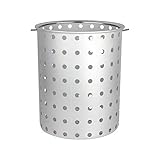
The basket should have perforations large enough to drain rapidly but small enough to retain shrimp, crab pieces, and sliced sausage. A removable basket with two insulated or heat-resistant handles is preferable to a single wire loop. Two handles keep the load balanced when the basket contains several gallons of hot food.
Look for a basket that sits slightly above the bottom of the pot. This creates space for liquid to circulate below the food and prevents ingredients from scorching against a hot base. A flat-bottom basket is easier to load and more stable than a narrow cone-shaped insert, while a basket with side walls that reach near the pot rim is easier to lift without spilling.
Before buying, check the basket’s empty weight. A stainless basket weighing 3 to 6 pounds can become difficult to handle once loaded with potatoes and shellfish. For pots above 60 quarts, a basket with reinforced handles or a separate lifting hook is worth prioritizing.
Material and construction
- Stainless steel resists rust, tolerates acidic boil liquids, and is usually the best long-term choice. A thicker base improves heat distribution.
- Aluminum heats quickly and keeps the total weight down, but it can discolor, dent, and react with strongly acidic ingredients. Avoid storing salty liquid in it.
- Enamel-coated steel is easy to wipe clean and often affordable, but chips expose the underlying metal and can eventually lead to corrosion.
- Thin stainless steel is not automatically durable. A lightweight pot may be convenient, but the base can warp if heated empty or cooled abruptly.
For regular use, choose stainless steel with rolled edges, securely riveted handles, and a base that sits flat. Rivets are generally preferable to welded handles on a large pot because they make the load-bearing connection visible and serviceable, although rivet heads can collect residue during cleaning.
Burner compatibility is a safety and performance issue
A stockpot designed for an outdoor burner should have a broad, stable base that matches the burner’s support ring. A tall, narrow pot balanced on a small burner is an accident risk, especially when the basket is being lifted. Measure the pot’s base diameter and compare it with the burner stand before purchase.
For a 44-quart pot, a burner in the 50,000–65,000 BTU range is a practical target. More heat is not always better: an oversized flame can scorch the bottom, heat the handles, and waste fuel once the liquid reaches a boil. A regulator with adjustable output gives better control than a fixed high-flame setup.
Most large seafood boil pots are intended for outdoor propane burners rather than indoor kitchen stovetops. Do not assume that a pot’s size or included basket makes it suitable for indoor use. Follow the burner and pot manufacturer’s instructions, keep the setup on a level noncombustible surface, and leave clearance around the flame.
Drainage and cleanup: the features that matter after dinner
A good basket should drain most of its liquid within about 30 to 60 seconds when suspended above the pot. Large vertical slots or evenly distributed round holes drain faster than a basket with only a few small openings. Avoid perforations so large that shrimp, crab legs, or small potatoes fall through.
A drain valve can be convenient, but it is not essential for most home boils. Valves add another seal, fitting, and crevice to clean, and they may clog with spices or shell fragments. A lift basket is often simpler and more reliable. If you choose a valve-equipped pot, look for a removable valve assembly and replaceable food-safe gasket.
Worked capacity example
Suppose you are serving six people and plan on 2.5 pounds of seafood per person, for 15 pounds total. Add approximately 6 pounds of potatoes, corn, sausage, and onions. Because food displaces liquid and needs room to move, do not size the pot for 21 pounds alone. A 44-quart pot gives substantially more working space than a 30-quart pot, especially if you add crab and lobster in a second stage. For the same menu, a 30-quart pot is better suited to cooking in two batches.
Decision matrix for choosing the right model
| Your priority | Best choice | Why | Trade-off |
|---|---|---|---|
| Lowest storage footprint | 20–30 quart aluminum or stainless pot | Shorter and easier to store | Less room for a full, mixed batch |
| Occasional family boils | 40–44 quart stainless pot with lift basket | Versatile capacity and better durability | Needs an outdoor storage location |
| Frequent large gatherings | 60 quart stainless pot with reinforced basket | Fewer batches and faster serving | Heavy when loaded; slower to heat |
| Beginner prioritizing easy handling | 30–44 quart pot with two basket handles | More manageable than an oversized commercial pot | May require staged cooking |
| Lowest initial cost | Basic aluminum pot and separate basket | Usually lighter and less expensive | More prone to dents and staining |
How to use and maintain a seafood boil pot
- Inspect the pot, basket, handles, and burner before each use. Confirm that the basket sits level and that no handle fasteners are loose.
- Fill only to the planned working level, leaving room for food displacement and bubbling.
- Bring the liquid to a boil before adding dense ingredients. Add potatoes first, followed by sausage and corn, then delicate seafood near the end.
- Lift the basket using both handles, keep your face and arms away from steam, and allow it to drain over the pot before moving it to a serving tray.
- Empty the pot while it is still warm, but not dangerously hot. Remove spices, shells, and food particles before washing.
- Wash the pot and basket with hot water and mild detergent. Rinse salt and acidic residue thoroughly, then dry completely to prevent spots and corrosion.
The parts most likely to wear are basket handles, burner regulators, drain-valve gaskets, and thin pot bases. Keep the basket dry between uses, do not store it nested inside a damp pot, and replace a cracked gasket rather than relying on overtightening. Never heat an empty aluminum or thin steel pot, and do not pour cold water into a piping-hot pot; thermal shock can warp the base.
Final buying recommendation
For most households, the best seafood boil pot with basket is a 40–44-quart stainless-steel model with a perforated, two-handle basket, a flat stable base, and compatibility with a 50,000–65,000 BTU outdoor propane burner. Choose 20–30 quarts if storage and smaller portions matter most. Move to 60 quarts only when you regularly serve larger groups and have a safe place to use and store the equipment. Prioritize a balanced basket, sturdy handles, useful working capacity, and easy cleaning over an included thermometer or oversized burner that you may not need.