Best Portable Woodworking Workbenches for 2026
What's inside
As an Amazon Associate I earn from qualifying purchases. This post may contain affiliate links at no extra cost to you.
The best portable woodworking workbench for most home woodworkers is the Kreg Mobile Project Center KWS1000, because it combines a 1,100-pound load rating, integrated clamping, a relatively compact folded form, and useful support for both assembly and cutting. The WORX Pegasus is the better lower-cost choice, while a Festool MFT/3 is the strongest option for precision track-saw and router work.
As an Amazon Associate we earn from qualifying purchases at no extra cost to you.


Contents
Best portable woodworking workbenches at a glance
| Model | Approx. folded size | Weight | Worktop/load capacity | Best for |
|---|---|---|---|---|
| Kreg Mobile Project Center KWS1000 | 31.5 × 27.5 × 7.5 in | About 28 lb | 27.5 × 31.5 in; up to 1,100 lb | General woodworking and strong workholding |
| WORX Pegasus WX051 | About 35 × 25 × 5 in | About 30 lb | 31 × 25 in; 300 lb as a bench | Budget buyers and occasional projects |
| BLACK+DECKER Workmate 425 | About 29 × 27 × 7 in | About 28 lb | Adjustable jaws; up to 550 lb | Small parts, hand tools, and repair work |
| Festool MFT/3 | About 43 × 29 × 4 in when folded | About 66 lb | Approximately 44 × 30 in; up to 264 lb | Precision cutting and modular clamping |
Dimensions and capacities can vary slightly by production version and regional specification. Load ratings also describe different things: a static load spread across the surface is not the same as a concentrated load at one corner or force from planing.
How the main contenders compare
Kreg Mobile Project Center KWS1000: best all-rounder
The Kreg KWS1000 is the most balanced choice when one bench must handle assembly, drilling, sanding, and occasional sawing. Its two-section top can be used as a broad surface or separated to hold a workpiece between the halves. The included bench dogs and clamp accessories make it more useful for woodworking than a flat folding table.
Its 1,100-pound rating is generous, but the bench is still light enough for one person to carry. Setup takes roughly 30 to 60 seconds after the first assembly. The legs lock positively, and the wide footprint is reasonably stable on a garage floor or driveway. On an uneven floor, however, a folding bench cannot match a heavy fixed cabinet bench. Place the heavier end over the lowest point and avoid hammering near an unsupported corner.
The main compromise is folded bulk. It is thinner than a permanent bench but not especially small in a crowded car. The plastic top can also flex slightly under concentrated force. For hand-planing, use a stop or clamp close to the workpiece rather than relying on the nominal load rating.
WORX Pegasus WX051: best value for limited use
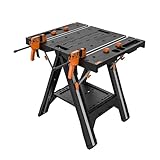
The WORX Pegasus is a practical choice for apartment workshops, DIY users, and anyone who needs a bench a few times a month. It folds quickly, weighs about 30 pounds, and includes clamping dogs. Its 300-pound bench capacity is enough for furniture assembly, trim work, routing smaller pieces, and general repairs.
The Pegasus is also designed to convert into a sawhorse, which makes it more versatile than its price suggests. The work surface is large enough for many small projects, but the plastic top and lighter frame transmit more vibration than the Kreg or Festool. That matters when chiseling, hand-planing, or using a benchtop planer.
Expect a setup time of approximately one minute. It is easy to transport, although the broad folded profile can be awkward on stairs. For stability, put both feet on the same plane; do not bridge a floor drain, threshold, or loose gravel with only one leg.
BLACK+DECKER Workmate 425: best for small workpieces
The Workmate 425 remains useful because its adjustable jaws grip irregular objects, narrow boards, and small components better than many flat-top folding benches. It is particularly convenient for sanding, drilling, carving, hardware installation, and household repairs.
The split jaw design can hold a board vertically or horizontally, and the bench folds into a compact package. Its approximately 550-pound capacity is substantial for its size, but the narrow footprint limits how aggressively it should be used. A long board can twist the frame if it extends far beyond the jaws without an outboard support.
Setup is usually under a minute, but adjusting the jaws takes longer than clamping a piece to a flat worktop. The wooden or composite jaw inserts are consumable parts: replace them when they become rounded, split, or contaminated with finish.
Festool MFT/3: best for precision cutting
The Festool MFT/3 is a different kind of portable bench. Its perforated top and compatible rail support are designed for repeatable crosscuts, track-saw work, routing, and modular clamping. The 20-millimeter hole pattern allows dogs and clamps to position parts accurately, which is valuable when making cabinets or breaking down sheet goods.
Its approximately 66-pound weight is the price of rigidity and precision. It is portable between rooms or vehicles, but it is not the bench to choose if you regularly carry equipment up stairs. Setup takes about two to three minutes, particularly if the rail guide must be positioned and checked.
The MFT/3 has a lower stated load capacity than the Kreg, yet it can feel more controlled during precision work because the top, legs, and clamps work as a coordinated system. It is less suitable for rough hammering or storing very heavy materials. Buyers should also budget for compatible clamps, dogs, and accessories.
Decision matrix: which bench fits your situation?
| Your situation | Best choice | Why |
|---|---|---|
| Small budget, occasional projects | WORX Pegasus | Quick setup, useful clamps, and a practical sawhorse conversion |
| One general-purpose bench for frequent home use | Kreg KWS1000 | Best balance of capacity, workholding, size, and portability |
| Small parts and repair jobs | BLACK+DECKER Workmate 425 | Adjustable jaws grip shapes that flat benches cannot hold securely |
| Cabinetmaking and track-saw accuracy | Festool MFT/3 | Perforated top, guide-rail compatibility, and repeatable clamping |
| Frequent transport in a compact vehicle | WORX Pegasus or Workmate 425 | Lower carrying burden and smaller folded packages |
| Heavy hand-tool work | Kreg KWS1000, with added support | Higher rating and broad top, though a fixed bench remains better |
What to check beyond the headline load rating
- Folded dimensions: Measure the storage shelf, vehicle opening, and stair landing—not just the floor area where the bench will be used.
- Weight: A 25- to 35-pound bench is manageable for most people. A 60-pound precision bench is portable, but usually with two hands and a planned route.
- Workholding: Included dogs are useful, but check whether they fit standard holes or require proprietary accessories. Clamps should hold the work without contacting fragile plastic edges.
- Leg geometry: Wide feet and diagonal bracing improve stability. Four small feet are more sensitive to uneven concrete than broad, independently adjustable feet.
- Top flatness: A flexible plastic top is fine for assembly but less desirable for accurate joinery. For precision, use a straightedge to check the surface before starting.
- Working height: A bench around 30 to 34 inches suits many general tasks. Lower work is often better for planing, while taller work can reduce bending during sanding and assembly.
Setup on an uneven floor
Portable benches become noticeably less stable on driveways, old garage slabs, and outdoor paving. Start by clearing loose grit from the feet. Open every leg fully and confirm that each locking mechanism is engaged. Press down on opposite corners before placing the workpiece; movement at this stage is easier to correct than movement under a saw.
If one foot does not sit firmly, use a purpose-made rubber leveling pad or a thin, stable shim beneath the foot. Do not stack loose scraps, cardboard, or several thin wedges. After clamping the work, keep force near the center of the bench and support long boards with a separate roller stand or sawhorse.
Ownership realities and maintenance
The parts most likely to wear are clamp pads, jaw inserts, leg locks, hinge points, and non-slip feet. Brush sawdust from hinges and locking slots rather than forcing dirty mechanisms closed. A small amount of manufacturer-approved dry lubricant can help metal pivots, but oily lubricant can attract abrasive dust.
Inspect the bench before each demanding job. Replace cracked dogs, split jaw inserts, bent clamps, or feet that no longer grip the floor. Avoid leaving a plastic bench in direct sun for long periods, since heat and ultraviolet exposure can make some polymers brittle. Store the unit folded but not under a load that can distort the top.
For a cost-per-use check, divide the purchase price by realistic annual uses. A $150 bench used 30 times per year for three years costs about $1.67 per use before accessories. A $300 precision bench used weekly for the same period costs about $1.92 per use. The more expensive choice can therefore be better value when its accuracy eliminates repeated setup, extra clamps, or replacement work surfaces.
Final recommendation
Choose the Kreg KWS1000 if you want the best portable woodworking workbench for varied home projects and need a strong, adaptable surface. Choose the WORX Pegasus when low cost, quick storage, and occasional use matter most. Choose the Workmate 425 for small or awkward parts, and the Festool MFT/3 when precision cutting and modular clamping justify its weight and higher overall investment.