Best Budget Woodworking Workbenches for 2026
What's inside
As an Amazon Associate I earn from qualifying purchases. This post may contain affiliate links at no extra cost to you.
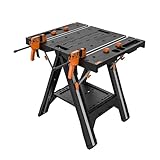
The best budget woodworking workbench for most small shops is the WORX Pegasus WX051: it offers a useful 31-by-25-inch surface, 725-pound capacity, folding storage, and enough clamping versatility for general DIY work without taking over a garage.
That is not the right choice for every project, though. A folding plastic bench is convenient but can flex under hand-planing, while a heavy steel or wood bench is more stable but harder to move and usually costs more. The comparison below focuses on the factors that matter in a real garage: weight capacity, top thickness and rigidity, usable workspace, storage, and setup time.
As an Amazon Associate we earn from qualifying purchases at no extra cost to you.


Contents
Best budget woodworking workbenches compared
| Workbench | Approx. market range in 2026 | Work surface | Capacity | Top construction | Storage | Typical setup |
|---|---|---|---|---|---|---|
| WORX Pegasus WX051 | $120–$180 | 31 × 25 in. | 725 lb. | Plastic resin top with folding frame | Folding; integrated lower shelf | 5–10 minutes |
| Keter Folding Work Table | $90–$150 | 33.5 × 21.7 in. | Up to 1,000 lb. | Polypropylene top with metal folding legs | Folds flat; no enclosed drawers | 5–10 minutes |
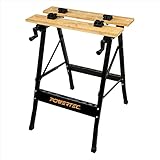
| BLACK+DECKER Workmate WM425 | $100–$160 | Approx. 29.5 × 19.5 in. | Up to 550 lb. | Split bamboo work surface | Folds flat; limited tool storage | 5–10 minutes |
| 46-inch steel garage workbench | $250–$450 | 46 × 24 in. | 1,000–1,500 lb. | Steel frame with 1–1.5 in. wood or composite top | Lower shelf, sometimes drawers | 45–90 minutes |
| DIY 2×4 workbench | $100–$250 in materials | Usually 48–72 × 24–30 in. | Often 500–1,000+ lb. | 2×4 frame with plywood or laminated top | Custom shelves and cabinets | 4–8 hours |
Published capacities are maximum static loads, not guarantees that a lightweight bench will remain stable while you strike a chisel or plane across a board. For woodworking, resistance to racking and sliding is often more important than the largest advertised number.
Our picks by garage and shop situation
Best all-around folding bench: WORX Pegasus WX051
The Pegasus is the best budget woodworking workbench when you need one bench for assembly, drilling, sanding, and occasional outdoor work. Its 725-pound rating is ample for furniture parts and benchtop machines, and the integrated clamping system is more useful than a plain folding table.
Its limitation is rigidity. The resin top is not equivalent to a thick beech or maple benchtop, and the 25-inch depth can feel cramped when assembling cabinets. It is a strong choice for renters, shared garages, and woodworkers who must clear the vehicle space after each session.
Best low-cost folding capacity: Keter Folding Work Table
The Keter Folding Work Table provides a large capacity for its price and folds into a relatively compact form. It is a practical choice for cutting sheet goods, fastening projects, and supporting a portable planer or miter saw when paired with proper infeed and outfeed support.
The broad plastic surface is convenient to clean, but it is not ideal for precision hand-tool work. Clamp placement can also be less flexible than on a dedicated woodworking top. Add a sacrificial plywood panel when you need a flat, replaceable surface or want to screw down temporary stops.
Best for portable handwork: BLACK+DECKER Workmate WM425
The Workmate WM425 is suited to small projects, carving, repair work, and jobs where clamping matters more than surface area. Its split bamboo jaws can hold irregular shapes and narrow boards in ways a flat folding table cannot.
Choose it when storage space is extremely limited or you regularly carry the bench between rooms. Its smaller top and lower capacity make it less suitable for cabinet assembly, large glue-ups, or machines that generate vibration.
Best stable garage option: a 46-inch steel workbench
A 46-inch steel workbench is the better buy when the bench can remain assembled in one location. Models in this category commonly provide a 24-inch depth, a lower shelf, and a wood or composite top around 1 to 1.5 inches thick. The extra mass and full-width frame make sanding and light planing more comfortable than on a folding plastic bench.
Look carefully at the top rather than judging by the steel frame alone. A thin pressed-wood panel may sag under a heavy vise, while a thicker laminated top can accept dog holes, bench hooks, and a properly supported vise. Some models include drawers, but inexpensive drawer slides are often the first component to become rough or misaligned.
How to choose the right size
Start with the largest object you expect to build, not the available empty floor area. A useful minimum for general woodworking is approximately 48 inches wide by 24 inches deep. A 60-by-30-inch top is more comfortable for cabinet parts and furniture assembly, but it needs a clear working zone around it.
Measure the garage with the vehicle parked in its normal position. Leave at least 30 inches on the active working side and enough clearance to rotate long boards. A 24-inch-deep bench against a wall needs roughly 54 inches of total depth for comfortable access from one side. If that footprint is unavailable, a folding model may be more productive than a larger bench that cannot be used without moving everything else.
Height matters as well. For general assembly, a top around 34 to 36 inches suits many users. For hand-planing, a slightly lower surface can provide better leverage; for detailed carving or sanding, a higher surface may reduce bending. Fixed-height budget benches are less adaptable, so include the height of rubber feet, a replaceable top, or a benchtop mat in your calculation.
Decision matrix
| Your situation | Best fit | Why |
|---|---|---|
| Under $150 and the bench must fold away | Keter Folding Work Table | Large capacity and quick setup for general project work |
| Under $200, with frequent clamping | WORX Pegasus WX051 | Integrated clamps and better all-purpose flexibility |
| Beginner making small projects | BLACK+DECKER Workmate WM425 | Compact footprint and useful split-jaw clamping |
| Weekly woodworking in a dedicated garage corner | 46-inch steel workbench | More stable, more workspace, and useful lower storage |
| Experienced maker needing a custom size | DIY 2×4 workbench | Allows a thicker top, tailored height, and purpose-built storage |
Top thickness, stability, and vise installation
For light assembly, a 0.75-inch top is serviceable. For a woodworking vise, dog holes, or repeated hand-planing, aim for about 1.25 to 2 inches of solid or laminated material, or reinforce the mounting area underneath. A thick top by itself does not prevent movement: the legs, stretchers, feet, and floor contact determine whether the bench rocks.
Before installing a vise, check the underside for crossbars and confirm that the mounting bolts will not interfere with a shelf or drawer. On a folding bench, avoid drilling permanent vise holes unless the manufacturer’s frame can safely handle the twisting force. A removable plywood vise board or clamp-on vise is safer and preserves the bench’s portability.
Setup and ownership costs
A budget bench often needs a few inexpensive improvements. A $140 folding bench plus a $35 plywood sacrificial top and $15 of non-slip matting costs about $190. If you use it twice per month for three years, that is 72 sessions, or approximately $2.64 per session before accessories. The plywood also protects the original top from saw cuts, glue, and drill-through damage.
For a fixed steel bench, spend time leveling the feet and tightening every fastener after the first few sessions. Recheck them after a month because vibration can loosen hardware. Keep the lower shelf from becoming overloaded on one side; uneven storage can make a narrow bench feel unstable.
What wears out first
- Folding-leg hinges and latches: Keep them free of packed sawdust and do not drag the bench while it is loaded.
- Plastic or bamboo surfaces: Replaceable plywood protects them from blades, glue, and hot tool batteries.
- Clamping pads: Smooth or cracked pads lose grip; replace them rather than overtightening the clamp.
- Drawer slides: Cheap slides suffer when drawers are overloaded. Store heavy hand tools on a shelf instead.
- Threaded fasteners: Check bolts periodically, particularly after using a planer, sander, or impact driver nearby.
Do not exceed the stated capacity, stand on a folding workbench, or assume its load rating covers a moving machine. For a portable planer or router table, use a wide, level support arrangement and keep the machine centered. If the bench rocks, fix the floor contact or add a proper leveling foot rather than compensating with loose wood shims.
Final verdict
Choose the WORX Pegasus WX051 for the best balance of portability, clamping, and everyday woodworking usefulness. Pick the Keter Folding Work Table when capacity and low cost matter most, the BLACK+DECKER Workmate WM425 for compact handwork, and a 46-inch steel bench when the garage allows a permanent workstation. If your needs are unusual or your budget is close to $200, a simple DIY 2×4 bench can deliver more workspace and a thicker top than most ready-made budget models—provided you are willing to spend an afternoon building and leveling it.