Makita Biscuit Joiner Review: Cuts, Settings, and Best Uses
What's inside
As an Amazon Associate I earn from qualifying purchases. This post may contain affiliate links at no extra cost to you.
The Makita biscuit joiner is a strong fit for cabinetmakers and serious hobbyists who need precise fence control and consistent slot depth in 1/2-inch to 3/4-inch stock, with the corded PJ7000 offering the best value for shop use and the cordless XJP03 making sense only if you are already invested in the Makita LXT system.
As an Amazon Associate we earn from qualifying purchases at no extra cost to you.


Contents
Fence Adjustments and Accuracy
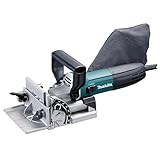
The fence system is the primary reason to choose a Makita biscuit joiner over budget alternatives. On the Makita PJ7000, the cast aluminum fence tilts from 0 to 90 degrees with positive stops at 0, 45, and 90 degrees, and locks with a single large cam lever. Height adjustment is rack-and-pinion controlled via a knurled knob, allowing micro-adjustments without play or slippage. This matters because fence height determines the vertical centering of the slot – even a 1/32-inch shift can cause misalignment when gluing up panels.
In practice, the fence holds position well under lateral pressure, which is a common failure point on lighter joiners where the fence deflects when pressed against a board edge. The PJ7000 fence can also be removed entirely for flat-on-board cuts and reinstalled without recalibration. For mitered work, the angle scale is clearly marked and the detents are positive enough to return to 45 degrees accurately. If you regularly join beveled casings or mitered boxes, this stability reduces the need for test cuts.
The cordless Makita XJP03Z (18V LXT) uses the same fence architecture as the PJ7000, so adjustments and locking feel identical. The main difference is weight distribution – the battery at the rear shifts the balance point slightly back, which requires a bit more forward pressure when referencing the fence on vertical workpieces.
Cutting Depth Consistency Across Biscuit Sizes
Makita biscuit joiners use a 4-inch (100mm) carbide-tipped blade with six teeth, spinning at 11,000 RPM on the corded PJ7000 and approximately 6,500 RPM on the cordless XJP03. Depth is set by a turret stop with six presets, corresponding to standard biscuit sizes:
- #0 biscuit: ~8mm deep slot for material as thin as 1/2 inch
- #10 biscuit: ~12.3mm deep slot for typical 5/8 to 3/4 inch stock
- #20 biscuit: ~14.7mm deep slot for 3/4 inch and thicker panels
- S, D, and MAX settings for detail and specialty biscuits
Depth consistency is controlled by the plunge mechanism and the depth stop, not just motor power. The PJ7000 has a spring-return plunge with dual guide rods that keeps the blade path linear. Reported variation between consecutive cuts in the same setting is typically under 0.2mm when the depth knob is fully seated and the blade is sharp. Dull blades or sawdust packed behind the depth turret are the most common causes of shallow cuts.
For common board thicknesses, here is how to match biscuit size to avoid blow-through:
- 1/2-inch (12.7mm) plywood or solid wood: Use #0 biscuits only. A #20 will risk cutting through the face.
- 5/8-inch (15.9mm) stock: #10 is the maximum safe size for centered slots.
- 3/4-inch (19mm) stock – the most common for panels and carcass work: #20 provides the strongest joint with about 4mm of material remaining on each side of the slot.
- 1-inch and thicker: #20 biscuits, often doubled up for wide glue-ups.
The depth scale is calibrated for standard 4mm thick biscuits. If you use third-party biscuits that are slightly thicker or swollen from humidity, the slot may feel tight. Always test the slot depth on scrap from the same batch of material before cutting your workpieces.
Dust Collection and Visibility
Biscuit joiners generate a high volume of fine dust in a very short burst, and poor extraction quickly obscures the cut line. The Makita PJ7000 includes a built-in dust port (35mm outer diameter) that connects to a standard dust bag or a 1-1/4 inch shop vacuum hose with an adapter. When connected to a vacuum, dust collection captures an estimated 80-85% of debris on edge cuts and slightly less on face cuts where the port orientation is less efficient.
The included fabric dust bag is adequate for a few joints on site but fills in 15-20 cuts in MDF or particleboard and should be emptied frequently to maintain airflow. Without a vacuum, dust ejects from the rear port and from the blade slot, which can cover the scale markings and fence height indicator. For indoor cabinet installation, vacuum connection is strongly recommended. The blade guard also includes a clear window, but it tends to haze over with fine dust after extended use – wiping it with a dry cloth restores visibility.
The XJP03 has the same port location but benefits slightly from its lower RPM – dust ejection is less aggressive, making the bag more effective for short runs without a vacuum.
Handling, Weight, and Ergonomics
Handling differs noticeably between corded and cordless. At 5.6 lbs (2.5 kg) without a cord, the PJ7000 is one of the lightest full-size biscuit joiners available, which helps when making repeated vertical cuts for carcass assembly. The top handle is rubber overmolded and positioned directly over the blade centerline, so plunge pressure feels straight and stable. The paddle switch with lock-on is positioned for thumb operation and includes an anti-restart function on the 120V model.
Vibration is well damped due to the small blade diameter and double-insulated motor housing. Front-grip surface area is large enough for two-handed control on long panels, which improves accuracy on 4-foot glue-ups where you make 4-5 slots per edge. Cord length is 8.2 feet on the PJ7000, sufficient for bench work without an extension in most shops.
The XJP03Z at 5.7 lbs tool-only and about 6.6 lbs with a 5.0Ah LXT battery feels heavier at the back and slightly less nimble for overhead work. Runtime on a 5.0Ah battery is approximately 250-300 cuts of #20 biscuits in softwood or plywood on a single charge; hardwoods like white oak reduce that by about 25% due to longer plunge time. For a full kitchen’s worth of face frames, plan on two batteries.
Makita Biscuit Joiner Spec Comparison
Choosing between the corded workhorse and the cordless option comes down to power availability, weight preference, and whether you already own Makita LXT batteries.
| Specification | Makita PJ7000 (Corded) | Makita XJP03Z (18V LXT Cordless) | DeWalt DW682K (Corded Reference) |
|---|---|---|---|
| Power Source | 120V AC, 5.6A (700W) | 18V LXT Battery | 120V AC, 6.5A |
| No-Load Speed | 11,000 RPM | 6,500 RPM | 10,000 RPM |
| Blade Diameter | 100mm (4 in) | 100mm (4 in) | 100mm (4 in) |
| Tool Weight | 5.6 lbs / 2.5 kg | 5.7 lbs / 2.6 kg (6.6 lbs with 5.0Ah battery) | 6.6 lbs / 3.0 kg |
| Fence Tilt Range | 0 – 90 degrees, stops at 0/45/90 | 0 – 90 degrees, stops at 0/45/90 | 0 – 90 degrees, stops at 0/45/90 |
| Depth Presets | 6 settings (0, 10, 20, S, D, MAX) | 6 settings (0, 10, 20, S, D, MAX) | 6 settings (0, 10, 20, MAX, plus 2 custom) |
| Max Cutting Depth | ~20mm | ~20mm | ~20mm |
| Dust Port Diameter | 35mm OD | 35mm OD | 35mm OD |
| General Market Price Range (2026) | $190 – $230 | $240 – $280 (tool only) | $180 – $220 |
Decision Matrix: Which Option Fits Your Situation
Use your workspace, frequency of use, and material mix to decide before buying:
| Your Situation | Best Choice | Why |
|---|---|---|
| Shop-based cabinet and panel work, access to outlet | Makita PJ7000 | Highest RPM, lightest weight, no battery cost, consistent power for hardwoods |
| On-site installation, trim, or flooring with no reliable power | Makita XJP03Z | Cordless convenience outweighs lower RPM; portability matters more than speed |
| Occasional use, tight budget, 1/2 to 3/4 inch stock | PJ7000 or similar corded type | Avoids $100+ battery investment for infrequent joints |
| Already own Makita 18V LXT batteries and charger | XJP03Z | Battery ecosystem makes cordless cost-effective despite lower speed |
| Precision mitered boxes and fine furniture | PJ7000 | Slightly more stable plunge at full RPM helps in dense hardwoods |
Durability and Ownership Realities
Biscuit joiners have few wear parts, but long-term accuracy depends on maintenance that product listings rarely mention. On Makita models, three areas require attention:
- Blade wear: The 100mm carbide blade dulls faster in MDF and plywood glue lines than in solid wood. A dull blade causes burning, slower plunges, and slightly narrower slots that make biscuit insertion difficult. Replace or sharpen after approximately 2,000-3,000 cuts in hardwood, or sooner if you notice increased resistance or chipping at the slot edges.
- Fence and base surfaces: Aluminum fences can develop burrs from contact with screws or metal clamps. Clean the fence face and base with a non-marring abrasive pad and apply a thin coat of paste wax every few months to keep workpieces sliding evenly. Check the four base screws annually; they can loosen with vibration.
- Depth turret and plunge rods: Sawdust compaction behind the turret is the leading cause of inconsistent depth. Blow out the housing with compressed air after each session and add a single drop of dry lubricant to the plunge rods monthly. Avoid oil that attracts dust.
Common mistakes that affect joint quality include plunging too slowly, which widens the slot through lateral movement; referencing the fence on a non-flat board face; and storing biscuits in open containers where they absorb humidity and swell. Keep biscuits sealed and use them within a few months of opening. For glue-ups longer than 36 inches, alternate the fence reference side between boards to average out any minor fence calibration error.
Best Uses and Limitations
Makita biscuit joiners excel at panel alignment for edge-to-edge glue-ups, carcass assembly for cabinets and bookshelves, and attaching face frames to casework. They are also useful for reinforcing miter joints with #0 or #10 biscuits where clamping alone is insufficient. The tool is less suited for structural joints that require high shear strength – for load-bearing frames or table aprons, dowels, domino tenons, or mortise-and-tenon joints provide more mechanical strength than compressed beech biscuits, which primarily aid alignment and add modest glue surface.
For thin stock under 1/2 inch and for joints within 1 inch of a board end, consider reducing biscuit size or spacing to prevent telegraphing the biscuit shape through the surface after finishing, especially with stain-grade softwoods.
FAQ
Can the Makita biscuit joiner cut slots for Festool Domino tenons? No. Biscuit joiners cut a crescent-shaped slot approximately 4mm wide for flat beech biscuits. Domino tenons require a dedicated oscillating mortiser that cuts a deeper, flat-bottomed mortise. The two systems are not interchangeable.
Do Makita biscuit joiners work with any brand of biscuits? Yes, as long as they are standard #0, #10, or #20 size (approximately 47x16mm, 53x19mm, and 56x23mm respectively) and 4mm thick. Brand variations in thickness are usually within 0.1-0.2mm and do not affect slot cutting, but very cheap or moisture-damaged biscuits can swell and fit too tightly.
How close can you place a biscuit to the end of a board? Maintain at least 2 inches from the end grain for #20 biscuits and 1.5 inches for #0 biscuits to avoid splitting or visible swelling on the end. For narrow boards under 4 inches wide, center a single biscuit rather than placing two near the edges.