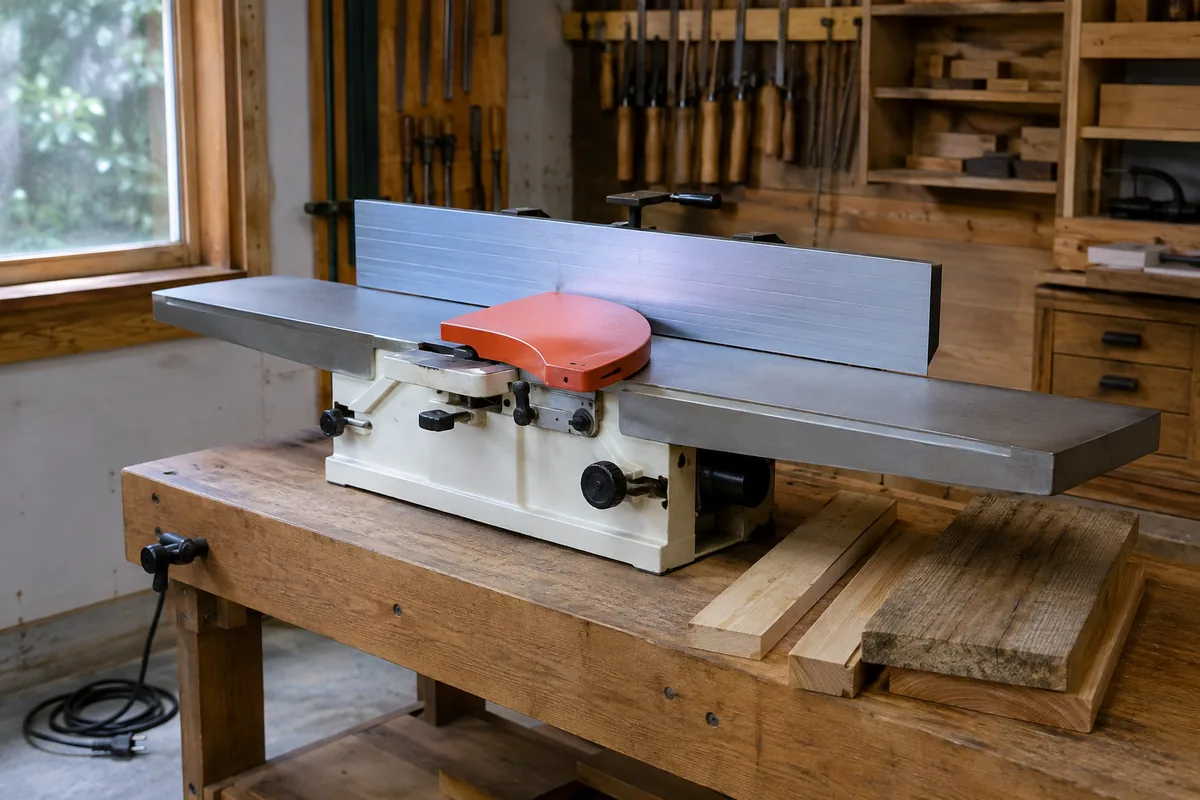
How to Joint Short Stock with Reliable Infeed Support
What's inside
As an Amazon Associate I earn from qualifying purchases. This post may contain affiliate links at no extra cost to you.
Contents
Why Short Stock Is Different on a Jointer
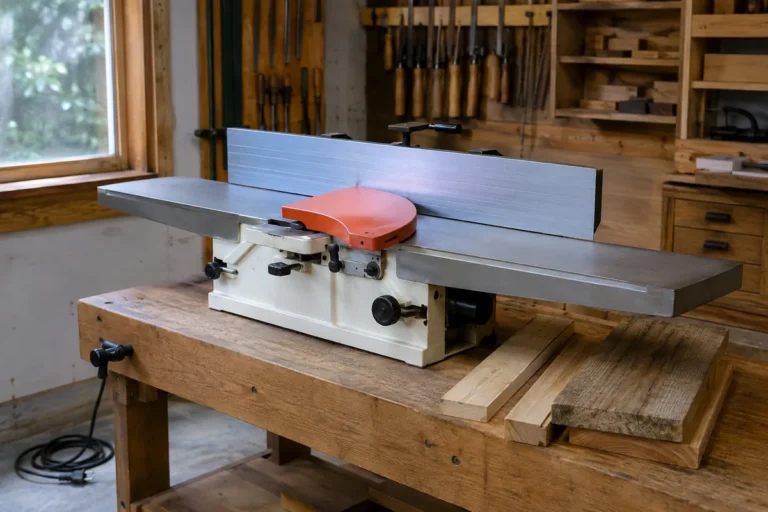
Jointing is about reference. The infeed table, cutterhead, and outfeed table have to support the board continuously while you take a light cut. With a 4-foot board, that’s easy — most of the weight stays on cast iron. With a 10-inch cutoff, you have almost nothing on the tables at any given moment, and your hands end up directly over the cutterhead to keep it from tipping or chattering.
Most 6-inch and 8-inch jointers list a minimum stock length of 10 to 12 inches in the manual. That is not just liability language. The distance between the front of the infeed table and the cutterhead center is typically 6 to 8 inches. If your board is shorter than that span, it will tip into the cutterhead opening when you transition from infeed to outfeed, causing snipe, gouging, or a sudden kickback as the knives grab an unsupported edge. Short stock also forces you to use small, inadequate push blocks that slip, or worse, your bare hands.
If you regularly work with drawer sides, small box parts, or cutoffs under 15 inches, you need two things: a rule for what is safe to joint, and reliable infeed support so the board enters flat and stays flat.
The Minimum Length Rule You Should Actually Follow
Forget the “3x the cutterhead width” myth. Use the table length. A practical shop rule is: stock should be at least 1.5x the length of the infeed table, or 12 inches, whichever is longer. On a typical benchtop 6-inch jointer with a 12-inch infeed table, that means 12 inches minimum. On a stationary 8-inch jointer with a 28-inch infeed table, 16 to 18 inches is a more realistic minimum if you want to joint without a sled.
Anything shorter than that should not be face-jointed freehand. You have three safe options: use a sled that extends the reference surface, gang the short pieces into a longer carrier board, or joint longer stock first and then cut to length. Edge-jointing short stock is slightly more forgiving than face-jointing because there is less tipping leverage, but the same support problem applies — if the board can rock front-to-back on the infeed table, it will rock into the knives.
Feed rate matters too. With short stock, people tend to push fast to get their hands clear. That causes scalloping and increases the chance the knives grab. Aim for 2 to 3 seconds to traverse the cutterhead on a 12-inch piece, with firm downward pressure only over the tables, never directly over the cutterhead.
Infeed Support Options That Actually Work
Reliable infeed support does not mean holding the board up in the air. It means keeping the board co-planar with the infeed table from at least 12 inches before the jointer until the board is fully on the outfeed table. The support must be the same height as the infeed table, dead flat, and it must not deflect under pressure.
A single roller stand placed 6 inches off the end of the jointer is the most common setup and the worst for short stock. Rollers spin, they have 1/16 inch of play, and they let a 10-inch board pivot sideways. They are fine for handling 6-foot boards on a table saw, they are poor reference surfaces for a jointer where 0.005 inch of deflection shows up as taper.
For short stock you want a solid, non-rolling surface:
1. Auxiliary infeed table. A piece of 3/4-inch Baltic birch or MDF, 8 to 12 inches wide and 18 to 24 inches long, with a cleat that hooks over the end of the jointer’s infeed table and leveling screws underneath. Melamine works well because short stock slides easily. Set it with a straightedge bridging from the auxiliary surface onto the jointer’s infeed table — no light should show under the straightedge. Lock it so it cannot tip if you lean on the far end.
2. Sled with a stop. For face-jointing pieces under 12 inches, a simple sled is safer than any infeed table. Take a flat piece of 1/2-inch plywood 24 inches long, add a 3/4-inch cleat at the trailing end as a push block, and add a thin stop at the front to keep the stock from sliding. The sled rides the tables, your hands stay on the sled well behind the cutterhead, and the short stock cannot dip. Put 80-grit sandpaper on the sled bed to prevent creep, or use a toggle clamp if you have many identical parts.
3. Wide, flat outfeed-side support. Short stock fails on the outfeed transition even more than on the infeed. If you only support the infeed, the piece will nosedive as it leaves the cutterhead. Match your infeed solution with an equally solid outfeed support, or have a second person catch without lifting.
Comparison: Infeed Support for Short Stock
| Support Type | Best For | Stability | Setup Time | Cost |
|---|---|---|---|---|
| Roller Stand | Long boards on table saw/planer | Low — roller deflects, board can pivot | 1 minute | $30–$60 |
| Solid Auxiliary Table (shop-made) | 12–18″ stock edge-jointed in small batches | High — solid reference if leveled | 5–10 minutes to level | $15–$30 in scrap |
| Jointing Sled | Pieces under 12″ or highly figured short stock | Very High — stock never tips | 1 hour to build, seconds to use | $20–$40 |
| Fixed Extension Tables (cast iron) | Permanent shop setup, frequent short parts | Very High | Permanent install | $150–$300+ |
If you joint short stock more than once a month, skip the roller stand and build both an auxiliary table and a sled. The combined cost is less than one ER visit. A roller stand is still useful for infeed on your planer or as an outfeed helper for a table saw, but it is not a precision reference.
How to Set Up and Run Short Stock Safely
Start with the jointer off and tables locked. Lay a 36-inch aluminum straightedge so it spans from your auxiliary infeed surface across the jointer’s infeed table. Adjust the auxiliary surface until it is flush within 0.005 inch — use feeler gauges if you have them. A business card is about 0.010 inch; you should not be able to slide one under the straightedge at the joint line. Check side-to-side as well, not just lengthwise.
Set depth of cut to 1/32 inch or less for short stock. A 1/16-inch cut doubles the cutting force and makes a short board want to stall or kick. Sharp knives matter more here than anywhere else. If you see crushed grain instead of clean shavings on maple or cherry, hone the knives before you run small parts.
Use proper push blocks, not push sticks. You need two wide blocks with a heel to catch the trailing end. Cheap plastic blocks with thin foam slip when dust builds up. Look for jointer push blocks with heel that have a large, flat base and a comfortable handle that keeps your fingers 4 inches above the table. For a sled, you only need one block on the sled itself — never reach over the cutterhead to pull from the outfeed side until the entire board has cleared the knives.
Sequence for edge-jointing a 10 to 14-inch board with an auxiliary table:
Place the board on the auxiliary surface with the concave edge down if you can identify it. Butt it against the fence. Apply light downward pressure on the auxiliary surface and slide it onto the infeed table without lifting. Transfer pressure to the push block over the infeed table as the front of the board passes the cutterhead. Once 2 inches of board are on the outfeed table, shift all pressure to the outfeed block and keep the board tight to the fence. Do not press down over the cutterhead gap. Let the outfeed table carry the cut surface.
For face-jointing anything under 12 inches, use the sled instead. Place the stock on the sled, tight to the heel, concave side down. If the board rocks on the sled, shim with a single layer of masking tape until it sits solid without rocking. Run the sled and stock together over the cutterhead in one smooth pass, using the sled handles. Do not attempt to hold short, thin stock (under 1/2 inch thick) directly on the tables — it will flex into the cutterhead opening and chatter.
When to Skip the Jointer Entirely
A jointer is not the right tool for every short piece. If the stock is under 8 inches long, under 1/2 inch thick, or already close to final dimension, you will get a better and safer result with other methods.
A hand plane on a shooting board gives you full control for pieces down to 4 inches. A drum sander with a flat carrier board can flatten short stock without tipping. And a planer sled does face-flattening with far less risk — the planer has a pressure bar and feed rollers that hold the board, while the jointer relies entirely on your hands.
If you must use power, a planer sled for jointing in your thickness planer is often the most honest solution for short stock. It is slower than a jointer, but the failure mode is a bad surface, not a hand in the cutterhead. For small shops that only occasionally flatten short cutoffs, that trade-off is worth it.
Finally, check your fence. On a jointer with a fence that deflects 0.010 inch under hand pressure, any infeed support you add is wasted. Lock the fence, push firmly at the top, and watch a dial indicator or feel for movement. If it moves, fix that before you chase better infeed support.