How to Choose Planer Feed Rollers for Rough Hardwood
What's inside
As an Amazon Associate I earn from qualifying purchases. This post may contain affiliate links at no extra cost to you.
Feeding rough-sawn hardwood through a planer is where cheap feed rollers show their limits. Mill-sawn oak, hickory, or hard maple comes in with varying thickness, hard knots, grit, and often a slight bow or twist. If your rollers can’t grip that surface consistently, you get stalling, chatter marks, washboarding, and deep roller dents that won’t plane out. Choosing the right rollers isn’t about getting the most aggressive bite – it’s about matching grip, pressure, and compliance to the wood and your machine.
Contents
Why rough hardwood is hard on rollers
Surfaced softwood is forgiving. Rough hardwood is not. The initial pass is the worst: you are cutting 1/16″ to 1/8″ with high cutting resistance, and the roller only contacts the high spots of the board. That concentrates all the feed force on a few square inches.
Two failure modes dominate. First is slip. The cutterhead pushes back on the board with 40 to 80 pounds of force depending on depth of cut, width, and species. If the infeed roller can’t overcome that, the board stops, the knives dwell in one spot and burn, and you get a deep gouge. Second is crushing. Too much roller pressure or too hard a serration pattern will emboss the wood. On soft maple or walnut, serrated steel marks can be 0.015″ to 0.030″ deep, which means you need to take another full pass just to clean them up, wasting material.
Grit is the third killer. Rough lumber from an air-dried pile or a bandsaw mill carries silica and dirt in the surface. That grit acts like sandpaper on rubber rollers and rounds over the teeth on cheap serrated steel rollers in a season.
The three roller types compared
Almost every 12″ to 20″ stationary planer uses one of three infeed roller designs. The outfeed is almost always a smooth steel roller – it rides on the planed surface and shouldn’t mark it.
| Roller Type | How It Grips | Best For | Downsides on Rough Hardwood |
|---|---|---|---|
| Serrated Steel (straight tooth) | Sharp longitudinal teeth bite into the wood | Heavy cuts in rough, hard stock; production shops | Leaves serration marks; can crush soft hardwoods if pressure is high; noisy |
| Rubber / Polyurethane Coated | High-friction compliant surface conforms to uneven thickness | Figured wood, pre-surfaced stock, low snipe needs | Slips on dusty or wet rough lumber; wears faster with grit; can glaze and harden |
| Segmented / Helical Serrated Steel | Narrow steel segments with spring suspension or helical teeth | Variable thickness, glued panels, rough boards with bow/twist | Most expensive; more parts to maintain; overkill for a small shop doing 4/4 stock |
For dedicated rough hardwood work, serrated steel is the workhorse. A 2″ to 2.5″ diameter serrated steel infeed roller with 12 to 16 teeth per inch gives the best balance of bite without excessive marking. Finer pitch (20+ TPI) grips less aggressively and clogs with pitch; coarser pitch (8-10 TPI) bites deep but leaves marks that are hard to remove on a 13″ lunchbox planer with limited depth capacity.
Rubber rollers typically use 60A to 75A durometer polyurethane. Softer (60A) conforms better and reduces snipe but slips more easily under heavy cut. Harder (75A-85A) feeds better but loses compliance. On rough hickory or white oak taking more than 1/16″ depth, even a new 70A rubber roller will often slip unless you slow feed speed to 16-20 FPM and keep the bed waxed.
What to look for in a spec sheet
Diameter and durometer matter more than brand names. Larger diameter rollers have a longer contact patch and bridge over low spots better. If you have a choice, a 2-1/2″ roller will feed bowed 6/4 stock far more reliably than a 1-7/8″ roller, with less required spring pressure.
Check these four numbers before you buy:
1. Roller pressure and spring range. Most 15″ and 20″ planers allow 25 to 60 lbs of downforce per roller via adjustable springs. For rough hardwood you want to run 35-50 lbs on the infeed. If you can’t adjust it, you can’t tune out slip vs. crush. Look for rollers sold with matched springs or shims.
2. Tooth geometry. Straight serrations feed straight. Helical or skewed serrations (often 5-10 degrees) help self-center the board and reduce lateral drift, which matters on wide slabs. Segmented rollers should have 1″ to 2″ wide segments with at least 1/16″ independent travel to accommodate thickness variation across the width.
3. Bore, keyway, and bearing fit. Stationary planers are not universal. Measure your shaft diameter (commonly 3/4″, 1″, or 25mm), key size, and overall length within 0.010″. A roller that is 1/8″ short leaves a dead spot at the edge of the board.
4. Hardness and coating. For steel, through-hardened 1045 or 4140 at 45-55 HRC will hold teeth much longer than mild steel with case hardening. For rubber, ask for cast polyurethane, not extruded PVC coating. Polyurethane resists cutting and oil far better and can be re-coated once.
If your current rubber rollers are glazed, cracked, or have flat spots, you can often buy polyurethane planer feed rollers as direct replacements without changing the steel core. For heavy rough stock, consider switching to serrated steel planer infeed rollers if your planer model supports them – the conversion is usually a drop-in on Taiwanese 15″ and 20″ four-post planers.
Matching rollers to your planer
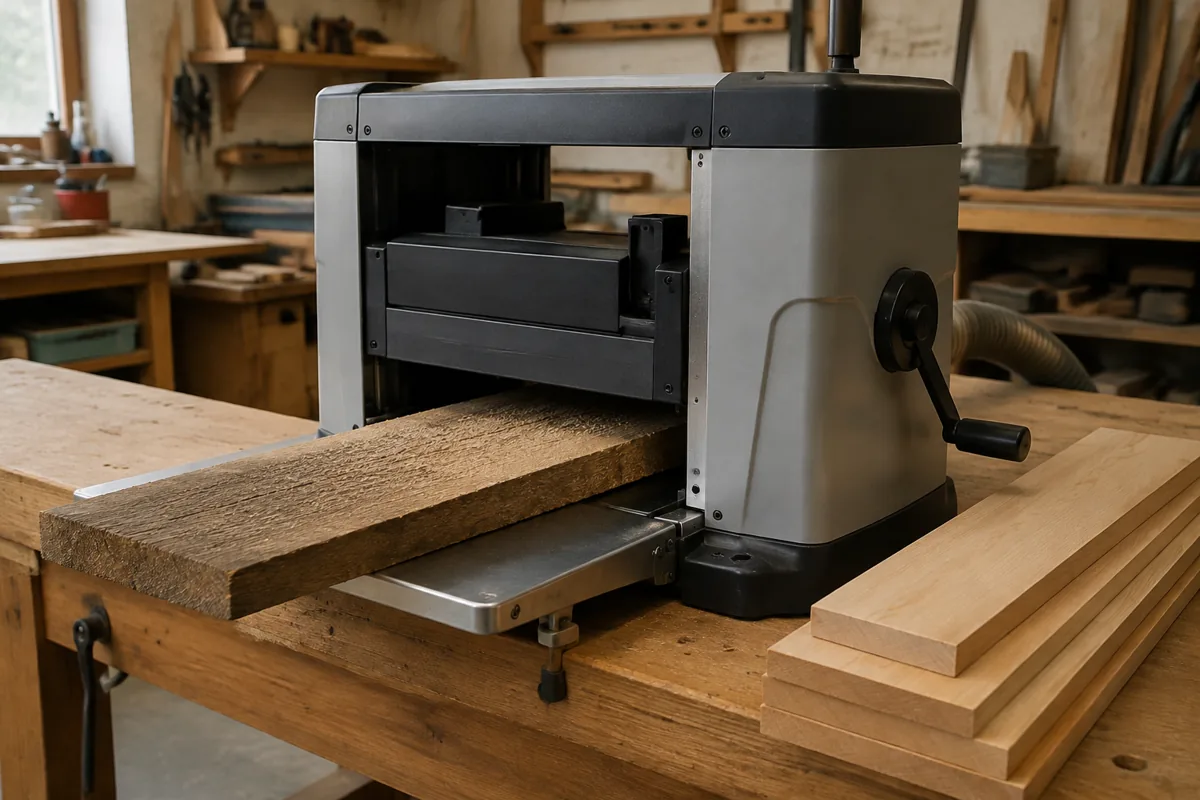
Lunchbox (portable) planers in the 12″ to 13″ range use small-diameter rubber rollers driven by a single chain. You have limited options: OEM-style rubber only, usually 50-60A. Don’t try to force a serrated steel roller in these – the gearbox and roller pressure aren’t designed for it and you’ll get severe snipe and motor stalls. Best upgrade path is a fresh, high-quality rubber set and keeping feed speed at the low setting if your machine has two speeds.
For 15″ to 20″ stationary four-post planers (the typical cast-iron import machines), you have real choice. These machines have separate infeed and outfeed rollers with adjustable spring pressure and typically run at 20 to 30 FPM. This is where a serrated steel infeed with a smooth steel outfeed is ideal for rough hardwood. If you plane a lot of wide glue-ups or live-edge slabs that vary 1/8″ side-to-side, segmented helical planer feed rollers are worth the extra $150 to $250 – they keep feeding when a solid roller would lift and chatter.
Check drive type. Solid rollers use a single sprocket and chain. Segmented rollers sometimes need a wider chain or dual sprockets. Confirm your planer’s chain pitch (often #40 or #41) and that the sprocket aligns. Misalignment by even 1/16″ will throw the chain under load.
When to stay cheap and when to upgrade
If you plane less than 200 board feet a month and mostly buy kiln-dried 4/4 that is already hit-and-miss surfaced, stay with quality rubber. It leaves a cleaner surface, is quieter, and replacement sets are $60 to $120 versus $180 to $350 for steel. Keep the bed clean, wax with paste wax (not silicone), and you won’t have feeding problems.
Upgrade to serrated or segmented steel when you regularly see any of these: frequent stalls on the first pass, needing to push boards to get them to feed, deep washboard after the roller slips and catches, or visible wear flats on your rubber rollers after six months. Gritty, air-dried, or reclaimed hardwood will eat rubber quickly. In that case steel pays for itself in one avoided regrind.
Don’t overspend on coatings marketed as “diamond grip” or “carbide impregnated” for wood. They increase friction slightly when new but once tooth tips wear, you cannot resharpen them and you are back to a slick roller. Standard hardened steel teeth can be lightly dressed with a fine file to restore bite.
Setup tips that prevent snipe and slip
New rollers won’t fix bad setup. Set roller height 0.020″ to 0.040″ below the cutterhead cutting circle on most 15″ machines – check your manual, some specify 1/32″. Too low and you lose feed pressure; too high and the board lifts into the knives and you get snipe on entry.
Set infeed and outfeed roller pressure evenly, then add about 5-10 lbs more on the infeed for rough stock. Use a fish scale on the roller arm to measure if you want to be precise. Keep bed rollers (if equipped) 0.002″ to 0.005″ above the bed for rough hardwood; lower them flush for final finish passes.
Clean rollers before you blame them. Pitch buildup on steel teeth cuts grip by half. Scrub with mineral spirits and a brass brush. Rubber rollers glazed from heat can be scuffed lightly with 120-grit to restore friction, but if the surface is hard and cracked, replace them.
Finally, take a lighter first pass. On rough 8/4 hard maple, a 1/32″ to 1/16″ skim to establish a flat reference face feeds far more reliably than trying to hog 1/8″ off a high spot. You will save knife life and roller wear, and the second pass will be flat and consistent.