Table Saw Outfeed Table vs Roller Stand for Long Stock
What's inside
As an Amazon Associate I earn from qualifying purchases. This post may contain affiliate links at no extra cost to you.
Long boards expose the limits of a table saw’s built-in table quickly. A 6-foot board can sag before it reaches the blade, lift as it leaves the saw, or twist against the fence. The result may be a rough cut, a stalled feed, or a board that kicks back. An outfeed table and a roller stand both support long stock, but they are not interchangeable.
The short version is simple: choose an outfeed table for repeatable ripping and crosscutting, especially when you work alone. Choose a roller stand for occasional support, changing work positions, or stock that must move in several directions. Many woodworkers eventually use both.
As an Amazon Associate we earn from qualifying purchases at no extra cost to you.


Contents
What an Outfeed Table Does
An outfeed table is a flat surface aligned with the table saw’s top. It supports the work after it passes the blade and keeps the board at a constant height. A well-built table is usually 24 to 36 inches deep, although a compact 18-inch extension can still make a major difference.
Flatness and alignment matter more than appearance. The table should be level with, or no more than about 1/32 inch below, the saw table. If it is higher than the saw, the board can catch at the transition. If it is too low, the trailing end drops and may pull the cut away from the fence.
The table also needs enough width to prevent a board from falling sideways. For a typical 10-inch table saw, a 24-inch-wide outfeed surface is useful. A full cabinet or assembly-table arrangement can be wider, but it takes more shop space and can obstruct access to the rear of the saw.
Use a slick, durable top such as melamine, laminate, or sealed plywood. Bare construction plywood creates friction and can snag rough stock. A replaceable top skin is practical because outfeed tables eventually acquire blade marks, glue, and dents.
What a Roller Stand Does
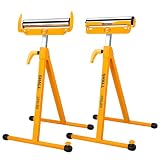
A roller stand is a portable support with one or more rollers at the top. It is fast to position and easy to store. A single stand placed behind a saw supports the end of a board, while two or three stands can support long material entering and leaving the machine.
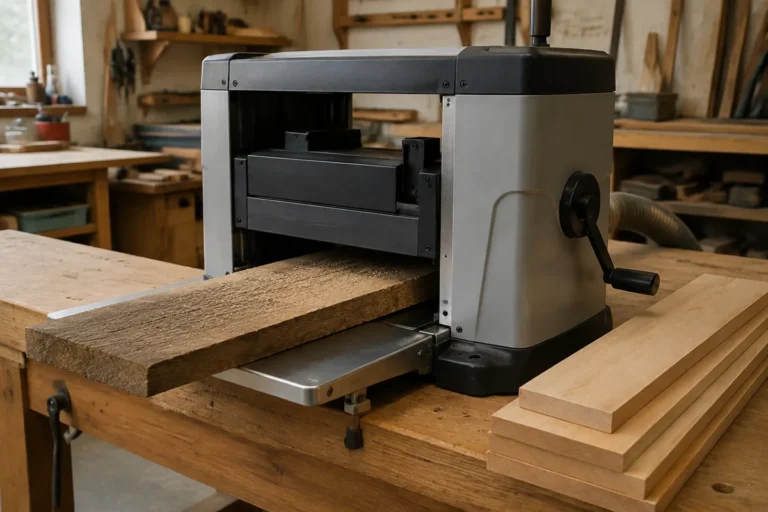
Roller stands are especially useful with stock that is too long for a permanent outfeed table. They work well for breaking down 8-foot lumber, cutting shelving, and supporting boards at a planer or band saw. A height-adjustable heavy-duty roller stand is usually a better choice than a very light folding stand.
The main weakness is movement. A roller lets the board shift sideways, and the stand itself can creep if its feet are narrow or the floor is uneven. The roller can also turn while you are trying to keep a board against the table saw fence. That is manageable for rough cuts, but frustrating when making accurate rips.
Ball-bearing rollers roll smoothly but can encourage sideways drift. Wider rollers or multi-roller heads offer better support for wide panels. Some stands have a flat support head that can be useful when you need to slide stock rather than roll it.
Outfeed Table vs. Roller Stand
| Factor | Outfeed table | Roller stand |
|---|---|---|
| Best use | Repeatable table saw work and long rips | Occasional support and flexible layouts |
| Typical cost | Low if shop-built; higher for manufactured systems | Often inexpensive per stand |
| Accuracy | Excellent when aligned correctly | Fair; depends on setup and board movement |
| Portability | Limited unless hinged or on casters | High |
| Space required | Permanent floor area behind the saw | Stored when not needed |
| Best for solo operation | Yes, particularly for narrow rips | Only with careful placement |
When an Outfeed Table Is the Better Buy
Buy or build an outfeed table if you routinely rip boards longer than about 4 feet, cut sheet goods, or work alone. It gives the trailing end a stable landing area instead of forcing you to catch the board while controlling the feed rate. That stability also reduces the temptation to reach over the blade or pull on the stock.
An outfeed table is the better option for repeated cabinet parts. Once its height is set, every board crosses the same transition. It also provides a useful place to attach a sacrificial fence extension, stop block, or dust-collection hose support.
A shop-built table is often the best value. A 24-by-36-inch top made from 3/4-inch plywood with a second layer underneath can be rigid enough for most contractor and cabinet saws. Add a lower shelf or locking casters if space is limited. If you prefer a ready-made solution, look for a table saw outfeed table with a stated height range that matches your saw.
When a Roller Stand Is Enough
The cheaper option is fine when you only cut long stock a few times each month, have to clear the saw after every job, or use several machines in the same area. One roller stand behind the saw can support a board while you make a rough cut. For an 8-foot board, two stands spaced several feet apart are more stable than one stand directly at the end.
Roller stands are also preferable when the support point must change. A planer may need support at one height, while a band saw or drill press table may sit somewhere else. In that situation, a portable stand is more useful than a fixed table.
Do not rely on one small stand for heavy sheet goods. A 3/4-inch plywood sheet weighs roughly 60 to 70 pounds at 4 by 8 feet. Its center can sag between supports, and a narrow roller can leave the sheet unstable. For panels, use a broad outfeed surface or a dedicated folding outfeed table.
Setup and Safety Details
Check alignment with a straightedge across the saw table and the support. Lock every adjustable stand before feeding stock. The support should be close enough that the board cannot drop more than an inch or two before it contacts the next surface.
Keep the outfeed area clear of clamps, offcuts, and cords. A board that hits an obstruction can stop suddenly while the blade is still cutting. For narrow rips, use a push stick or push block and keep your body out of the kickback path. Neither an outfeed table nor a roller stand replaces the riving knife, blade guard, or proper fence adjustment.
If you have room, the most capable arrangement is a flat outfeed table permanently aligned with the saw, plus one or two folding roller stands for unusually long or wide stock. That combination costs more than a single stand but handles routine accuracy and occasional oversized work without forcing one support system to do everything.