How to Choose a Jointer for Flattening Short, Wide Boards
What's inside
As an Amazon Associate I earn from qualifying purchases. This post may contain affiliate links at no extra cost to you.
Contents
Why short, wide boards are difficult
A jointer can flatten one face of a board, but short, wide stock is a demanding case. A short board has little length to register on the tables, while a wide board can rock, catch, or expose a cutterhead across a large area. If the board is cupped, it may bridge the cutterhead and come out looking smooth but still bowed. If it is twisted, pushing it flat against the infeed table can machine the wrong shape into it.
Before shopping, measure the shortest and widest pieces you expect to joint. Also note their thickness and weight. A 12-inch-wide board that is 18 inches long is a different handling problem from a 12-by-36-inch panel. A jointer’s advertised width is not a promise that every board at that width will be easy or safe to feed.
Decide whether a jointer is the right tool
A jointer is most useful when you need a flat reference face, then an adjoining straight edge. It is not a thickness planer: a planer makes the opposite face parallel to a reference face, but it does not reliably remove twist from an unflattened board. For a short, wide board, consider whether the job actually requires a full-width flat face. If it only needs a reliable reference surface for later work, a sled through a planer can be a practical alternative, especially for a one-off project.
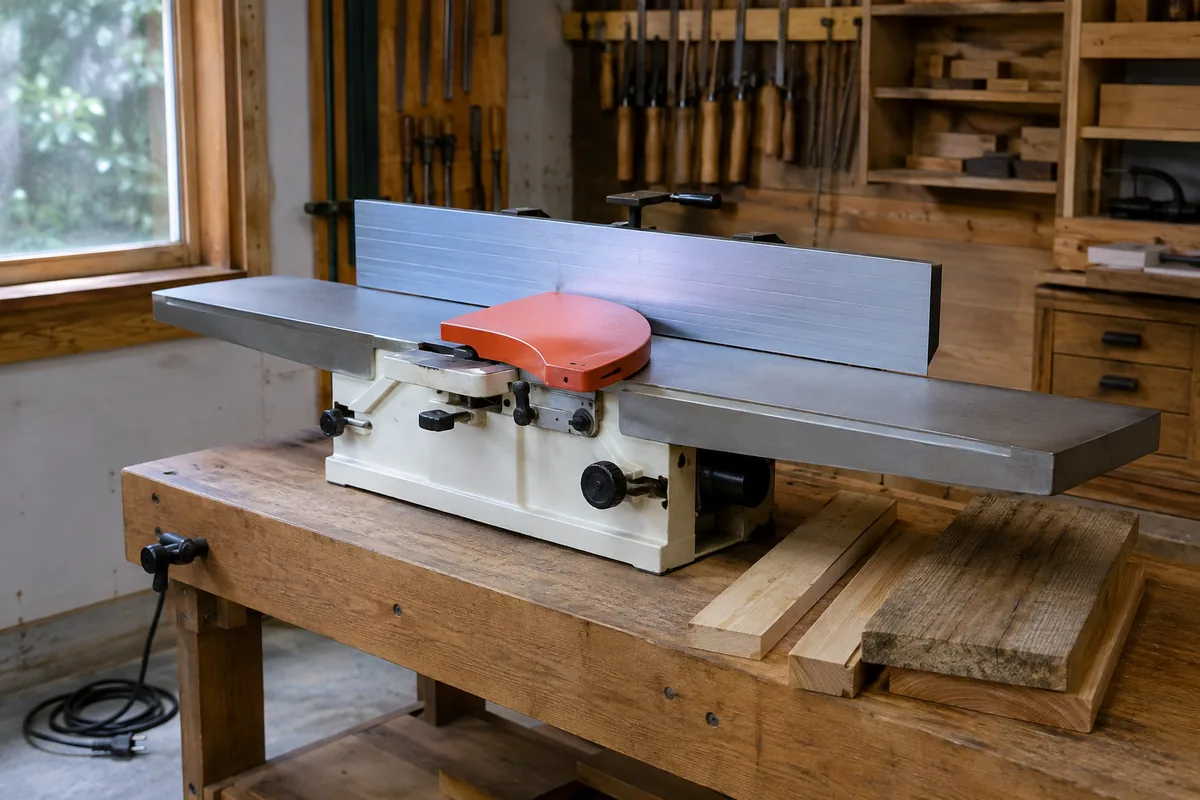
For regular flattening, a benchtop jointer costs and occupies less than a floor-standing machine, but its narrow tables and limited width rule it out for many wide boards. A wide jointer gives more working width, but takes more space, needs a suitable dust-collection setup, and can be harder to feed accurately.
Compare the practical options
| Option | Best fit | Main limitation |
|---|---|---|
| Benchtop jointer, often 6–8 inches wide | Narrow boards and occasional face jointing where space and price matter | Cannot flatten a board wider than its cutterhead; short tables give less support |
| Floor-standing jointer, often 8–12 inches wide | Frequent work and wider stock, with better table support and a more substantial stand | Higher purchase cost, more floor space, and greater setup demands |
| Planer sled | Occasional flattening when a planer is already available | Needs shimming and careful workholding; does not joint an edge in the same operation |
Width is the first filter, but table length and stability matter too. A short board may fit under an 8-inch cutterhead yet be awkward on short tables. A heavier floor-standing jointer generally resists movement better, but weight alone does not guarantee accurate tables or a well-adjusted machine.
Features worth paying for
Look for tables that are long enough to support your stock, a fence that stays square and locks securely, and a guard that returns over the cutterhead reliably. Check whether the machine uses straight knives or a helical-style cutterhead. Replaceable inserts can be convenient after a small nick, but they do not flatten a board better by themselves. Knife quality, alignment, and table setup matter more than the cutterhead label.
Table length is especially relevant to short stock, but do not assume a longer table makes very short pieces safe. Many jointers have minimum workpiece dimensions in the manual. Follow them. If your boards are shorter than the stated minimum, use another method rather than trying to hold a tiny piece against the tables by hand.
Also check the available cut depth, but resist the temptation to remove a lot at once. For cupped hardwood, start with shallow passes—around 1/32 inch or less—and check the face as you go. Deep cuts increase push force and can worsen tear-out, chatter, or snipe-like dips near the ends. The machine must be connected to dust collection; a jointer can throw chips quickly, and a clogged port affects both visibility and cleanup.
Short-board handling and safety
On a conventional jointer, place the board’s concave side down when flattening a cupped face. That gives the board a more stable stance. Mark the high spots, take light passes, and keep downward pressure over the infeed table before the cutterhead and over the outfeed table after the leading end reaches it. Do not press down over the cutterhead to force a rocking board flat; that can machine a hollow into the face.
Short stock can be unsafe because there is little distance between your hands and the knives. Use push blocks designed for jointer work, maintain the guard, and keep hands clear of the cutterhead. Do not joint end grain, loose knots, stock with embedded metal, or a board that cannot sit steadily on the tables. If the board rocks or catches, stop and reassess rather than forcing the feed.
Wide boards also need a realistic pass plan. A bowed board may contact only at its ends or center; several light passes can establish a flat face, but the board must be supported without tipping. If your stock is near the machine’s full width, ask whether you can safely control it throughout the cut. For occasional oversize pieces, a planer sled or router sled may be more controllable than buying a jointer large enough for a rare task.
Make the buying decision
For boards narrower than 8 inches and occasional use, a benchtop jointer can be a reasonable budget choice. It is not a bargain if your common stock is wider than its capacity or if its short tables make your pieces difficult to control. If you routinely flatten boards around 10–12 inches wide, look at a floor-standing machine sized for that work and verify the actual table length, footprint, electrical requirements, and dust-port size before purchase.
If wide, short boards are the exception, keep the planer-sled option open. A planer sled can hold a twisted board with shims so the planer cuts one flat face; once that face is established, flip the board to thickness it. This takes setup time and can be less convenient than a jointer for repeated work, but it avoids buying a wider machine for a few boards. For a jointer purchase, prioritize capacity you will use, stable support, and safe handling over extra features that do not solve your board-size problem.

