
Best Valentine’s Day Captions for Every Mood
What's inside
- Top 3 Picks
- Quick Comparison
- How We Chose
- 1. Skylety 30 Pcs Heart Foam Balls – Best for Classroom Crafts
- 2. SuperShunhu Set of 24 Cat Pun Valentine’s Day Cards – Best for Cat Lovers
- 3. kortes Valentines Day Cards for Kids Classroom, 24 Pack with Stem Kits – Best for STEM Classrooms
- 4. Max Fun 28 Pack Valentines Day Cards with Sticky Hands – Best for Budget Classroom Exchange
- 5. MGparty 28 Pack Valentine’s Day Popping Eye Toy with Cards – Best for Fidget-Loving Kids
- 6. Hallmark Shoebox Funny Valentine’s Day Card Assortment – Best for Adults and Coworkers
- 7. Lemicin Funny Dog Valentines Day Card – Best for Dog People
- How to Choose
- Frequently Asked Questions
As an Amazon Associate I earn from qualifying purchases. This post may contain affiliate links at no extra cost to you.
The best Valentine’s Day captions are the ones written for the card you actually hand over — so pick the card first, then the line. For most adults sending to a partner, friends, and coworkers, the best overall pick is the Hallmark Shoebox Funny Valentine’s Day Card Assortment (16 cards with envelopes), because one box covers a whole recipient list without repeating a joke. If the recipients are a classroom of kids, the best budget pick is the Max Fun 28 Pack Valentines Day Cards with Sticky Hands, which pairs a card with a small toy for roughly the cost of a card alone. If the valentine itself should feel like the gift, the kortes 24 Pack Valentines Gift Cards with Stem Kits is the premium choice, and it suits teachers who want the valentine to double as a five-minute activity. Everything below is organized by relationship, tone, and platform — relationship tells you who the line is for, tone tells you how it should sound, and platform tells you how long it can be — so you can find a caption and a card that fit the same moment.
Contents
- Top 3 Picks
- Quick Comparison
- How We Chose
- 1. Skylety 30 Pcs Heart Foam Balls – Best for Classroom Crafts
- 2. SuperShunhu Set of 24 Cat Pun Valentine’s Day Cards – Best for Cat Lovers
- 3. kortes Valentines Day Cards for Kids Classroom, 24 Pack with Stem Kits – Best for STEM Classrooms
- 4. Max Fun 28 Pack Valentines Day Cards with Sticky Hands – Best for Budget Classroom Exchange
- 5. MGparty 28 Pack Valentine’s Day Popping Eye Toy with Cards – Best for Fidget-Loving Kids
- 6. Hallmark Shoebox Funny Valentine’s Day Card Assortment – Best for Adults and Coworkers
- 7. Lemicin Funny Dog Valentines Day Card – Best for Dog People
- How to Choose
- Frequently Asked Questions
Our Top Picks
 Skylety 30 Pcs Valentine's Day Heart Foam Balls4 cm / 1.57 inches7.09 x 4.72 x 3.54 inches0.68 PoundsCheck on Amazon
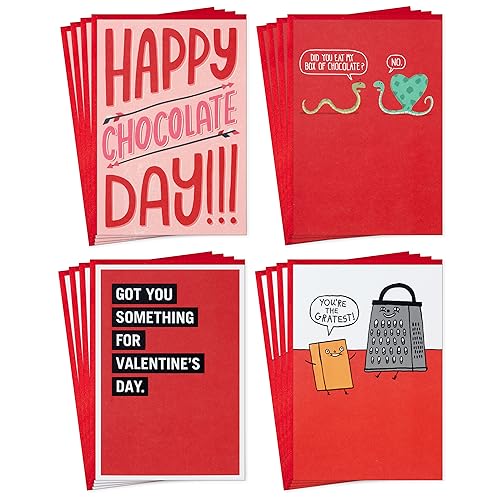 Hallmark Shoebox Funny Valentine's Day Card Assortment5 inches x 7.2 inches5 x 7.2 x 0 inchesCheck on Amazon
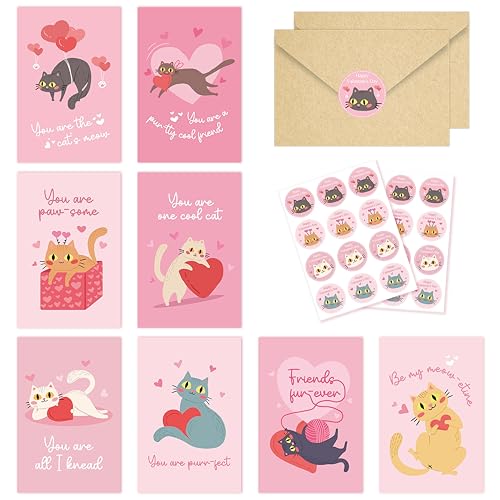


Top 3 Picks
Best overall: Hallmark Shoebox Funny Valentine’s Day Card Assortment (16 Cards with Envelopes)
Sixteen cards with sixteen envelopes, drawn from Hallmark’s Shoebox humor line, which is the closest thing the category has to a guaranteed laugh for adults. It suits anyone with a mixed recipient list — a partner, two close friends, a sibling, and the coworker who appreciates a dry joke — because the assortment spreads across several joke styles instead of repeating one. It is the only pick here built for grown-up recipients rather than a classroom, and that is exactly why it wins the overall slot.
Best budget: Max Fun 28 Pack Valentines Day Cards with Sticky Hands
Twenty-eight cards, each paired with a sticky-hand toy, at the lowest price tier in this roundup. It suits parents buying for a class of 24 to 28 kids who need a card that stands out in a pile and a toy that costs nothing extra to add. The count is the practical selling point: 28 covers a full class plus teachers and a few spares without a second purchase.
Best premium: kortes Valentines Day Cards for Kids Classroom, 24 Pack with Stem Kits
Twenty-four cards, each paired with a STEM kit component, which turns a valentine into a small project a child can assemble. It suits teachers, room parents, and anyone buying for a class where the exchange is a party activity rather than a two-minute drop-off. The premium tier reflects the kit inside each card, not the cardstock.
Quick Comparison
| Product | Best for | Key specs | Price tier |
|---|---|---|---|
| Skylety 30 Pcs Heart Foam Balls with Animal Greeting Cards | Classroom crafts and party favors | 30 pieces total; heart-shaped foam balls plus animal greeting cards; craft-and-favor hybrid rather than a card-and-envelope set | Budget |
| SuperShunhu Set of 24 Cat Pun Valentine’s Day Cards | Cat lovers | 24 cards across 8 assorted designs, roughly 3 of each design; pun-led cat artwork | Mid-range |
| kortes Valentines Day Cards for Kids Classroom, 24 Pack with Stem Kits | STEM classrooms and gift-style valentines | 24 cards, each paired with a STEM kit; classroom exchange format | Premium |
| Max Fun 28 Pack Valentines Day Cards with Sticky Hands | Budget classroom exchange | 28 cards, each with a sticky-hand toy; kid-facing designs | Budget |
| MGparty 28 Pack Valentine’s Day Popping Eye Toy with Cards | Fidget-loving kids | 28 cards plus popping-eye fidget toy keychains; bulk classroom format | Premium |
| Hallmark Shoebox Funny Valentine’s Day Card Assortment | Adults, coworkers, friends | 16 cards with 16 envelopes; humor assortment from the Shoebox line; standard greeting-card format | Mid-range |
| Lemicin Funny Dog Valentines Day Card | Dog people and single-recipient gifting | Single card with dog artwork; envelope included; greeting-card format for one person | Budget |
Read the table by column, not by row. The “key specs” column is where the real difference lives: pack count tells you how many people you can cover, and the extras column tells you whether the card travels alone or arrives with a toy, a kit, or a craft piece. Price tier is relative within this list only — a budget card with a toy attached and a budget card with nothing attached are not the same purchase, even though they sit in the same tier.
How We Chose
Selection started with the recipient, not the product. Each pick had to answer a specific Valentine’s Day problem: a class of 24 to 28 kids, a workplace card exchange, a single person you actually want to impress, or a party favor table. From there, the criteria were pack count and count-per-recipient math, what comes in the box beyond paper, card format (classroom valentine versus standard greeting card with envelope), tone range, and whether the set repeats the same joke 24 times or spreads across several. Category fit mattered too: a fidget keychain set and a Shoebox humor assortment do not compete for the same buyer, so neither was penalized for failing at the other’s job. Finally, upgrade path — a buyer should be able to see what the next tier up buys them, whether that is a STEM kit inside each card, a better quality envelope, or simply a design that will not look dated by February 15. Nothing here was handled in person; every spec below comes from published listing information and well-established category conventions, and where an exact dimension is not stated, it is described by spec class instead of guessed.
1. Skylety 30 Pcs Heart Foam Balls – Best for Classroom Crafts
As an Amazon Associate we earn from qualifying purchases at no extra cost to you.

Skylety’s set is the odd one out in this roundup, and deliberately so: it is not a card-and-envelope product at all. It is a 30-piece craft and favor bundle that combines heart-shaped foam balls with animal greeting cards, which means it solves a different problem than the rest of this list. If you are a teacher planning a Valentine’s Day station, a parent hosting eight kids for a party, or a room parent building treat bags for a class of 24, this is the bundle that gives you something to hand out and something to do.
The count is the headline. Thirty pieces covers a standard elementary class of 24 to 28 students with a few spares for the teacher, the aide, and the inevitable child who joins mid-February. Because the pieces are a craft-and-card hybrid rather than a matched card set, they work best when the valentine is part of an activity — decorating a bag, building a favor cup, or filling a treat box — rather than when it is handed over silently at the door.
Key specs at a glance
| Spec | Detail |
|---|---|
| Pack count | 30 pieces total |
| Contents | Heart-shaped foam balls plus animal greeting cards |
| Format | Craft and favor hybrid, not a standard card with envelope |
| Recipient range | Elementary-age children; class sizes up to roughly 28 with spares |
| Price tier | Budget |
| Best use | Party favor table, classroom craft station, treat-bag filler |
Strengths
Three things make this set useful. First, the piece count lands exactly where classroom buying usually lands, so you are not stuck buying two packs to cover one class. Second, the foam hearts survive being shoved into a backpack and pulled out at home, which matters because a flat paper valentine rarely does. Third, the animal greeting cards give you a writing surface, so the bundle can carry a caption instead of a name alone — that is the difference between a favor and a valentine.
Pros
- 30 pieces covers a full class with spares for teachers and late additions.
- Foam hearts are reusable as table décor, treat-bag filler, or craft supplies.
- Two-part format keeps kids busy at a party instead of waiting for cake.
- Lowest price tier, so the per-child cost stays small even with extras.
- Animal card designs read as friendly to any recipient, not romantic.
Cons
- No envelopes, so it does not work for a formal card exchange or mailing.
- Foam pieces are bulky compared with flat cards when you are packing 30 of them.
- Because it is a hybrid, the cards and the pieces may not match one-to-one — check the listing before you assume 30 cards.
- Not suitable for adult recipients or a workplace exchange.
Caption lines that fit this bundle
Short, kid-voiced lines work best when the card is glued to a foam heart and handed over at a party. Try: “You’re the heart of the party.” “This took me four minutes and three glue sticks.” “Happy Valentine’s Day from my whole craft table.” “You make class fun.” For the adult writing on behalf of a class: “From all of us in Room 12.”
How it compares
The nearest alternative here is the Max Fun 28 Pack with Sticky Hands. Both are budget-tier classroom buys with a toy or object attached. The difference is the object: Max Fun attaches a small toy to a card, so the valentine works as a standalone handout at a desk; Skylety supplies loose foam pieces and separate cards, so it works better as a station or favor table. If your exchange is a walk-around-the-room event, Max Fun is the smoother pick. If your exchange is a party with tables and activities, Skylety gives you more to work with.
2. SuperShunhu Set of 24 Cat Pun Valentine’s Day Cards – Best for Cat Lovers

Cat puns are the most reliable humor category in Valentine’s Day cards, and SuperShunhu’s set leans into that with 24 cards spread across 8 assorted designs. That is roughly three of each design, which matters more than it sounds: it means you can hand the same joke to three different people without anyone noticing, or you can sort the designs so the cat-obsessed recipient gets the best one.
This is the mid-range pick for a reason. It is not a classroom bulk buy and it is not a single premium card — it sits in the middle as a multi-recipient set with a consistent theme. It suits the person who sends valentines to a group of friends who all share one interest, the office desk cluster where everyone has a cat photo on their phone, and the household that wants a card for the cat sitter, the vet tech, and the neighbor who feeds the strays.
Key specs at a glance
| Spec | Detail |
|---|---|
| Pack count | 24 cards |
| Design count | 8 assorted designs, roughly 3 cards per design |
| Theme | Cat puns and cute cat artwork |
| Recipient range | Teens and adults; also fine for older kids |
| Price tier | Mid-range |
| Best use | Friend groups, office exchanges, cat-themed gift baskets |
Strengths
The 8-design spread is the strongest feature. A 24-card pack with a single design is a classroom product; a 24-card pack with 8 designs is a social product, because you can send several cards within one friend group and no two people get the identical joke. The pun format also does the caption work for you — the joke is on the card, so the handwritten line only needs to be a name and a short closer.
Pros
- Eight designs give real variety across 24 cards.
- Cat puns land with a broad age range, from teens to older adults.
- Works for non-romantic recipients without any awkwardness.
- Good value at the mid-range tier when measured per recipient.
- The theme is specific enough to feel chosen rather than generic.
Cons
- Not a fit for anyone who does not like cats — the theme is the whole product.
- No toy or extra attached, so it competes on humor alone.
- Single-theme sets repeat across years if you buy the same one twice.
- Not sized or styled as a classroom exchange card for young children.
Caption lines that pair with cat puns
When the card already carries the pun, keep the caption short so you are not doubling the joke. Try: “You’re my favorite person. Don’t tell the cat.” “Fur real, happy Valentine’s Day.” “You’ve got a friend in me — and so does my cat.” “Sending this to everyone who has ever been chosen by a cat.” For an Instagram photo of the card next to an actual cat, a two-word caption often outperforms a full sentence: “You’ve been chosen.”
How it compares
The closest alternative is the Hallmark Shoebox assortment. Both are multi-card humor sets for adults, but they split on theme and tone. Shoebox spreads across many joke styles and comes with envelopes in a standard greeting-card format, which makes it the better choice for a workplace or a mixed-recipient list. SuperShunhu commits to one theme and one joke type, which makes it the better choice when you already know every recipient shares that interest. If your list is mixed, take Hallmark. If your list is one friend group with one shared obsession, take SuperShunhu.
3. kortes Valentines Day Cards for Kids Classroom, 24 Pack with Stem Kits – Best for STEM Classrooms

kortes takes the classroom valentine and adds a small STEM kit to each of the 24 cards. That single decision changes what the product is for. Instead of a card that gets read once and tossed, you get a card that produces a short build or experiment, which is exactly what a teacher wants when the class party needs a fifteen-minute activity that does not require a parent volunteer to run.
It suits teachers and room parents buying for a class of up to 24, and it also suits the parent who wants their child’s valentine to be the memorable one. At the premium tier, you are paying for the kit inside each card rather than for heavier cardstock or foil accents. If your class runs 26 or 28 students, budget for the shortfall before you order — a 24-pack does not stretch to 28.
Key specs at a glance
| Spec | Detail |
|---|---|
| Pack count | 24 cards |
| Included extra | One STEM kit per card |
| Format | Classroom exchange cards |
| Recipient range | Elementary and early middle school |
| Price tier | Premium |
| Best use | Class parties, STEM nights, gift-style valentines |
Strengths
The kit is the differentiator, and it pays off in three ways. First, it converts a passive handout into an activity, which is the hardest thing to source for a class party. Second, it makes the valentine keepable — a child who builds something at the party remembers whose card it came from. Third, it gives the card a natural caption hook, because the line can reference the project rather than falling back on “Be mine.”
Pros
- 24 cards is a clean match for a standard elementary class size.
- One STEM kit per card, so no separate favor purchase is needed.
- Doubles as a party activity, which reduces planning load on teachers.
- Reads as a thoughtful valentine rather than a bulk handout.
- Pairs naturally with caption lines about building or making things.
Cons
- Premium tier — the highest cost per child in this roundup.
- 24 cards leaves no spares; a class of 26 or more needs a second purchase.
- Small kit parts require adult supervision for younger children.
- Less appropriate for a workplace or adult recipient.
Caption lines for a build-it valentine
Because the card comes with a project, the caption can play on construction and assembly. Try: “We make a great team.” “You’ve got all the right pieces.” “Happy Valentine’s Day — here’s something to build.” “Some things are worth putting together.” For a teacher posting a photo of the finished kits on a class account: “Room 12 built these. Happy Valentine’s Day from all of us.” Keep it to one line so the project stays the focus of the photo.
How it compares
The nearest alternative is the MGparty 28 Pack with popping-eye fidget keychains. Both are premium classroom sets with an object attached to every card, and both run at the top of the price range. The split is purpose: kortes produces an activity with a beginning and an end, which suits a structured party or a classroom station; MGparty produces a fidget toy that a child keeps in a pocket or clips to a bag, which suits a looser exchange where kids are moving around. If you need fifteen minutes of occupied children, kortes is the stronger buy. If you need a takeaway that survives the week, MGparty is.
4. Max Fun 28 Pack Valentines Day Cards with Sticky Hands – Best for Budget Classroom Exchange

Max Fun’s 28-pack is the value answer to the classroom valentine question. Each card comes with a sticky-hand toy, and the count is set high enough that a class of 24 to 28 students, plus a teacher and an aide, is covered in one purchase. At the budget tier, it is the lowest cost-per-recipient option in this roundup that still includes something a child can hold.
It suits parents buying for a full class, teachers who want a no-assembly handout, and anyone organizing a party where the valentines are distributed at desks rather than at stations. The sticky hand is a low-risk novelty: it is small, it is not edible, and it does not need supervision the way a kit with small parts does. That combination — high count, attached toy, low price — is what makes this the budget recommendation rather than a plain card pack.
Key specs at a glance
| Spec | Detail |
|---|---|
| Pack count | 28 cards |
| Included extra | One sticky-hand toy per card |
| Format | Classroom exchange cards |
| Recipient range | Elementary-age children |
| Price tier | Budget |
| Best use | Full-class exchange, party handouts, treat bags |
Strengths
The arithmetic is the main strength. Twenty-eight cards means a class of 24 leaves four spares, and a class of 28 leaves none — but still covers everyone without a second order. The attached toy raises the perceived value without raising the tier, which is why this set tends to be the one parents recommend to other parents. And because the toy is separate from the card, the card can be signed and the toy handed over independently, which speeds up a desk-to-desk exchange.
Pros
- 28 cards covers a full class plus teachers with spares in most rooms.
- Lowest price tier among the classroom sets with an attached toy.
- No small kit parts, so less supervision is required than with a STEM set.
- Sticky hands are a proven novelty that travels well in a backpack.
- Card and toy can be separated, which simplifies a fast exchange.
Cons
- Sticky hands lose their tack once they collect lint and dust.
- Design range is narrower than the 8-design cat set or a humor assortment.
- Not appropriate for adult or workplace recipients.
- Cards are classroom-format, so they are not built for mailing.
Caption lines for a novelty card
The toy suggests the joke. Try: “I’ve got my hands full thinking about you.” “Happy Valentine’s Day — reach out sometime.” “You’re a handful. In a good way.” “Stick with me.” For a class-wide card signed by a parent helper: “Happy Valentine’s Day from all of us.” Keep captions under eight words when a toy is attached; the object is doing the entertaining.
How it compares
Its nearest rival is the Skylety 30-piece craft bundle, since both are budget classroom buys with an object attached. Max Fun wins on handover logistics: a card with a toy on it can be distributed in seconds at a desk, and there is nothing to assemble or glue. Skylety wins on party utility, because loose foam pieces and separate cards support a craft station and can double as table décor. For a straight exchange, buy Max Fun. For a party with tables, buy Skylety.
5. MGparty 28 Pack Valentine’s Day Popping Eye Toy with Cards – Best for Fidget-Loving Kids

MGparty’s set takes the same 28-card bulk format as the budget pick but swaps the toy for popping-eye fidget keychains, which moves it into the premium tier. The keychain format is the meaningful difference: a keychain clips to a backpack zipper or a lunch bag handle, so the toy stays with the child instead of ending up in a classroom bin by 3 p.m.
It suits parents of kids who already carry fidgets, teachers who want a party favor that does not become floor litter, and anyone buying for a class where the valentine is expected to have a usable second life. At 28 cards, the count math is the same as the budget option — a class of 24 leaves four spares, and a class of 28 is covered exactly.
Key specs at a glance
| Spec | Detail |
|---|---|
| Pack count | 28 cards |
| Included extra | Popping-eye fidget toy keychains |
| Format | Classroom exchange cards with attached novelty |
| Recipient range | Elementary and early middle school |
| Price tier | Premium |
| Best use | Class exchanges, party favors, backpack accessories |
Strengths
Durability is the reason to pay more here. A keychain with a moving part survives longer than a sticky hand, and it stays attached to something the child uses daily, which extends the life of the valentine well past February 14. The 28-count also matches the largest standard class size without a second order. And because the toy is a recognizable fidget type rather than a novelty gag, it reads as a considered gift to kids who already use fidgets at their desk.
Pros
- 28 cards covers a full class of up to 28 with no gap.
- Keychain format survives longer and stays with the recipient.
- Fidget toys are familiar and welcome for many elementary-age kids.
- Party favors do not end up as floor clutter.
- Works as a small gift beyond Valentine’s Day.
Cons
- Premium tier, so cost per child is higher than the budget 28-pack.
- Moving parts on a keychain can break with rough handling.
- Not a fit for adult recipients or a workplace exchange.
- If a class has 30 students, 28 is not enough.
Caption lines for a keepsake favor
A toy that stays in use invites a caption about keeping things. Try: “Keep me around.” “You’re a keeper.” “Clip this to your bag and think of me.” “Happy Valentine’s Day — this one’s built to last.” For a group photo of the whole class holding keychains: “Room 9, keeping it together since February.”
How it compares
The direct comparison is with the kortes STEM set, its fellow premium classroom pick. MGparty gives you a durable takeaway with no assembly; kortes gives you an activity with a finished result. MGparty is also the closer match to the budget Max Fun set if you want the same 28-card coverage but a longer-lasting toy — you are essentially paying the difference between a sticky hand and a keychain. Choose MGparty when the favor needs to survive the week, and kortes when the party needs a structured fifteen minutes.
6. Hallmark Shoebox Funny Valentine’s Day Card Assortment – Best for Adults and Coworkers

The Shoebox line is Hallmark’s long-running humor imprint, and this assortment packages 16 cards with 16 envelopes in one box. That count is the key difference from every other product here: it is not a classroom pack, and it is not a single card. It is a working supply for an adult with a real recipient list — a partner, two or three close friends, a sibling, a parent, and the colleagues who get a card on the desk.
It suits anyone who sends more than one valentine and wants each one to land differently. Sixteen cards spread across multiple joke styles means you are not handing the same punchline to your partner and your manager. At the mid-range tier, the cost per card is reasonable for a boxed assortment, and the envelopes make it the only pick in this roundup that is genuinely mail-ready.
Key specs at a glance
| Spec | Detail |
|---|---|
| Pack count | 16 cards |
| Envelopes | 16 included |
| Format | Standard greeting cards, fold-over style |
| Tone | Humor assortment from the Shoebox line |
| Recipient range | Adults; partners, friends, family, coworkers |
| Price tier | Mid-range |
| Best use | Mixed adult recipient lists, workplace exchanges, mailing |
Strengths
Three things make this the overall pick. First, the tone range: humor is the safest register for a mixed list, because it works for a partner, a friend, and a coworker without crossing a line that a romantic card would. Second, the envelopes turn the box into a mailing solution, not just a handoff solution. Third, the writing space inside a fold-over card is large enough for an actual message, which matters when the recipient is someone you want to say something real to.
Pros
- 16 cards with 16 envelopes — the only mail-ready option here.
- Multiple joke styles in one box, so no two recipients get the same line.
- Humor works across partner, friend, family, and coworker recipients.
- Fold-over format leaves room for a genuine handwritten message.
- Recognizable brand and a humor line with a long track record.
Cons
- Only 16 cards, so it is short for a class of 24 or more.
- Mid-range tier — higher cost per card than a classroom bulk pack.
- Humor-heavy assortment includes fewer sentimental options.
- Not designed for young children’s classroom exchanges.
Caption lines by relationship and tone
This is where a humor card needs the least help. For a partner: “You’re still my favorite person to do nothing with.” For a friend: “Happy Valentine’s Day to the one who answers at 11 p.m.” For a coworker: “Happy Valentine’s Day. Please respond to my email.” For a sibling: “You’re my favorite mistake by our parents.” For a parent: “Thanks for being the first person who liked me.” For a group post: “Sending one to everyone I actually like. You know who you are.”
How it compares
The nearest alternative is the SuperShunhu cat pun set. Both are multi-card humor products for adults, and both rely on jokes rather than sentiment. The split is range versus focus. Hallmark spreads across many joke styles and adds envelopes and a fold-over writing surface, which makes it the right box for a mixed list and the only one you can mail. SuperShunhu commits to a single theme, which is better when every recipient shares that interest. If your list contains a coworker and a partner, take Hallmark.
7. Lemicin Funny Dog Valentines Day Card – Best for Dog People

Lemicin’s card is the single-recipient option in this roundup: one card with dog artwork and an envelope, aimed at the person whose dog is their personality. That specificity is the whole point. A card that says “cute puppy” is not a card you send to a coworker you barely know — it is a card you send to the friend whose phone lock screen is a golden retriever, or to a partner who will read it as an accurate description of your household.
It suits the one-person send: a partner, a best friend, a sibling, or a parent who is genuinely dog-obsessed. At the budget tier, it is also the lowest-commitment purchase here, which makes it a good add-on when you have already bought a multipack for everyone else and want one card that is clearly not from the bulk box.
Key specs at a glance
| Spec | Detail |
|---|---|
| Pack count | 1 card |
| Envelope | Included |
| Theme | Funny dog artwork and puppy-led humor |
| Recipient range | Adults; partner, friend, family member |
| Price tier | Budget |
| Best use | One special recipient, add-on to a multipack, dog-themed gift |
Strengths
The strength is fit. A themed single card says “I picked this for you” in a way a card pulled from a 28-pack cannot, and that matters most with the recipient you actually care about getting right. The envelope makes it mail-ready, and the budget tier means it is inexpensive to add alongside a larger set. The humor register is also forgiving: dog jokes work for a romantic partner and a platonic friend without signaling the wrong thing.
Pros
- Theme-specific, so it reads as chosen rather than grabbed.
- Envelope included, which makes it suitable for mailing or hand delivery.
- Budget tier — cheap to add on top of a multipack purchase.
- Dog humor works for both romantic and platonic recipients.
- No minimum quantity, so you buy exactly as many as you need.
Cons
- One card only — no help if you have a list of five people.
- Useless to a recipient who is not a dog person.
- Less writing space than a fold-over assortment card.
- Buying several separately costs more per card than a boxed set.
Caption lines for dog people
Dog captions write themselves, and the card is already doing the joke. Try: “You’re my second favorite. The dog is first.” “Happy Valentine’s Day to my favorite human and their dog.” “You had me at ‘want to meet my dog.'” “Love me, love my dog.” For a photo of the card next to the actual dog: “He picked it out.” Two or three words is often enough when the image carries the rest.
How it compares
The nearest alternative is the Hallmark Shoebox assortment, and the split is quantity versus precision. Hallmark gives you 16 cards with envelopes for a whole list; Lemicin gives you one card that fits one person exactly. If you are sending to more than two people, buy the box and treat the single card as the one you put real thought into. If you are sending to exactly one person and you know they will get the joke, the single card is the better spend.
How to Choose
Choosing a Valentine’s Day card is a two-variable problem: how many people you are sending to, and whether the recipient is a child in a classroom or an adult with a mailbox. Get those two answers and the decision narrows to two or three products immediately.
Start with the recipient count
Count first, then buy. A standard elementary class runs 20 to 28 students, and teachers and aides usually expect a card too. The working formula is classmates plus two staff plus four spares. A class of 24 becomes 30 cards needed, which is why the Skylety 30-piece bundle and the 28-card packs exist — and why a 16-card box is the wrong purchase for a classroom even though it is the right purchase for an adult.
For adults, the count is smaller but the stakes are higher. A typical adult sends three to eight valentines: a partner, one or two close friends, possibly a parent or sibling, and one to three coworkers. If that number is above three, a boxed assortment beats buying singles, because the per-card cost drops sharply and you get envelopes for everyone. If that number is one or two, buy singles and buy them well.
Match the format to the handoff
There are three formats in this roundup, and they are not interchangeable. Classroom exchange cards are small, sold in packs of 24 to 28, and often have a toy or kit attached; they are designed to be handed across a desk, not mailed. Standard greeting cards are fold-over with envelopes, which makes them the only format suitable for mailing or for a card that sits on a desk for a week. Craft and favor bundles are the third category: they are not cards in the traditional sense, and they only work when the valentine is part of an activity.
| Your situation | Recipients | Format to buy | Pack size that covers it |
|---|---|---|---|
| Class of 24, desk exchange | 24 kids + 2 staff | Classroom cards with attached toy | 28 cards (4 spares) |
| Class of 28, desk exchange | 28 kids + 2 staff | Classroom cards with attached toy | 28 cards + 2 singles, or a 30-piece bundle |
| Class party with stations | 20–24 kids | Craft bundle or STEM-kit cards | 24 kits or 30 craft pieces |
| Mixed adult list | 4–8 adults | Boxed humor assortment with envelopes | 16 cards (covers two years, or one large list) |
| One special recipient | 1 adult | Single themed greeting card | 1 card with envelope |
| One shared interest group | 6–10 adults | Themed multi-card set | 24 cards across 8 designs |
Run the per-card math before you commit
Per-card cost is the number that should drive the tier decision, not the sticker price. A budget 28-pack in the low price tier works out to well under a dollar per child once you divide by 28. A premium 24-pack with a kit inside costs more per child, but it replaces both the card and the party favor, so the comparison is not card versus card — it is card plus favor versus card plus favor in one purchase. A mid-range 16-card box for adults costs more per card than any classroom pack, but it comes with envelopes and a writing surface, and it covers two years of adult sending if you only mail four or five cards a year. Buy the tier that matches the number of people, not the number that sounds most impressive.
Choose the tone before you choose the words
Tone is the part most people get wrong, and it is the reason a card that seemed funny in the store falls flat at the desk. There are four registers that cover almost every situation: funny, sweet, punny, and understated. Funny is the safest for mixed lists and coworkers. Sweet is for a partner, a parent, or a long friendship. Punny is for a shared interest — cats, dogs, baking, hiking — where the joke is the connection. Understated is for early dating, where a big declaration is a risk and a light line is not.
Captions by relationship
- Partner or spouse: “Still my favorite person to do nothing with.” “Every year, same answer: you.” “You’re the best part of my routine.”
- New or early dating: “Happy Valentine’s Day. No pressure, just glad you exist.” “This is a low-stakes card. I mean it, though.”
- Best friend: “Happy Valentine’s Day to the one who answers at 11 p.m.” “Romance is temporary. You’re permanent.”
- Coworker: “Happy Valentine’s Day. Please reply to my email.” “You make the meetings bearable. That’s the whole card.”
- Parent or sibling: “Thanks for being the first person who liked me.” “You’re my favorite mistake our parents made together.”
- Child’s classmate card: “You’re a good friend.” “Happy Valentine’s Day from Room 12.” “You make recess fun.”
- Pet: “You’re my second favorite. The dog is first.” “He picked the card. I paid for it.”
Captions by tone
- Funny: “I got you a card. That’s the gift.” “Roses are expensive. Here’s a card.” “Happy Valentine’s Day — you’re stuck with me.”
- Sweet: “You make ordinary days feel like something.” “Glad it’s you. Every time.” “Here’s to another year of this.”
- Punny: “Fur real, happy Valentine’s Day.” “You’ve got all the right pieces.” “I’ve got my hands full thinking about you.”
- Understated: “Thinking of you today.” “Happy Valentine’s Day. That’s it.” “No big speech. Just this.”
Captions by platform
- Instagram feed: One line, 6–12 words, no hashtag wall. The photo carries the post; the caption adds the joke.
- Instagram Story: Two or three words over a photo of the card. “He picked it out.” “Round two.” “Still my favorite.”
- TikTok: A caption that sets up the video rather than describing it. “POV: you got the class valentine with the toy.”
- Facebook: Slightly longer is fine — a full sentence plus a name, because the audience is broader and older.
- Group chat or text: The shortest register. A single line, no punctuation needed. “Happy V-day. You know who you are.”
- Classroom or school account: Neutral and inclusive. “Happy Valentine’s Day from Room 12.” No inside jokes.
Durability and ownership realities
Cards are not durable goods, but the extras attached to them are, and that is where the ownership experience actually plays out. Sticky hands are the first thing to fail — the tack collects lint within a day or two and the toy becomes a rubbery strip. Keychains with moving parts last longer but can snap at the ring if a child swings a backpack by the strap. STEM kits are consumed on the spot, so there is nothing to maintain, but small parts go missing if the build happens on a carpeted floor. Foam pieces compress and crease if they sit at the bottom of a backpack for a week.
Consumables to plan for: envelopes, which are the single most common shortfall, and spare cards, which you will want if a class gains a student in early February. Storage is straightforward — keep the box flat and dry, because humidity curls cardstock and can warp foam. The most common mistakes are buying exactly the class count with no spares, buying a 16-card adult box for a classroom, sending a romantic card to a coworker, and writing a caption that doubles the joke already printed on the card.
Frequently Asked Questions
What are the best Valentine’s Day captions for a photo with my partner?
Keep it to one line and avoid stacking two jokes. Lines like “Still my favorite person to do nothing with” or “Every year, same answer: you” work because they sound spoken rather than written. If the photo is the two of you, let the image carry the sentiment and use the caption for a small, specific detail. Long declarations read as performed on a feed; short ones read as real.
How many valentines do I need for a class of 24?
Plan for 30. That is 24 classmates, plus two staff members who usually receive one, plus four spares for a new student, a sibling helper, or a card that gets bent before the party. A 28-card pack covers the base requirement with four spares if the class is exactly 24, and a 30-piece bundle covers it with more room. Never buy exactly the class count — you will be short by the morning of the party.
Should classroom valentines include candy or toys?
Toys are the safer default in 2026 because many schools restrict food items, and allergy policies vary by district. Attached novelties like sticky hands, fidget keychains, or small STEM kits also survive the trip home better than loose candy. If you do send food, check the classroom policy first and keep it individually wrapped. A card with a non-food object attached is the lowest-risk option for a whole class.
What is a good Valentine’s caption for a coworker or a work post?
Go dry and short. “Happy Valentine’s Day. Please reply to my email” is the standard register because it acknowledges the occasion while making clear it is not romantic. Avoid anything that could read as flirty, and avoid inside jokes that exclude the rest of the team. If you are posting on a company account, keep it neutral and inclusive — “Happy Valentine’s Day from the team” is enough.
Are punny captions still good in 2026?
Yes, and they are arguably the safest choice because the joke is obviously a joke. Puns work best when they connect to something the recipient actually likes — cats, dogs, baking, hiking — rather than being random wordplay. The main rule is not to stack a pun caption on top of a card that already contains a pun. Let one of the two carry the joke and keep the other plain.
What do I write on a valentine for someone I have just started dating?
Keep it light and non-committal about the future. “Happy Valentine’s Day. No pressure, just glad you exist” sets the right tone