
What's inside
As an Amazon Associate I earn from qualifying purchases. This post may contain affiliate links at no extra cost to you.
For most small shops, a 13-inch benchtop planer with a three-knife cutterhead and a good dust port is the sweet spot, and the DeWalt DW735X is the model other planers are usually measured against. This review looks at five benchtop planers based on specifications and reviewer feedback, covering who each suits, where each falls short, and what to compare before you buy.
| Pick | Best for | Key feature |
|---|---|---|
| DeWalt DW735X | Serious hobbyists and small pro shops | Three-knife head and two-speed feed |
| DeWalt DW734 | Rough lumber on a tighter budget | Compact design with a solid reputation |
| Makita 2012NB | Quiet, smooth finish work | Four-column carriage design |
| WEN PL1326 | Occasional use and tight spaces | Lightweight, simple controls |
| Delta 22-555 | Wider boards in a portable body | Larger capacity benchtop style |
Contents
Our Top Picks
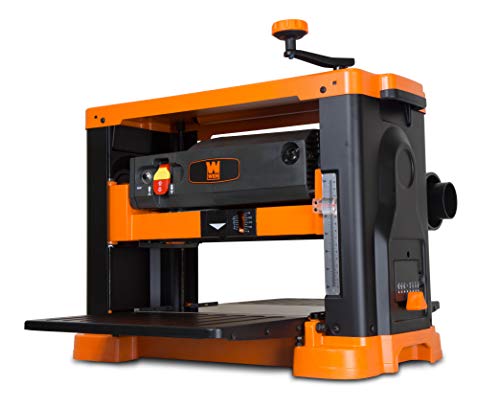 WEN PL1326 15-Amp 13-Inch Spiral Benchtop Thickness PlanerSpiral, 13-Inch, Single Speed81 poundsCheck on Amazon


1. DeWalt DW735X Thickness Planer
The DW735X is the planer many woodworkers recommend first, mostly because its three-knife cutterhead leaves a clean surface and its fan-assisted dust ejection reduces the mess. The two-speed feed lets you take faster passes for rough stock and slower passes for finish work. It is heavier than some rivals, which makes it a bit of a chore to move, and replacement knives are an ongoing consumable. Buy it if you plan to mill lumber regularly. Compare it with the DW734 if budget is tight.
DeWalt DW735X Thickness Planer
2. DeWalt DW734 Thickness Planer
The DW734 is the lighter sibling, and it has earned a following among hobbyists who want a dependable planer without the extra features. It handles common board widths and includes a solid feed system. Compared with the DW735X, it has a simpler head and a single feed speed, so expect a little more sanding on tough grain. It is a strong choice for woodworkers who plane occasionally, and it is easier to store between projects. Check for current blade availability before ordering.
3. Makita 2012NB Planer
Makita’s 12-inch planer is often praised for a smooth, quiet operation and a carriage that stays aligned. It is well suited to people who care about the surface finish on hardwoods and who may work in a shared space where noise matters. The tradeoff is a narrower capacity than 13-inch models, and the dust port needs a vacuum or collector to keep the shop clean. If you plane mostly narrow boards, it is an excellent fit, and it tends to hold up with careful maintenance.
4. WEN PL1326 Thickness Planer
For a woodworker who needs a planer a few times a year, the WEN PL1326 offers a straightforward and budget-aware route. It is light, easy to move, and handles basic jobs such as reducing a board to a common thickness. Expect more snipe and tear-out on difficult stock than with premium machines, and you may need to spend time tuning the settings. It is not a daily driver for a production shop, but it makes sense for a hobbyist with a modest workload.
5. Delta 22-555 Portable Planer
A planer with a slightly larger capacity gives you freedom to work wider boards without gluing up narrow ones first. The Delta 22-555 is aimed at woodworkers who want that extra width in a machine they can still move around the shop. Because it is a larger tool, it needs a stable stand or bench, and you should plan for the weight. Read recent reviews on availability of replacement knives and parts, which can differ by region.
How to Choose a Benchtop Planer
Capacity
Look at maximum width and depth of cut. Thirteen inches covers most boards, while narrower planers suit smaller projects. If you glue up panels before planing, you may not need extra width.
Cutterhead style
Straight knives are common and inexpensive to replace. Helical or spiral heads reduce tear-out on figured wood and are quieter, but they cost more. Think about the species you use before paying extra.
Snipe control
Snipe is a slight dip at the board’s ends. Most benchtop planers have it to some degree. Good infeed and outfeed support, along with careful technique, make a bigger difference than a model name.
Dust collection
A planer makes a lot of chips. Fan-assisted ejection helps, but you still need a collector or a shop vacuum with a large hose. Plan the setup before you buy.
Setup Tips That Improve Results
A planer is only as good as its setup. Put it on a sturdy bench or stand at a comfortable height, and add roller stands or a long board to support the stock before and after the machine. Check that the bed is clean before every session, since a bit of resin or sawdust affects the thickness. Feed boards with the grain direction in mind so the knives cut with the fibers, not against them.
Take light passes, especially on wide boards and hardwoods. A little at a time gives a smoother finish and puts less stress on the motor. Flip the board and plane both faces if you want it flat, and consider a flat reference, such as a jointer or a sled, if the stock is cupped. Always remove nails, staples, and dirt from reclaimed wood, because these ruin knives.
Which Planer for Which Shop
If you buy rough lumber by the board foot and mill most of what you build, the DW735X is easier to justify, because the savings on lumber add up and the extra speed range saves time. If you mostly buy surfaced boards and plane only to match thicknesses or clean up reclaimed stock, a lighter machine such as the DW734 or WEN will do the job without taking over your bench.
Shop size matters too. A garage that doubles as a parking space needs a planer that stores on a shelf, which favors lighter models. A dedicated shop with a stand and a dust collector can take a heavier machine. Think about noise as well: planers are loud, and ear protection is a must regardless of the brand. If neighbors are close, schedule your planing for sensible hours.
Finally, consider the cost of consumables. Straight knives wear and chip when they hit hidden grit or nails, so check how easy it is to buy replacements and how simple the change is. A planer with awkward blade changes tends to be used less, and an unused planer is money wasted. Reading owner comments about knife changes tells you more than any spec sheet.
Common Mistakes
- Taking heavy cuts. It strains the motor and increases snipe and tear-out.
- Ignoring dust collection. Chips clog the machine and the air.
- Skipping outfeed support. Boards droop and cause snipe.
- Planing wet or dirty wood. It dulls knives and leaves rough surfaces.
- Assuming a planer flattens warped boards. It copies the shape unless you provide a flat reference.
Frequently Asked Questions
Do I need a jointer as well?
A planer makes the faces parallel but does not flatten warp by itself. A jointer, or a planer sled, solves that problem.
How often should I change the knives?
When the surface looks torn or you notice lines in the board. Frequency depends on the wood and how clean it is.
Can a planer handle hardwoods?
Yes, with sharp knives and light cuts. Dense species will be harder on the machine.
Is a helical head worth it?
For figured woods and noise reduction, many woodworkers say yes. For softwoods and basic projects, standard knives are fine.
Conclusion
A benchtop planer saves money on rough lumber and gives you control over thickness. Based on specifications and reviewer feedback, the DeWalt DW735X is the strongest all-rounder, the DW734 and Makita suit lighter use, and WEN and Delta serve budget and capacity needs. Set it up carefully and it will serve for years.
As an Amazon Associate we earn from qualifying purchases.
Related guides
More from Amazon
Programs that pair well with the guide above. Offers and eligibility are set by Amazon and may change.
A free business account with business pricing and bulk-buying tools for work, shop or home office.
Create a business accountFree shipping on eligible items, Prime Video and more. Eligible new members can start with a free trial.
Start a Prime free trialAudiobooks and podcasts to listen to on the go. Eligible new members can start with a free trial.
Try Audible freeAd-free music streaming. Eligible new subscribers can start with a free trial.
Try Music Unlimited freeAs an Amazon Associate we earn from qualifying purchases.

Write Your Review
No reviews yet. Be the first to share your experience!