How to Flatten a Wide Board with Multiple Jointer Passes
What's inside
As an Amazon Associate I earn from qualifying purchases. This post may contain affiliate links at no extra cost to you.
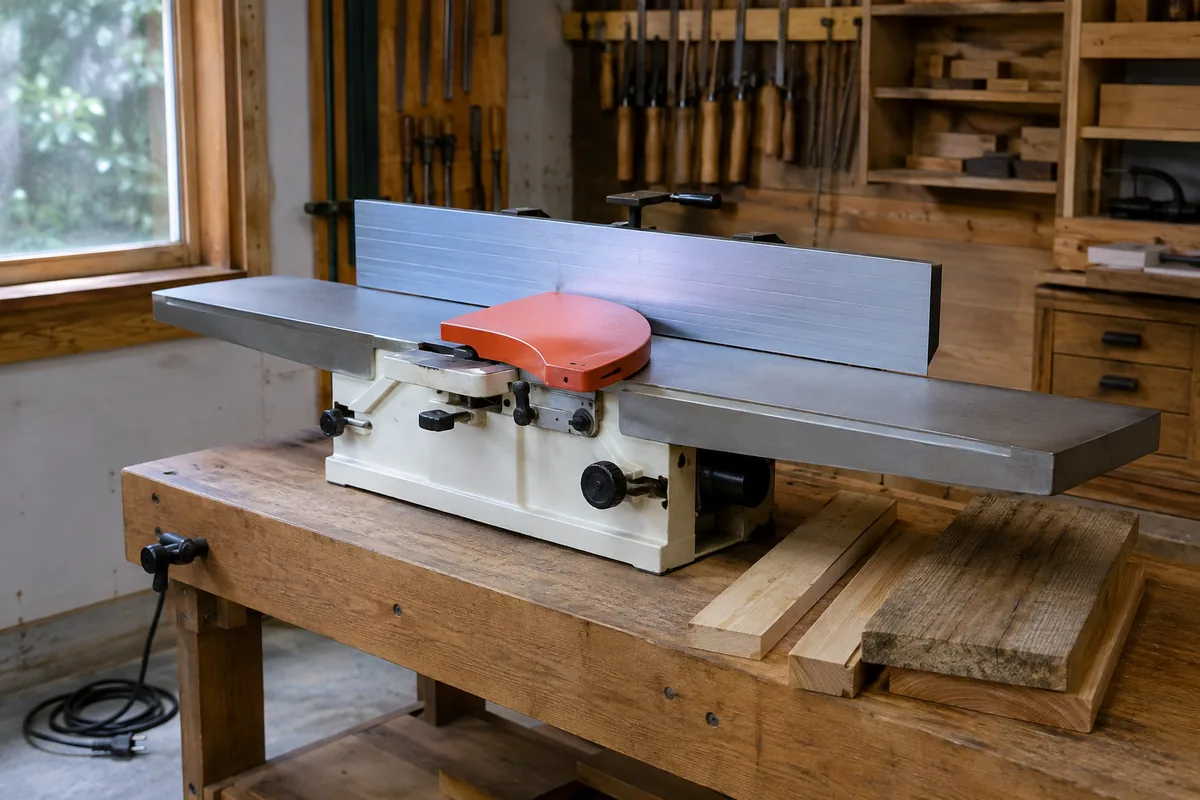
A jointer flattens a face by removing high spots as the board passes over the cutterhead. With a wide board, the limiting factor is usually the jointer’s width, not its length. If the board is wider than the machine’s cutterhead, you can still flatten it with overlapping passes—but the result depends on keeping the board supported and each pass aligned.
This method works best when the board is only moderately wider than the jointer and has enough thickness to tolerate the material removal. It is not a good way to flatten a very cupped slab by taking deep cuts, or to correct a board that is twisted so much that it rocks dangerously on the machine.
Contents
Check the board and jointer
Measure the board’s width, thickness, length, and the jointer’s cutting width. A board 9 inches wide on a 6-inch jointer leaves about 1½ inches outside the cutterhead on each side when centered. That overhang is manageable if the board is straight enough to support securely. A board 14 inches wide on the same machine is a different proposition: the unsupported edges can tip, and the overlap between passes becomes harder to control.
Inspect the board for twist, bow, cup, loose knots, and embedded metal. Mark high spots with pencil or chalk. Check that the jointer tables are aligned, the fence is square to the outfeed table, and the knives or inserts are sharp. Dull cutters tear grain and make it harder to see whether successive passes are truly coplanar.
For a board substantially wider than the jointer, consider a router flattening sled instead. A sled supports the full width and avoids balancing a wide board on narrow tables. It takes setup time and leaves a surface that may need sanding or planing, but it is often safer and more predictable for slabs.
Set up for shallow cuts
Set the depth of cut conservatively. Start at about 1/32 inch (0.8 mm), then reduce it to 1/64 inch (0.4 mm) if the board is heavy, unstable, or prone to tear-out. Many jointers can take deeper cuts, but maximum capacity is not a sensible target for a wide board. Deep cuts increase the chance of chatter, kickback, snipe-like dips at the ends, and a board lifting or tipping during the pass.
Keep your hands away from the cutterhead. Use push blocks that grip the work, and keep pressure on the infeed side until the leading end reaches the outfeed table. Then shift pressure to the outfeed table without pressing down so hard that you bend the board into the machine. Keep the board firmly against the fence if you are using the fence as a reference, but do not let the fence force a twisted board into an unstable position.
Before starting, make sure the board can travel through the entire cut without striking the fence, guard, or nearby objects. A helper can support a long board at the far end, but should not pull it through or lift it away from the tables. If the board is too awkward for one operator to control, use another flattening method.
Make overlapping passes
For a board wider than the cutterhead, mark its width into lanes. The center lane is a useful starting point. Joint that lane with the board held flat on the tables, then shift the board laterally so the next pass overlaps the finished lane by roughly 1 to 2 inches. Repeat on the other side. The overlap gives the cutterhead a reference strip and reduces the risk of leaving a ridge between passes.
Make the center pass first, then work outward in alternating steps. For example, on a 9-inch board over a 6-inch cutterhead, a centered pass covers roughly the middle 6 inches. Shift the board about 1½ inches left for the next pass, then about 1½ inches right from center for the third. Adjust the shifts to suit the actual width and keep a substantial overlap. Do not try to remove the entire overhanging edge in one narrow pass.
Use a pencil grid across the face to track progress. After each pass, check which marks remain and use a straightedge across the width to spot ridges. A straightedge spanning the full board is more useful than judging the surface by feel alone. If a ridge remains at a lane boundary, take another light pass with the cutterhead centered over that area, overlapping both sides.
Do not steer the board sideways while it is over the cutterhead. Lift it clear before changing lanes. Sideways movement during a cut can leave gouges, expose fingers to the cutter, or make the board catch. Keep the feed direction consistent and avoid reversing the board mid-pass unless the grain direction makes tear-out unavoidable and the machine procedure permits it.
Choose the right method
| Method | Best use | Main trade-off |
|---|---|---|
| Overlapping jointer passes | Boards slightly wider than the cutterhead | Requires careful support and may leave lane ridges |
| Router flattening sled | Wide slabs or boards with substantial cup | More setup; leaves a routed surface to clean up |
| Wide-belt or drum sanding service | Large panels needing a refined surface | Usually requires access to a shop or paid service |
A wider jointer is the most direct solution if you regularly flatten stock wider than your current machine. A wider benchtop or stationary jointer gives you more support across the face, but it costs more and takes more floor space. Buy for the width you actually process, not an occasional oversized board. For infrequent work, a sled or local machine shop can be the cheaper choice.
Check flatness and plane
When the face looks uniform, check it lengthwise with a straightedge and diagonally for twist. A board can have a smooth-looking surface that is still twisted, especially if one side was pressed down during the passes. If it rocks on a known-flat surface, stop and reassess rather than trying to fix the twist with heavier cuts.
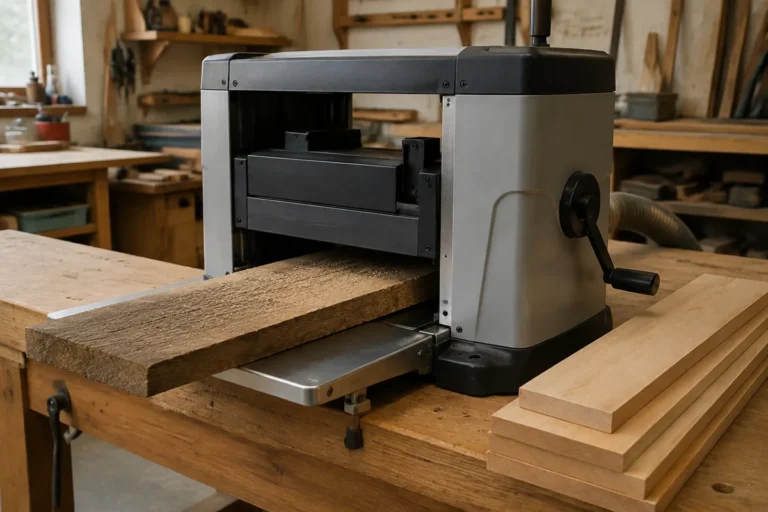
Once one face is flat, mark it as the reference face. Run the board through a thickness planer with that face down to make the opposite face parallel. A planer does not reliably remove twist from an unflattened board; it tends to reproduce the board’s shape. If the board is too wide for your planer, use the flattening method appropriate to its size, then finish with a wide-belt sander or another suitable machine.
Expect some material loss. A board with a 1/8-inch cup may need more than 1/8 inch removed to produce a flat face because the high points and low points are not distributed evenly. If that would leave the board too thin, or the required cuts make it unsafe to handle, do not force the job on a jointer. A stable sled or professional flattening service is the better choice.