Best Jointers for Straightening Long, Narrow Boards
What's inside
As an Amazon Associate I earn from qualifying purchases. This post may contain affiliate links at no extra cost to you.
Contents
What a jointer can—and cannot—do
A jointer makes one board face flat and one edge straight and square to that face. For a long, narrow board, the edge is often the job: a straight edge makes a reliable reference for a table-saw rip cut or a glue joint. The jointer does not make both edges parallel, and it is not a thickness planer. If you joint one edge and then need a consistent width, rip the opposite edge at the table saw.
Capacity matters more than motor size for this work. The board has to stay supported before and after the cutterhead, and the tables need to be long enough to register it without tipping. A short jointer can work on short stock; with a long board, it takes more care and produces less predictable results.
As an Amazon Associate we earn from qualifying purchases at no extra cost to you.

Choose width and table length
For ordinary furniture lumber, a 6-inch jointer is adequate for edges on most boards up to about 5 inches wide. A 8-inch machine gives more room for wide faces and leaves extra capacity if your stock varies. Neither width alone guarantees good results on a 6-foot board: table length, outfeed support, and setup matter just as much.
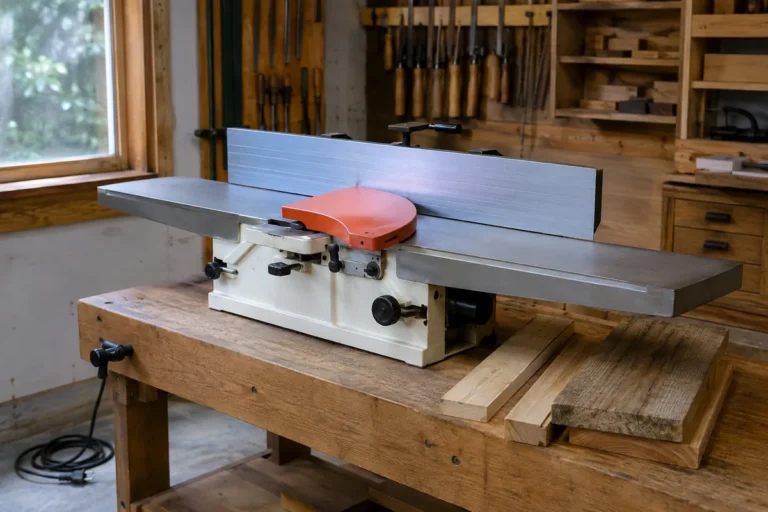
Benchtop jointers are lighter and less expensive, but their shorter beds are a real limitation on long stock. They can straighten a narrow board with careful technique and roller stands, but a long board may teeter at the cutterhead or lose contact with the tables. A floor-standing machine with roughly 60 inches or more of combined table length is easier to control. Longer beds help, though they do not replace proper support.
How the main options compare
| Type | Typical useful capacity | Best fit | Main trade-off |
|---|---|---|---|
| Benchtop, 6-inch | Narrow edges; shorter boards are easiest | Small shop, occasional work, limited budget | Short tables make long boards harder to keep steady |
| Floor-standing, 6-inch | Most furniture-board edges and moderate face jointing | Regular use without a large footprint | Less face-jointing width than an 8-inch machine |
| Floor-standing, 8-inch | Wider faces and edges, with a longer working bed on many models | Frequent milling or wider stock | Higher cost, greater weight, and more space required |
For a first jointer, a 6-inch floor-standing jointer is a sensible middle ground if you have room for it. Choose a floor-standing 8-inch jointer when you routinely work with wider boards or want more capacity for face jointing. Check actual table length and the machine’s footprint before buying; labels such as “8-inch” describe cutter width, not overall support.
Cutterhead and fence details
Straight-knife cutterheads are common and can leave a good surface when knives are sharp and correctly aligned. Replacing or setting knives can take time, and a nick can leave a visible line down the board. Helical or spiral cutterheads use small inserts; a damaged insert can usually be rotated or replaced individually. They often cost more up front, and they do not compensate for poor setup or careless feeding.
Look for a fence that locks securely and stays square to the table. A fence that shifts during a cut can spoil the reference edge. Verify squareness with a reliable machinist’s square rather than trusting the scale. Also inspect guard coverage, dust collection hookup, and whether the tables can be adjusted and locked without awkward access.
Joint long boards safely
Inspect the board first. Remove loose bark and dirt, and check for nails or other metal; striking metal can damage knives or inserts and create a serious hazard. Choose the edge with the least severe bow or twist as your starting reference. Mark the high spots if they are not obvious.
Set a shallow cut, usually around 1/32 inch for a finishing pass. A heavier cut removes material faster but increases the chance of tear-out, chatter, or pushing the board off its intended path. Feed steadily, with downward pressure near the cutterhead and forward pressure toward the fence. As the leading end reaches the outfeed table, shift pressure gradually to the outfeed side; pressing down hard on the infeed end can lift the board’s far end and create a tapered or curved edge.
Use outfeed rollers or a helper for boards that extend well beyond the tables, but set rollers to support the board without lifting it. A roller stand that is too high can steer the work and cause a step in the edge. Keep hands clear of the cutterhead, use the guard, and never joint stock shorter than the machine’s stated minimum length. If the board rocks, has a severe twist, or is too flexible to control, cut it shorter or use another method rather than forcing it through.
When a cheaper option is enough
A benchtop 6-inch jointer can be the right purchase if you only straighten occasional narrow boards, your stock is short enough to control, and you can build a stable stand. Add properly adjusted support for long pieces, and expect to take lighter cuts and check the edge more often. If most of your work involves boards around 6 feet or longer, frequent glue-ups, or repeated face jointing, the floor-standing machine’s longer tables are usually worth the extra cost and space.
Before choosing, measure the longest board you expect to joint, the width of your typical stock, and the clear floor space around the machine. For straightening long, narrow edges, a well-set 6-inch floor model is often sufficient; paying for 8-inch capacity makes sense when you will actually use the extra width.