
What's inside
As an Amazon Associate I earn from qualifying purchases. This post may contain affiliate links at no extra cost to you.
A jointer makes one face and one edge flat and square, while a planer makes the opposite face parallel and brings the board to a uniform thickness. They are teammates, not rivals. If you can only buy one, a planer with a flattening sled is often the more flexible choice for small shops, but a jointer remains the most direct way to get truly flat stock. Here is how to decide.
| Pick | Best for | Key feature |
|---|---|---|
| Cutech 40160H-CT Benchtop Jointer | Flattening faces and edges in a small shop | Spiral cutterhead design |
| WEN JT630H Benchtop Jointer | Entry-level jointing | Compact and budget-friendly |
| Delta 22-555 Portable Planer | Thicknessing wider boards | Larger capacity in a portable body |
| Wixey WR510 Digital Planer Readout | Accurate thickness settings | Digital display for the planer |
| Microjig GRR-RIPPER Push Block | Safer feeding on jointers and saws | Controlled, stable hand placement |
Contents
Our Top Picks
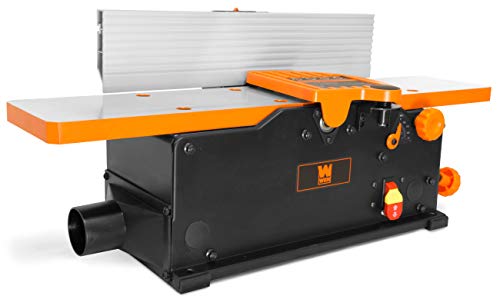
 Cutech 40160HB 6-Inch Spiral Cutterhead Benchtop Jointer with6 inch30 x 18 x 14 InchesCheck on Amazon
What a Jointer Does
A jointer has two tables and a cutterhead between them. You pass a board across the head to shave one face until it is flat. Then you hold that flat face against the fence and joint an edge square to it. These two surfaces become your reference. Without them, a planer has nothing true to work from. A jointer is also the cleanest way to prepare edges for glue-ups, because a freshly jointed edge matches another without gaps.
What a Planer Does
A planer feeds a board under a cutterhead, with the face that went across the jointer riding against the bed. The cutter trims the top face to match, so the board is a consistent thickness from end to end. A planer does not flatten warped boards on its own, because the feed rollers press the board flat as it passes and it springs back afterward. That is why the jointer, or an alternative flattening method, comes first.
Machines and Accessories to Consider
1. Cutech 40160H-CT Benchtop Jointer
A benchtop jointer with a spiral cutterhead is popular for small shops because it leaves a smooth finish and is quieter than straight-knife designs. It works well for short and moderate boards, but the short tables make long boards harder to flatten. Use outfeed support and take light passes. It suits woodworkers who need accurate edges for panel glue-ups.
Cutech 40160H-CT Benchtop Jointer
2. WEN JT630H Benchtop Jointer
This jointer is aimed at beginners who want an affordable way to learn. It handles basic jointing for small projects and fits on a workbench. Expect to spend time aligning the tables and fence, and understand that capacity is limited. It is a stepping stone for someone who works with narrow boards, rather than a replacement for a larger machine.
3. Delta 22-555 Portable Planer
If you already have a way to flatten one face, a planer with good capacity brings boards to final thickness. The Delta 22-555 is a portable machine that handles wider stock than many compact planers. It needs a stable stand and good dust collection, and you should plan to buy extra knives. Compare it with other models before you decide.
Delta 22-555 Portable Planer
4. Wixey WR510 Digital Planer Readout
This is an accessory that shows planer thickness digitally. It is useful when you need to match boards to a specific dimension and want repeatable settings. It attaches to compatible planers, so check the compatibility chart for your model. It will not improve the planer itself, but it removes guesswork when setting depth.
Wixey WR510 Digital Planer Readout
5. Microjig GRR-RIPPER Push Block
Jointers cut close to your hands, so a push block is not optional. The GRR-RIPPER gives you control and keeps your hands away from the cutter. It works on table saws and routers too, which makes it a flexible safety purchase. Read the instructions carefully, since techniques differ from simple push sticks.
Microjig GRR-RIPPER Push Block
Which Should You Buy First?
If you often buy rough lumber and want truly flat, square stock, buy a jointer first, then add a planer. You can flatten a face on a jointer, thickness on a planer, and rip the final edges on a saw. If your budget allows only one machine, a planer plus a flattening sled is a practical approach, because it can flatten and thickness boards in one tool. The sled is a simple shop-made jig: a flat platform with shims that holds the board steady while the planer removes high spots.
If you buy surfaced lumber and mostly need to remove small amounts, a planer alone may be enough. If you mostly work with narrow boards and edge joints, a jointer’s value is higher. Consider how you will use the tool, the space you have, and the width of boards you expect.
A Simple Milling Workflow
Once you own both machines, a repeatable routine saves time and produces better boards. Start by letting rough lumber acclimate in your shop for a week or two, stacked with stickers between layers so air can circulate. Cut boards a few inches longer than their final length, since the ends often have checks and snipe.
Next, identify the best face and the grain direction, then joint that face flat with light passes until the cutterhead touches the whole surface. Joint one edge square to it. Move to the planer, with the jointed face down, and take light passes until the opposite face is clean, then flip and plane both sides evenly to relieve stress. Rip to width on a saw with the jointed edge against the fence, and finally trim to length.
Always leave a little extra thickness for sanding, and let the boards rest after milling, because wood can move as internal stress is released. If a board has changed shape overnight, re-joint it lightly before assembly. This process takes more steps than buying surfaced lumber, but it gives you control over grain selection and board quality, which is part of the appeal of owning these machines.
Common Mistakes
- Expecting a planer to flatten a cupped board. It will copy the cup unless you use a sled.
- Jointing with dull knives. It causes tear-out and uneven surfaces.
- Skipping outfeed support. Long boards tilt and lead to dips.
- Taking heavy cuts. Light passes are safer and smoother.
- Using bare hands near the cutterhead. Always use a push block.
Frequently Asked Questions
Can I use a planer instead of a jointer?
With a sled, yes, to flatten one face. It is slower for edges, so many woodworkers use a table saw or router for those.
What order do I use them?
Joint one face, joint one edge, plane to thickness, then rip to width on a saw.
Is a benchtop jointer enough?
For short boards and small projects, yes. Longer boards benefit from longer tables.
Do I need a spiral head?
No, but it reduces tear-out on figured wood and is quieter.
Conclusion
A jointer creates a flat reference, and a planer makes the rest of the board match it. Based on specifications and reviewer feedback, a benchtop jointer and a good planer are a solid pairing, and accessories such as a push block and a readout improve safety and accuracy. Buy according to the lumber you use and the space you have.
As an Amazon Associate we earn from qualifying purchases.
Related guides
More from Amazon
Programs that pair well with the guide above. Offers and eligibility are set by Amazon and may change.
A free business account with business pricing and bulk-buying tools for work, shop or home office.
Create a business accountFree shipping on eligible items, Prime Video and more. Eligible new members can start with a free trial.
Start a Prime free trialAudiobooks and podcasts to listen to on the go. Eligible new members can start with a free trial.
Try Audible freeAd-free music streaming. Eligible new subscribers can start with a free trial.
Try Music Unlimited freeAs an Amazon Associate we earn from qualifying purchases.


Write Your Review
No reviews yet. Be the first to share your experience!