Best Pool Solar Covers for Faster Heating
What's inside
- Best Pool Solar Covers for Faster Heating
- Quick comparison: thickness, heat retention, and handling
- Which thickness should you buy?
- Best choice by pool and usage situation
- Above-ground versus in-ground pool requirements
- How much does sizing affect performance?
- Handling, reel selection, and daily use
- What wears out first?
- Bottom line
- Best Pool Solar Covers for Faster Heating
- Quick comparison: thickness, heat retention, and handling
- Which thickness should you buy?
- Best choice by pool and usage situation
- Above-ground versus in-ground pool requirements
- How much does sizing affect performance?
- Handling, reel selection, and daily use
- What wears out first?
- Bottom line
As an Amazon Associate I earn from qualifying purchases. This post may contain affiliate links at no extra cost to you.
Contents
- Best Pool Solar Covers for Faster Heating
- Quick comparison: thickness, heat retention, and handling
- Which thickness should you buy?
- Best choice by pool and usage situation
- Above-ground versus in-ground pool requirements
- How much does sizing affect performance?
- Handling, reel selection, and daily use
- What wears out first?
- Bottom line
Best Pool Solar Covers for Faster Heating
The best pool solar covers for faster heating are usually 12-mil or 16-mil blue bubble covers sized to the waterline, with a compatible reel if the pool is larger than a small above-ground model.
A solar cover is a floating plastic blanket rather than a heater. Its air bubbles face downward, where they create a layer of insulation, while the upper film lets sunlight reach the water. The main benefits are reducing overnight heat loss and slowing evaporation; the cover does not warm water effectively when it is left on during swimming or when the pool receives little direct sun.
As an Amazon Associate we earn from qualifying purchases at no extra cost to you.


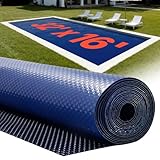
Quick comparison: thickness, heat retention, and handling
| Cover type | Typical thickness | Heat retention | Evaporation reduction | Expected ownership profile | Best fit |
|---|---|---|---|---|---|
| Light-duty bubble cover | 8 mil | Good in mild weather | High when fitted closely | Lowest cost; tears and bubble collapse sooner | Small above-ground pools and occasional use |
| Standard bubble cover | 12 mil | Very good balance | Very high | Moderate weight and easier to fold | Most above-ground and in-ground pools |
| Heavy-duty bubble cover | 16 mil | Best among common bubble covers | Very high | Higher purchase cost; needs careful storage and a reel | Frequent use, windy sites, and long seasons |
| Opaque or dark solar cover | 12–16 mil | Can absorb more solar energy in strong sun | Very high | May degrade faster if left exposed; performance varies by material | Cool climates with strong daytime sun |
| Liquid solar blanket | Not applicable | Lower and less consistent | Some reduction | No physical cover to store, but requires repeated dosing | Pools where a solid cover cannot be handled |
Thickness is not a perfect measure of heating performance. A well-fitted 12-mil cover can outperform a poorly fitted 16-mil cover with large uncovered gaps. Thicker material generally resists punctures, folds less readily, and provides a slightly more stable insulating layer, but it is heavier and more awkward to remove.
Which thickness should you buy?
Choose 8 mil for low-cost, occasional coverage
An 8-mil cover is suitable when the pool is small, the cover will be removed only occasionally, and the goal is mainly to slow evaporation. It is easier for one person to lift and usually costs less. The tradeoff is a shorter service life if it is dragged across concrete, exposed to strong chemicals, or repeatedly folded while wet.
Choose 12 mil for the best all-around value
For most homeowners, 12 mil is the sensible middle ground. It provides substantial evaporation control without becoming excessively difficult to roll. It suits both many above-ground pools and medium-sized in-ground pools, provided the cover is supported by a reel or handled by two people.
Choose 16 mil for frequent use and maximum durability
A 16-mil cover makes sense when the pool is used throughout the season, heating costs matter, or the cover will be rolled and unrolled almost every day. It is not indestructible: the bubbles can still collapse from ultraviolet exposure and chemical damage, and the film can still tear at a sharp coping edge. Its advantage is greater resistance to routine handling, not immunity from neglect.
Best choice by pool and usage situation
| Your situation | Recommended choice | Why | Handling requirement |
|---|---|---|---|
| Small round above-ground pool, used on weekends | 8–12 mil cover | Affordable, light, and easy to remove | One person can usually fold it; avoid dragging |
| Large above-ground pool used several times weekly | 12 mil cover with reel | Good balance of heat retention and manageable weight | Use an above-ground reel that fits the top rails |
| In-ground pool with daily swimming | 12–16 mil cover with reel | Frequent rolling justifies stronger material and organized storage | Two people or a reel; never drag over the deck |
| Windy location | 12–16 mil cover with secure reel and cover clips | Extra thickness helps handling, but attachment matters more | Remove during severe wind rather than relying on clips alone |
| Very limited storage space | 8–12 mil cover cut to a compact shape | Lighter material is easier to hang or roll | Keep it out of sunlight when off the pool |
| Maximum service life priority | 16 mil cover plus reel and storage cover | Reduces abrasion, folding stress, and ultraviolet exposure | Roll smoothly and store dry or loosely rolled |
Above-ground versus in-ground pool requirements
Above-ground pools often have round or oval shapes and flexible top rails. Measure the actual water surface rather than relying only on the advertised pool diameter. An above-ground cover can be slightly smaller than the waterline, but an undersized cover leaves a ring of water exposed and loses heat. A small amount of trimming is preferable to ordering a cover that is permanently too small.
In-ground pools are more complicated because of steps, benches, coves, attached spas, and irregular corners. Order a cover that matches the largest practical outline, then trim it gradually while it floats on the water. Leave enough clearance that it does not catch on coping or snag on return fittings. Covers for kidney-shaped or freeform pools are usually easier to manage when paired with a reel and a cover designed to be trimmed on site.
For either pool type, the bubbles face the water. The smooth film faces upward. Reversing the cover reduces its intended insulating contact and can accelerate wear on the bubble layer.
How much does sizing affect performance?
Consider a rectangular pool measuring 16 feet by 32 feet. Its surface area is:
16 × 32 = 512 square feet.
A cover that leaves a 6-inch gap along both long sides exposes approximately:
2 × (0.5 × 32) × 16 = 512? square feet? No.
The correct exposed area is calculated as the two side strips plus the two end strips. With a 6-inch gap on every side, the covered dimensions become 15 feet by 31 feet, or 465 square feet. The uncovered area is therefore:
512 − 465 = 47 square feet.
That is about 9% of the pool surface left uncovered. The cover may still work, but the missing area creates a significant path for evaporation and nighttime heat loss. This is why measuring the waterline and trimming for a close fit matters more than choosing the thickest available film.
Handling, reel selection, and daily use
A solar cover becomes inconvenient when it is treated as a loose sheet. For pools wider than roughly 12 feet, a reel is usually worth buying. A reel keeps the material from being dragged across the deck, makes removal faster, and reduces creases that eventually become tears. Above-ground reels commonly attach to the pool frame; in-ground reels may sit on the deck or be recessed, depending on the pool layout.
- Remove the cover completely before swimming. Do not leave a rolled cover partly over the water.
- Roll rather than fold whenever possible, especially with 16-mil material.
- Use two people for a large cover if no reel is installed.
- Keep the bubble side wet during temporary removal to limit distortion.
- Store it shaded and away from sharp edges, pets, lawn equipment, and treated pool chemicals.
- Do not place the cover directly on hot concrete for extended periods.
Never use a solar cover as a child-safety barrier. It is not designed to support a person or pet, and it should not replace a compliant safety cover where one is required.
What wears out first?
The bubble layer is usually the first visible failure point. Bubbles may flatten, become brittle, or separate from the upper film after prolonged ultraviolet exposure. The perimeter is also vulnerable: repeated pulling, sharp coping, and contact with ladder hardware can create small tears that spread during the next removal.
Water chemistry affects longevity. Excessively high sanitizer levels, shocking while the cover remains on the pool, and very hot water can accelerate deterioration. Follow the pool chemical manufacturer’s guidance, and remove the cover during chemical treatments when instructed. Rinse off dirt with fresh water; avoid harsh household cleaners, stiff brushes, and pressure washing.
Typical market pricing is roughly $30–$90 for a small, light-duty cover, $60–$180 for many standard 12-mil covers, and $120–$350 or more for large 16-mil covers. Reels commonly add about $80–$300 for basic to sturdier systems. The cheapest cover can cost more per season if it needs replacing after one summer, while an oversized heavy cover can remain unused because it is too difficult to handle.
Bottom line
Choose a properly fitted 12-mil bubble cover for the best balance of heating, evaporation reduction, price, and usability. Move to 16 mil when the pool is large, used daily, or exposed to demanding handling conditions. Choose 8 mil only when low weight and low upfront cost are more important than maximum life. Whatever the thickness, a close fit, bubble-side-down installation, reel, shade storage, and disciplined chemical care will do more for real-world performance than a thicker cover used incorrectly.