Best Little Giant Ladders: Model Lineup Compared
What's inside
- Little Giant Velocity vs. Leveler at a glance
- Which model is best for your situation?
- Velocity: the better carry-and-setup compromise
- Leveler: the better choice for uneven surfaces
- Reach height: do not buy by the tallest number alone
- Hinge durability and the parts most likely to wear
- A practical ownership calculation
- Final recommendation
- Little Giant Velocity vs. Leveler at a glance
- Which model is best for your situation?
- Velocity: the better carry-and-setup compromise
- Leveler: the better choice for uneven surfaces
- Reach height: do not buy by the tallest number alone
- Hinge durability and the parts most likely to wear
- A practical ownership calculation
- Final recommendation
As an Amazon Associate I earn from qualifying purchases. This post may contain affiliate links at no extra cost to you.
The best Little Giant ladders for most homeowners are the Velocity M22 for general-purpose work, the Leveler M22 when uneven ground is common, and the larger M26 or M32 versions when you regularly need extension-ladder reach rather than occasional indoor access.
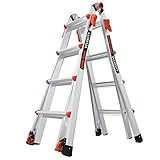
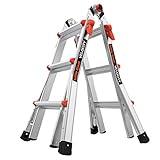
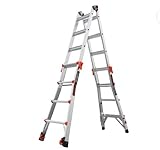
Little Giant’s Velocity and Leveler families share a convertible design: each can be used as a stepladder, extension ladder, or two-sided trestle-style ladder. The important difference is not simply maximum height. It is how much that height costs in carry weight, storage space, setup effort, and stability on real job sites.
As an Amazon Associate we earn from qualifying purchases at no extra cost to you.

Contents
- Little Giant Velocity vs. Leveler at a glance
- Which model is best for your situation?
- Velocity: the better carry-and-setup compromise
- Leveler: the better choice for uneven surfaces
- Reach height: do not buy by the tallest number alone
- Hinge durability and the parts most likely to wear
- A practical ownership calculation
- Final recommendation
Little Giant Velocity vs. Leveler at a glance
| Model | Approx. stepladder height | Approx. extension height | Duty rating | Approx. ladder weight | Best fit |
|---|---|---|---|---|---|
| Velocity M17 | 5–8 ft | 11–15 ft | 300 lb | About 39 lb | Indoor work, lower ceilings, compact storage |
| Velocity M22 | 5–9 ft | 11–19 ft | 300 lb | About 46 lb | Best all-around household choice |
| Velocity M26 | 6–11 ft | 13–23 ft | 300 lb | About 55 lb | Gutters, second-story maintenance, remodeling |
| Velocity M32 | 7–15 ft | 15–27 ft | 300 lb | About 66 lb | Frequent high-reach work |
| Leveler M17 | 5–8 ft | 11–15 ft | 300 lb | About 43 lb | Uneven floors and outdoor ground |
| Leveler M22 | 5–9 ft | 11–19 ft | 300 lb | About 50 lb | General work where leveling matters |
| Leveler M26 | 6–11 ft | 13–23 ft | 300 lb | About 60 lb | Sloped driveways, stairs, uneven yards |
| Leveler M32 | 7–15 ft | 15–27 ft | 300 lb | About 74 lb | High reach on inconsistent surfaces |
Dimensions and weights can vary slightly by production revision and included accessories, so use the label and current manufacturer specification sheet before ordering. The useful comparison is the pattern: Leveler models are generally heavier because of their adjustable leg system, while the matching Velocity models are easier to carry.
Which model is best for your situation?
| Your situation | Recommended choice | Why |
|---|---|---|
| Mostly indoor work and limited storage | Velocity M17 | Shortest and lightest option; enough for many rooms and single-story tasks |
| One ladder for repairs, painting, and occasional outdoor work | Velocity M22 | Useful reach without the carrying burden of the larger models |
| Uneven paving, stairs, landscaping, or sloped ground | Leveler M17 or M22 | Independently adjustable legs can be more valuable than extra height |
| Regular gutter, roofline, or second-story maintenance | Velocity M26 or Leveler M26 | More extension reach while remaining manageable for many users |
| Frequent professional use and high access points | Velocity M32 or Leveler M32 | Maximum reach in these families, but substantially heavier to transport |
| Infrequent use and a tight budget | Smaller Velocity model | A lower purchase price and lower carry weight usually matter more than unused reach |
Velocity: the better carry-and-setup compromise
The Velocity is the sensible choice when you move the ladder often. Its aluminum frame, wide-flared base, non-slip feet, and Rock Lock adjusters provide the core features of the Little Giant convertible design without adding the Leveler’s independently adjustable legs.
Its main advantage appears after several repositionings. A Velocity M22 weighs roughly 46 pounds, while a comparable Leveler is around 50 pounds. That difference is noticeable when carrying the ladder through a house, lifting it onto a vehicle, or moving it repeatedly during a painting project. The M17 is more convenient still for indoor work.
Velocity models use hinged sections and locking mechanisms that allow several configurations. The hinges are robust, but they are not maintenance-free. Dirt, dried paint, and bent hardware can prevent a lock from engaging completely. Never treat resistance in a hinge as something to overcome with force; stop, inspect the joint, and confirm that both locks have seated before climbing.
Leveler: the better choice for uneven surfaces
The Leveler adds adjustable legs so the ladder can compensate for differences in ground height. This is useful on stairs, sloped driveways, uneven lawns, and older floors where a conventional ladder would need unsafe shimming.
The benefit is practical rather than cosmetic. If one side is several inches lower, the ladder can be leveled by adjusting the leg instead of placing boards, blocks, or loose material under a foot. That reduces setup improvisation and makes the Leveler more versatile outdoors.
The trade-off is weight and complexity. The adjustable leg assemblies add hardware that must be kept clean and checked for secure engagement. A Leveler M26 or M32 can be tiring to carry alone, particularly if you are also transporting tools. Choose it because you need leveling capability, not because it is automatically stronger than a comparable Velocity model. Both families commonly carry a 300-pound maximum load rating, including the user, clothing, tools, and materials.
Reach height: do not buy by the tallest number alone
Advertised ladder height is not the same as safe working height. In extension configuration, the ladder must rest at a safe angle and extend above the landing when used for access. In stepladder configuration, standing on the top cap or the highest prohibited step is unsafe, so usable reach is lower than the physical ladder height.
For example, suppose your gutter is 18 feet above the ground. A model advertised with roughly 19 feet of extension height may be a poor choice if the setup location, required landing extension, slope, and safe standing position leave too little margin. The M26 gives more practical headroom than the M22, even though the M22 may technically approach the task in a favorable setup.
A useful selection rule is to measure the actual access point, then select the smallest model that provides a comfortable safety margin. Extra size increases purchase cost, storage demands, setup time, and the chance that the ladder stays in the garage because it is inconvenient to move.
Hinge durability and the parts most likely to wear
The aluminum rails themselves are usually not the first concern. Ownership wear is more likely to appear at the moving interfaces:
- Hinge locks: repeated operation, grit, paint, or impact can make release buttons stiff or prevent full engagement.
- Rock Lock adjusters: plastic housings and release mechanisms can be damaged if the ladder is dragged while partially folded.
- Feet: rubber ends wear faster on abrasive concrete than on clean indoor flooring.
- Leveler hardware: adjustable legs accumulate mud and debris and need more inspection than fixed feet.
- Rivets and rails: bending, dents, or looseness after a fall are reasons to remove the ladder from service.
For durability, carry the ladder rather than dragging it, keep the hinges free of construction debris, and store it under cover. Do not substitute ordinary oil or grease unless the manufacturer’s instructions allow it; lubricants can attract grit or interfere with locking components. If a hinge, rung, foot, or leg will not lock as designed, replace the component through an authorized parts channel or retire the ladder.
A practical ownership calculation
Consider a homeowner who expects to use a ladder 12 times per year for five years: 60 uses. If a lighter Velocity M22 costs in the general mid-hundreds of dollars and a Leveler M22 costs somewhat more, the difference may amount to only a few dollars per use over that period. However, the Leveler’s extra cost is worthwhile only if its adjustable legs prevent repeated unsafe setups or eliminate the need to own a second ladder.
Conversely, if the ladder will be used twice a year, carrying an extra four or more pounds every time may matter more than the theoretical flexibility. The best value is therefore determined by frequency and surface conditions, not maximum specification alone.
Final recommendation
Choose the Velocity M22 as the best balanced option for most homes. Select the Velocity M17 when storage and carrying weight are priorities, or the Velocity M26 when second-story work is routine. Choose the matching Leveler size when uneven ground, stairs, or sloped surfaces are regular parts of the job. Move to the M32 only when you genuinely need its additional reach and have a safe plan for transport, setup, and storage.
Whichever model you choose, verify the exact current weight, configuration limits, and duty rating on the ladder’s label before use. A correct size, fully engaged hinge, stable footing, and a clear working area matter more than the highest number in the product description.