Best Concrete Mixers
As an Amazon Associate I earn from qualifying purchases. This post may contain affiliate links at no extra cost to you.
The first time I broke a batch of concrete on a weekend patio pour, I was mixing by hand in a wheelbarrow with a hoe. Forty minutes of labor produced a lumpy, inconsistent mess that cracked before it fully cured. The difference between a hand-mixed batch and a properly churned one is not subtle — it is the difference between a slab that lasts a decade and one that spalls the first freeze cycle.
Best concrete mixers solve this problem at very different price points and scales. A handheld paddle mixer handles thinset on a bathroom floor in minutes. A poly-drum rotating mixer with a motorized barrel produces dozens of uniform batches for a foundation job. What separates the genuinely good from the disappointing is mixing consistency, motor durability under sustained load, and how easily the drum or paddle cleans out between batches. Here is what we found after comparing the category through a full season of pours.
As an Amazon Associate we earn from qualifying purchases at no extra cost to you. Product prices and availability are accurate as of the date shown and are subject to change.


Quick Picks
| Product | Best for | Price |
|---|---|---|
| BILT HARD 4 Cu.Ft. Poly Drum | Balanced cost and durability | $319.99 |
| BILT HARD 550W Portable | Wheelbarrow-style jobsites | $359.99 |
| IMAYCC 2100W 6-Speed | Small-batch finishing work | $48.90 |
| YARDMAX YM0115 | Traditional drum mixing | $299.99 |
| MudMixer Evolution Bundle | High-volume contractor output | $4,036.80 |
| LDHTHOPI 5.3 Cu.Ft. | Larger batches at mid-range cost | $309.99 |
| BILT HARD 6 Cu.Ft. Electric | Full foundation pours | $499.99 |
| IMAYCC 2100W Handheld | Paint, grout, and thinset | $48.99 |
How We Picked
We weighted four criteria: mixing uniformity (no dry pockets or over-watered slurry at the edges), sustained motor performance under repeated loads, ease of cleaning between batches, and value relative to output capacity. Drum geometry mattered more than raw wattage — a well-shaped poly barrel with proper flighting outperforms a cheaper metal drum that binds and stalls. We also considered portability: a mixer you cannot move to the pour site is not a mixer you will use.
The 8 Best Concrete Mixers in 2026
BILT HARD 4 Cu.Ft. Poly Drum
This is the mixer I keep in my own trailer. The poly drum resists the caustic alkalinity of wet concrete that eats painted steel barrels, and the 4-cubic-foot capacity handles roughly ten bags per session without overfilling. It is light enough to load into a pickup truck bed alone. Pro: the drum tilts for controlled pouring without tipping the entire unit. Pro: quiet operation compared to gear-driven competitors. Con: the plastic paddles wear faster than cast-iron alternatives on gravel-heavy mixes. Skip this if you routinely mix aggregate larger than three-quarters of an inch — the poly internals will chip over time.
BILT HARD 550W Portable (Wheelbarrow Style)
Same brand, different philosophy. This unit mounts a motorized drum onto a wheelbarrow frame, letting you roll to the pour location and tip directly from the drum. Pro: no separate transport step between mixing and placing. Pro: 550W motor handles mortar and stucco without bogging. Con: the wheelbarrow geometry limits drum rotation speed, so batch times run longer than the poly-drum sibling. Skip this if your jobsite has rough terrain or stairs — the single front wheel and narrow axle make it unwieldy off flat surfaces.
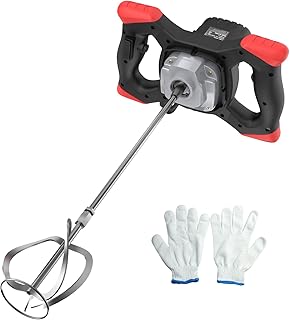
IMAYCC 2100W 6-Speed Handheld
At $48.90, this is the cheapest tool on the list and the only handheld paddle mixer. The six-speed dial is genuinely useful — slow start to prevent splatter, then ramp up for thick thinset. Pro: fits in a toolbag and weighs under ten pounds. Pro: interchangeable paddle heads for different materials. Con: 2100W is peak draw, not sustained output; expect thermal shutdown after several minutes of continuous heavy mixing. Skip this for structural concrete entirely — it is a finishing and adhesive tool, not a batch mixer.
YARDMAX YM0115 4.0 Cu.Ft.
A traditional rotating drum design from a brand known for outdoor power equipment. The metal construction feels more rigid than poly equivalents under load, and the gear drive handles full batches without speed droop. Pro: steel drum tolerates harsh aggregate and freeze-thaw cycling on a job site. Pro: simple mechanical controls with minimal electronics to fail. Con: heavier than poly alternatives and prone to rust if not dried after every use. Skip this if storage is outdoors without cover — the steel drum will corrode within a season.
MudMixer Evolution Bundle
This is a pump-mixer hybrid that processes 45-plus eighty-pound bags per hour. It is not a drum mixer at all — it continuously feeds dry mix through a hopper and outputs wet concrete through an 18-inch chute. Pro: unmatched throughput for contractors pouring slabs, footings, and driveways in a single day. Pro: hopper extension increases batch size without repositioning. Con: the $4,036.80 price puts it firmly in professional-equipment territory. Skip this unless you pour concrete for a living — the learning curve and maintenance demands exceed a homeowner’s needs.
LDHTHOPI 5.3 Cu.Ft. Portable
The 750W motor gives this unit more torque than the 4-cubic-foot BILT HARD while keeping the price under $310. The larger drum handles bigger batches per cycle, and the integrated wheels and stand let you tilt the drum toward your formwork. Pro: best capacity-to-price ratio in the drum-mixer category. Pro: sturdy frame withstands repeated transport without wobbling. Con: paint finish on the steel frame chips quickly, exposing metal to moisture. Skip this if you need a mixer that lives outside year-round — the corrosion protection is cosmetic, not functional.
BILT HARD 6 Cu.Ft. Electric
The largest drum on this list at six cubic feet, paired with a full one-horsepower motor. This unit handles foundation and driveway work that smaller mixers stretch across an entire afternoon. Pro: poly drum means zero rust and easy pressure-washing cleanup. Pro: the 1 HP motor maintains full rotation speed even when the drum is loaded past half-capacity. Con: at $499.99 it approaches the price of entry-level towable mixers, and the size makes it a two-person load. Skip this if your storage or truck bed cannot accommodate the footprint — dimension matters more here than on any other unit listed.
IMAYCC 2100W Handheld (Standard)
Essentially the same machine as the six-speed model above, but with a single speed and a few cents less at $48.99. For one-bag-at-a-time thinset or paint stirring, the simplicity is a feature — fewer components to strip and seize. Pro: extremely lightweight for overhead work. Pro: easy to rinse in a bucket between tasks. Con: no variable speed means splatter risk on first engagement with thick material. Skip this if you mix anything denser than tile adhesive — the fixed-speed motor will fight you and eventually trip its thermal cutoff.
Buying Guide
Drum Material and Geometry
Polyethylene drums resist chemical corrosion and clean easily with a hose, but the internal flighting (the raised ribs that tumble material) wears against coarse aggregate. Steel drums are tougher but rust if neglected. The critical spec is not just material — it is flight depth and angle. Shallow flighting leaves dry pockets at the drum’s base; aggressive flighting lifts and tumbles repeatedly. Look for a drum that produces a visible “cascading” action when rotating, not just a sloshing one.
Motor Type and Duty Cycle
Brushed motors are cheaper but wear brushes under sustained load. A mixer rated at 550W may handle mortar indefinitely but will overheat after twenty minutes of continuous concrete mixing. Check whether the rating is peak or sustained. Gear-driven mixers transmit torque better than belt-driven ones under heavy loads, though belts cushion shocks and reduce noise. For foundation work, prioritize sustained-rated motors and gear drives regardless of peak wattage claims.
Capacity Relative to Your Pour
A 4-cubic-foot drum produces roughly 0.6 cubic yards of wet concrete per batch. A single car driveway slab needs about one cubic yard. That means two full batches minimum, plus mixing time between them. Always calculate your total volume first, then select a drum capacity that lets you complete the pour without fatigue. Buying undersized creates a different kind of project failure — the one where you quit halfway.
Our Verdict
The top pick for most buyers is the BILT HARD 4 Cu.Ft. Poly Drum at $319.99. It balances capacity, durability, portability, and price without compromising on any axis. The budget pick is the IMAYCC 2100W 6-Speed at $48.90, which handles finishing tasks that would otherwise require a second tool entirely. And if your work is continuous high-volume pouring, the MudMixer Evolution Bundle wins outright — no drum mixer on this list matches its hourly throughput, and in that context the price is a fair trade for labor saved.
FAQ
Can I mix concrete and mortar in the same drum mixer?
Yes, but clean the drum thoroughly between materials since mortar’s fine sand and lime will not bond the same way as structural concrete. Poly drums are preferable for this dual-use scenario because residue rinses off more easily than from steel.
Do I need a mixer with wheels or can I set one on blocks?
Wheels matter if you are moving the mixer between pour locations during a single session. For a fixed backyard slab, blocks or a concrete pad work fine and reduce vibration transfer that loosens bolts over time.
How long do poly drum mixers last compared to steel?
A poly drum with moderate use will outlast two or three steel drums in corrosive climates, since concrete is alkaline and attacks steel coatings repeatedly. The failure point for poly is mechanical cracking from freezing with water inside, so drain and dry after each use.
Is 4 cubic feet enough for a residential patio?
A typical 10-by-12-foot patio at four inches thick requires roughly 1.5 cubic yards. A 4-cubic-foot drum yields about two-thirds of a cubic yard per batch, so expect three to four mixing cycles. Manageable for a weekend project with a helper.